10
Loading video...



By Khaleda Rahman, Hannah Parry, and Alex Backus
Share
Newsweek is a Trust Project member
See more of our trusted coverage when you search.Prefer Newsweek on Googleto see more of our trusted coverage when you search.
When President Donald Trump announced Katie Zacharia as his new White House press secretary, he referred to her as an attorney—but she has not passed a U.S. bar exam, according to new reporting late Wednesday.
Zacharia sat for the California bar exam after graduating from Pepperdine University’s law school in 2011 but did not pass, The Wall Street Journal reported, citing a person with direct knowledge of the matter.
In response to the report, the White House pointed Newsweek to Zacharia’s legal background, saying that she earned her law degree from Pepperdine before moving to China with her husband, where she worked in international transaction law.
Read More on News
“Katie is a fabulous and wonderful addition to the team,” White House Communications Director Steven Cheung said. “She is uniquely qualified and whip smart to help inform the American people about all the great things President Trump and his Administration have been doing, and she will do an incredible job as Press Secretary.”
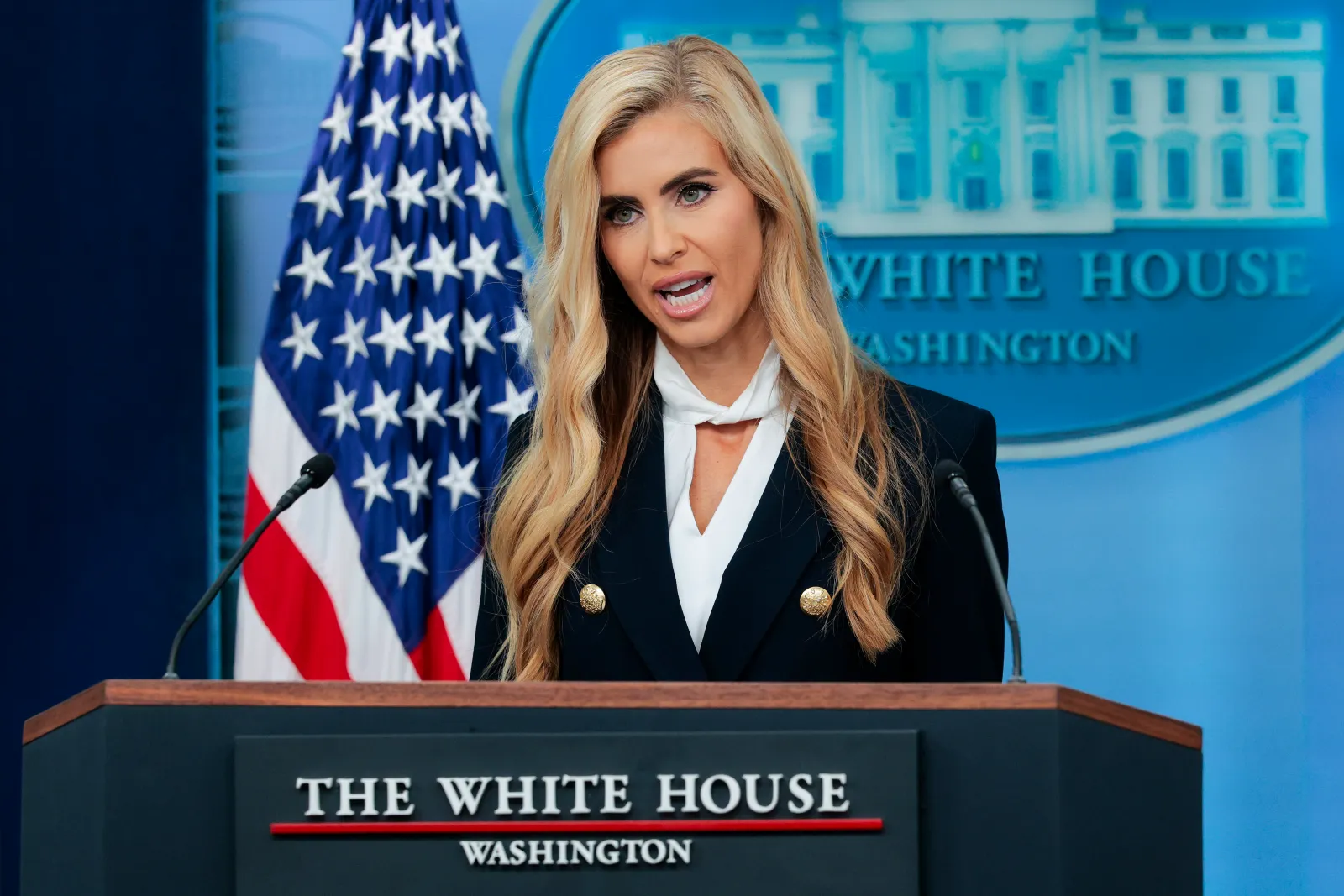
Shortly after the conservative commentator made her debut in the White House briefing room on Tuesday, a journalist asked which state Zacharia had passed the bar exam in.
"When I moved to China," she replied. That has raised further questions about whether it is possible for her to have done so, and the legal work she has undertaken since.
“I practiced international transaction law, with all the appropriate credentials,” Zacharia said in a statement to Newsweek on Wednesday.
The Campaign for Accountability, a nonprofit watchdog, has filed a complaint with the California State Bar Association calling for an investigation into Zacharia over her claims that she has “repeatedly held herself out to the public as entitled to practice law without a license to do so."
“Ms. Zacharia has represented herself as a lawyer repeatedly to buttress her reputation and credibility as a television legal commentator and now as the White House spokesperson, yet it seems it was all a lie,” Campaign for Accountability Executive Director Michelle Kuppersmith said in a statement.
“In California, calling yourself a lawyer without a license isn’t puffery; it’s a crime. The State Bar should investigate whether Ms. Zacharia has misled the public about her credentials and hold her accountable if she has,” she said.
The White House responded Wednesday by calling the Campaign for Accountability a "radical leftist-organization run by rabid numbskulls suffering from a severe case of Trump Derangement Syndrome."
"Nobody takes them seriously because they are deranged low lifes," Cheung added.
Journalist Judd Legum, who writes the Popular Information newsletter, wrote on Tuesday that Zacharia has long touted her credentials as a lawyer during appearances on national news outlets. Legum added that Zacharia was identified as a lawyer during at least 18 appearances on Fox News Channel since March 2025.
Aspiring lawyers must normally pass a state’s bar exam before they can be licensed to practice law in that state. However, the criteria for admission to the bar are set by each state, according to the American Bar Association.
White House press secretary positions have no formal bar-admission requirement under publicly available White House employment guidelines; bar admission is not a prerequisite for the communications role.
Newsweek has reached out to the State Bar of California and the California Justice Department for comment.
Here, Newsweek looks at the questions that have arisen about Zacharia’s legal career.
...
Has She Ever Passed a US Bar Exam?
There is no evidence that Zacharia ever passed a bar exam or has been admitted to practice law in any U.S. state or D.C., according to Legum.
A spokesperson for the State Bar of California, where Zacharia resides, told Newsweek that it "has no record of Kate Sharon Zacharia or Kate Sharon Black (or Katie in both instances) having been licensed to practice law in California."
Zacharia did not respond to Newsweek's questions asking if she was ever licensed to practice law in the United States or if she had ever taken or passed a bar exam in any state.
Zacharia graduated from Pepperdine University with a bachelor’s degree in political science and government in 2007, and a law degree in 2011, according to her LinkedIn profile.
She went on to work as an associate on the international practice team at the law firm Zhong Lun in Beijing from August 2011 until June 2013, her profile said.
It added that she worked full-time as general counsel for Fix California, a nonprofit founded by Trump ally Richard Grenell, from January 2024 to March 2025.
It is not clear what work Zacharia did in that role. However, a general counsel is an organization’s chief in-house lawyer, typically tasked with overseeing legal issues and advice across the organization.
Newsweek has contacted Zhong Lun and Fix California for comment via email and awaits their responses.
Can Americans Take a Bar Exam in China?
Bar examinations in the United States are administered by individual states and are held at designated testing locations within those jurisdictions. This means it would not be possible for Zacharia to have taken one in China.
"One cannot take an American state bar exam in China. Bar exams are administered at designated testing locations in each state of the union," Democratic California Representative Ted Lieu, who is an attorney, wrote on X.
Experts say that, even if Zacharia worked for a law firm in China, she would not have been admitted to the bar there; it is only available to Chinese citizens.
"She could not have passed the PRC [People’s Republic of China] bar exam, either, since you have to be a PRC national to take it," Donald C. Clarke, a professor at George Washington University Law School who specializes in Chinese law, told the Post.
Clarke said that firms such as Zhong Lun can hire foreigners to do certain tasks. "But the person still would not be allowed do anything that required a PRC or foreign bar qualification to do," he said.
What Is the Difference Between a Lawyer and Attorney?
The dispute has also focused attention on the distinction between a lawyer and an attorney.
While some say that a lawyer is an individual with a law degree and an attorney is someone with an active license to practice law, experts told Newsweek the terms are generally interchangeable.
"There is no difference between the two. They each imply that a person is licensed to provide legal services," Stephen Gillers, a professor at New York University School of Law, told Newsweek.
Leonard Niehoff, a professor at the University of Michigan Law School, agreed.
"In my view, the terms are interchangeable and refer to a legal professional who is authorized by the relevant jurisdiction to practice law and represent clients," Niehoff told Newsweek.
"If there is a distinction, I don't think it helps Katie Zacharia, because she has apparently held herself out as an ‘attorney’ and has not corrected others who have referred to her as an ‘attorney.’"
Could She Face Consequences?
Both also noted there could be legal consequences for falsely claiming to be a licensed attorney.
"In all American transactions, falsely holding yourself out as an attorney or a lawyer is unlawful and, in some places, it is a crime," Gillers said.
Niehoff added that "most, if not all, states have laws that prohibit the unauthorized practice of law. This usually includes falsely or misleadingly suggesting to the public that you are licensed to practice law."
"In many jurisdictions, the unauthorized practice of law is a crime, so the consequences of misrepresenting your status can be serious."
Zacharia says she worked as general counsel for a nonprofit in California. There, state law says that anyone "advertising or holding himself or herself out as practicing or entitled to practice law or otherwise practicing law" when they do not have an active license at the time is guilty of a misdemeanor. It is punishable by up to one year in a county jail or by a fine of up to $1,000, or both.
Newsweek’s reporters and editors used Martyn, our AI assistant, to produce this story. Learn more about Martyn here.
Contact Newsweek editors on this story: Rebecca Flood, James Debens, Edward T. Cummins
Submit Correction
View Editorial & AI Guidelines