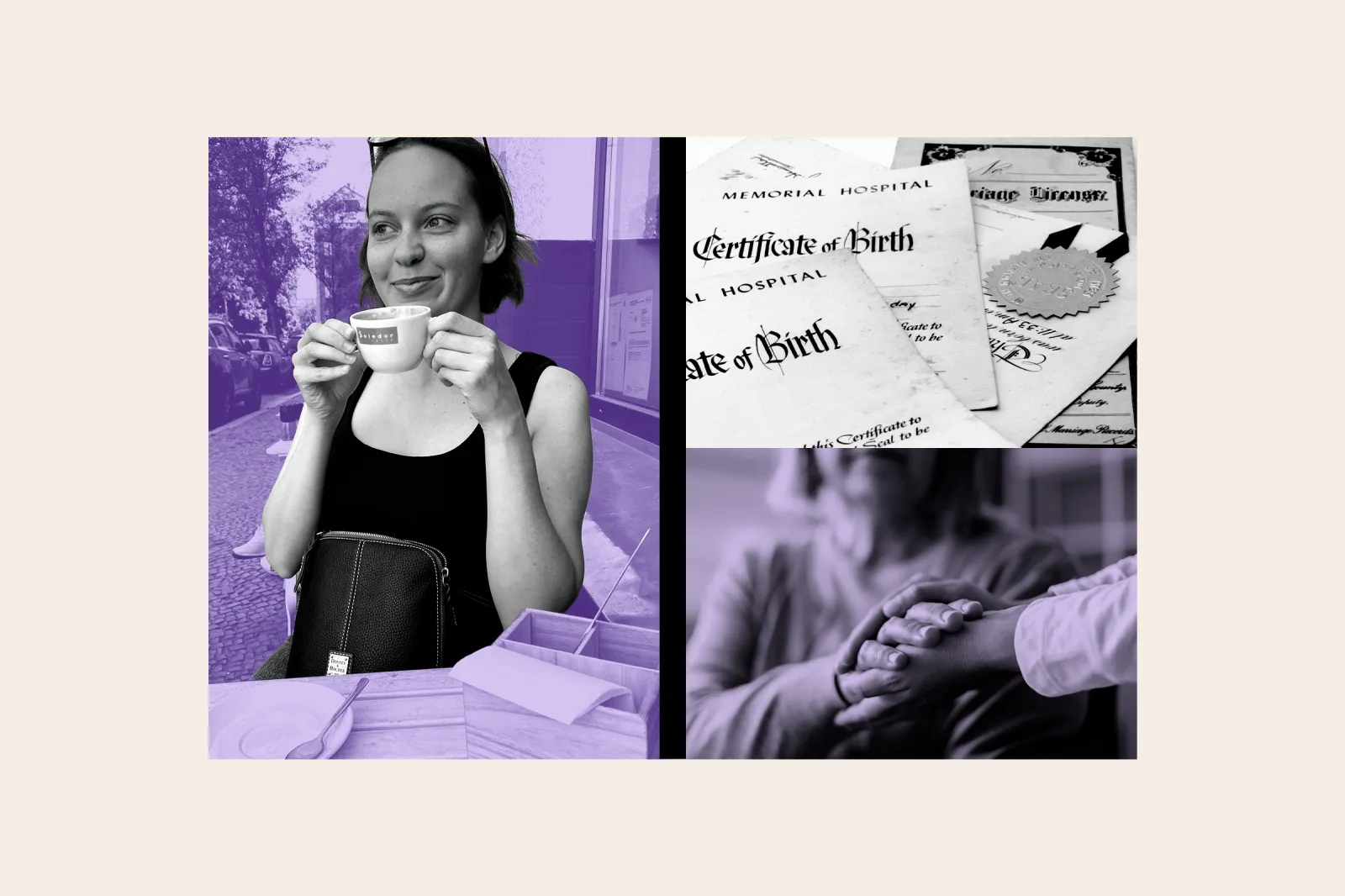
Photo-illustration by Newsweek/Getty/Courtesy of Emily Smith.

By Emily Smith
0
Share
Newsweek is a Trust Project member
See more of our trusted coverage when you search.Prefer Newsweek on Googleto see more of our trusted coverage when you search.
As a fifth grade project, I had to make a family tree.
This was an impossible task for me, since my mom is adopted, and I didn’t know my dad. When I asked my mom how I should fill out the tree, she cobbled something together: her adoptive father’s mother, alive somewhere in Alabama; a lineage of people from Rhode Island my mother’s adoptive mother never spoke to after transplanting to Florida. “The most important part of the tree is you and me,” she said. “Just you and me against the world.”
My mom knew nothing about the family who had given her up for adoption and didn’t care to know. She had been a single, 19-year-old mom—and if she could do it, she blamed those who couldn’t.
Read More on My Turn
My 12-Year-Old Daughter Woke Up As Usual—That Same Day Life Changed Forever6 min read

I Loved Tanning. 22 Years Later, I’m still Living With the Consequences9 min read

A Stranger Put $250 in My Kid’s Account. Twice4 min read

But I wanted to know everything.

...
Years later, I was halfway through my first semester of an MFA program at Columbia University when my mom called to tell me the results from her online DNA test had come in. I was rocking my chair on its legs at my desk in New York City when she described her origins as German. She was interested purely in her ethnicity. Any interest in whether she looked like her mom or dad disappeared when she had me: a mirror to look into.
“Anyway,” she said. “I’ll give you the log-in so you can look around yourself. Just promise me you won’t contact anyone on it.”
I thumped my chair to the ground. This was of interest.
My mom’s style of parenting is to form a bond by way of decision-making for everyone involved. What’s right for her is right for all. As a kid, it felt impossible to voice my opinion. So instead, I picked up lying.
“Sure,” I said, my fingers crossed. I wasn’t going to argue that I had a right to know my own family. She would’ve seen it as a betrayal.
I immediately logged onto her account and looked for any DNA matches to other members of the website she used. Voila! The algorithm suggested her closest match was a first cousin. I messaged him right away.
“Weird question,” I wrote, then asked if he knew anyone in his family who’d given up a baby girl the same day and year my mom was born.
“Yes!” he responded. “My sister.”
It turned out this match was not a first cousin. It was an uncle.
It was an accident that I had found him—not something I thought would really happen. I felt elated, then imagined telling my mom. It felt like winning a bad-luck lottery.
Before I could tell my mom anything, my new connection shared my biological grandmother’s phone number. I couldn’t help myself. I called.
She—grandma *Susan—answered.
“I’ve always prayed your mother would reach out,” she said. “I think about her every year on her birthday. I’m so glad to hear from you.”
Exactly like my mom, Susan had gotten pregnant when she was 19. It was the ’70s—“rock and roll,” she told me. She couldn’t afford a child, and although the father’s family offered to raise my mom, Susan feared their Baptist religiosity and believed my mom’s best bet was adoption.
It was bizarre how much Susan’s story and my mom’s had in common. Maybe that’s why we talked easily for an hour, as though we had always known each other.
When my mom called later that week, it was dusk and she was tearing dead palm fronds out of her tropicals garden. She held the phone between her shoulder and ear, and each jerk of a frond forced an ocean-wave shuffle from the fabric of her shirt rubbing against the mouthpiece.
“Hey, I wanted to ask you about something,” she said, her voice far away. “You haven’t called my biological mother…have you?”
I said nothing. I realized she had seen my messages on the DNA website. Before I could do more than hesitate, she hung up. My chest suddenly felt ice cold.
*
As I was growing up, my mom worked as a call-taker at a travel agency.
As far as jobs you’re forced to take to pay the bills go, her gig wasn’t so bad. Before the Great Recession, the energy in that office felt like a newsroom, with phones ringing endlessly and office mates dangling over their cubicles to listen in on roadside soap operas. My mother had given up a partial college scholarship to a dance program to raise me, but in her sheeny panty hose and wispy brown floral office dresses, flawlessly orchestrating a connection between tow drivers and unlucky motorists all day, the job felt like a dance.
In the early 2000s, the agency gave employees free tickets to theme parks. Even though we packed our lunches and my mom never had more than $10 to her name, the two of us spent weekends riding The Haunted Mansion at Disney World and feeding kibble to giraffes at Busch Gardens. One weekend, we rushed for front row seats to see Shamu, smug with our winnings, only to wetly discover together what everyone else already knew: the seats were in the “splash zone.” Walking around after the show in our soaked clothes, it didn’t matter that we looked ridiculous, because we looked ridiculous together.
*
By Thanksgiving I still hadn’t heard from my mom, and my increasingly anxious calls went unanswered.
Finally I texted her.
“I think it’s OK for me to be curious,” I wrote, “and at the same time not disclose any of your information in order to respect your privacy.”
Still, no response.
A month passed. In December, I wrote: “So you’re going to ignore me forever.”
“I’ll call u 2nt,” came the terse reply.
When another week passed without contact, I texted a link to a website with services for mother-daughter counseling.
My mother responded immediately: “Let’s address one thing at a time. I am most upset right now that you took away my decision to find my biological mother. You did it with no regard to my feelings or what I want.”
I was shocked by the response. My mother wanted me to consider her feelings, but she never considered mine. Did she realize that Susan was my family, too, and that I had just as much of a right to a relationship with her?
The next day, I sent another link for counseling. Not because I wanted counseling. I wanted to upset my mother like she was upsetting me. Sending the links felt like the equivalent to screaming and shouting.
“Please stop sending me links for counseling,” she wrote. “Maybe you should go to counseling.”
“I do. That’s how I know it’s helpful.”
“Did you tell your therapist about you finding my biological mother without my permission?”
I felt punished not for interacting with Susan, but for disrupting the dynamic of our mother-daughter relationship. It had always been “just the two of us.” Like Lorelai and Rory. With words like “permission” in play, the mismatch between who my mom saw me as and who I was infuriated me. I felt like she was trying to hang onto the past.
I couldn’t place the time when our bubble had burst and our relationship had racked up mileage by distance. Maybe, like childhood friends carrying each other through our own adolescences, we struggle to connect as adults. It’s no one’s fault we know each other by memories alone.
By January, I had kept up a light email and text correspondence with Susan, but my mom remained out of touch. It was clear I could only have a relationship with one of them.
Finally, my mom called using her polite, f—-you voice she’d developed at AAA when customers pissed her off. It worked: I was 10 years old again.
“You’ve forced me to make a choice—to meet Susan or not—that I didn’t ever want to consider,” she said.
As if she were a diplomat at the negotiating table, she stated that I would no longer be in contact with Susan. No question. End of story. There was no lie I could tell to get out of it. I took my mother’s ultimatum to heart and never spoke to Susan again. Not even to say goodbye.
Meanwhile, Susan’s texts kept coming through.
“Happy New Year, Emily! I was just down in FL but wasn’t there long. I get homesick for salt water and orange blossoms.” And then: “Hope you are doing well. I’d love to meet you soon if that’s possible? How is your mother doing?”
After a few more texts, she got the jist: “I guess you decided against meeting us. That makes me sad but I understand. Please know and let your mother know I gave her up because I loved her. I love you too.”
She kept texting me for years—once or twice a year to say Merry Christmas, or that she was thinking of me and my mom. Then, in 2022, the texts stopped. She gave up. And so did I.
Recently, my mom came to terms with me reaching out to her birth mom.
“I’ve had seven years to think about what you want. To see other people’s points of view,” she told me. “If it’s what you need to fulfill something in you, then I’m OK with that.”
I haven’t decided what to do. Despite this new freedom, I’m scared Susan will never pick up the phone—that she’ll treat me the way I treated her. I just hope second chances run in the family.
*Name has been changed to protect privacy.
Emily Smith is a writer living in New York City. Her work appears in Business Insider, Buzzfeed and elsewhere.
View 0 Comments
Submit Correction
View Editorial & AI Guidelines