...

By Ian Randall
Deputy Science Editor
0
Share
Newsweek is a Trust Project member
See more of our trusted coverage when you search.Prefer Newsweek on Googleto see more of our trusted coverage when you search.
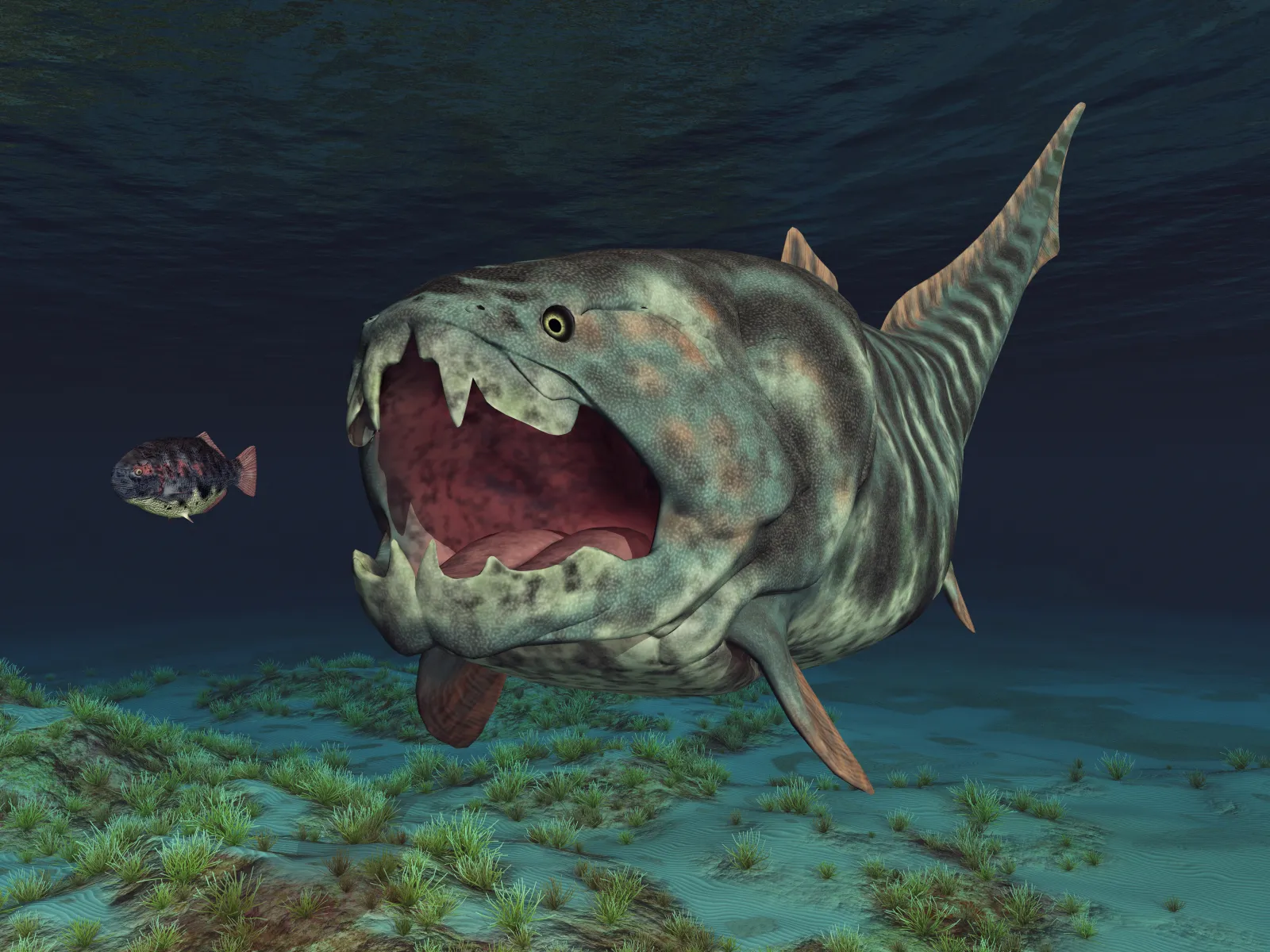
Cleveland’s iconic prehistoric sea monster—the 14-foot-long armored fish Dunkleosteus terrelli—just got a lot stranger.
This marine apex predator lived some 360 million years ago, had razor-sharp bone blades instead of teeth and was one of the biggest and most ferocious of the “arthrodires,” an extinct group of shark-like armored fish.
First discovered in the 1860s, Dunkleosteus’ fearsome appearance has made it one of the most recognizable prehistoric animals to the public—and, in the eyes of the paleontological community, has made it arguably the “poster child” of the arthrodires.
Read More on Science
However, new research has revealed that Dunkleosteus was something of an “evolutionary oddball,” and not really representative of the arthrodires at all.
“The last major work examining the jaw anatomy of Dunkleosteus in detail was published in 1932, when arthrodire anatomy was still poorly understood,” said paper author and paleobiologist Russel Engelman of Case Western University, Ohio, in a statement.
Arthrodire fossils, the team note, are often challenging to study—with their bodies mostly being composed of cartilage, it is only their bony head and torso armor that typically makes it into the geological record; even then, specimens are usually crushed and flattened.
“Most of the work at that time focused on just figuring out how the bones fit back together.”
...
In their study, Engleman and colleagues revisited specimens from the Cleveland Museum of Natural History—home of the world’s largest and best-preserved collection of Dunkleosteus fossils—with a fresh eye.
Although Dunkleosteus is believed to have lived in oceans around the globe during the Devonian Period (358.9—419.2 million years ago), conditions in the shallow sea that once lay where Cleveland sits today allowed for exceptional fossil preservation.
“Since the 1930s, there have been significant advances in our understanding of arthrodire anatomy, particularly from well-preserved fossils from Australia,” Engelman added.
“More recent studies have tried biomechanical modeling of Dunkleosteus, but no one has really gone back and looked at what the bones themselves say about muscle attachments and function.”

...
The researchers’ analysis has made several surprising revelations about the iconic Devonian fish.
The team found that Dunkleosteus’ iconic bone blades were actually unique to Dunkleosteus and a few of its close relatives; most arthrodires had actual teeth.
This discovery helps better sit the fish in its evolutionary context; the development of the specialized bone-blades, ideal for tearing bits out of prey, reflects increasing adaptation for hunting other large fish.
Their analysis determined that far more of Dunkleosteus’ skull was made up of cartilage than was previously thought—nearly half, in total—including most major jaw connections and muscle attachment sites.
Furthermore, the team discovered a feature similar to one seen in modern rays and sharks—a sizable bony channel that would have played host to a facial jaw muscle.
“These discoveries highlight that arthrodires cannot be thought of as primitive, homogenous animals,” said Engleman.
Instead, he concluded, they represent “a highly diverse group of fishes that flourished and occupied many different ecological roles during their history.”
Do you have a tip on a science story that Newsweek should be covering? Do you have a question about fossils? Let us know via science@newsweek.com.
Reference
Engelman, R. K., Carr, R. K., Trinajstic, K., Johanson, Z., & Lebedev, O. A. (2025). Functional anatomy, jaw mechanisms, and feeding behavior of Dunkleosteus terrelli (Placodermi, Arthrodira). The Anatomical Record. https://doi.org/10.1002/ar.70075
View 0 Comments
Submit Correction
View Editorial & AI Guidelines