Photo-Illustration by Newsweek/Getty/Associated Press

By Tom O'Connor
Deputy Editor, National Security and Foreign Policy
0
Share
Newsweek is a Trust Project member
See more of our trusted coverage when you search.Prefer Newsweek on Googleto see more of our trusted coverage when you search.
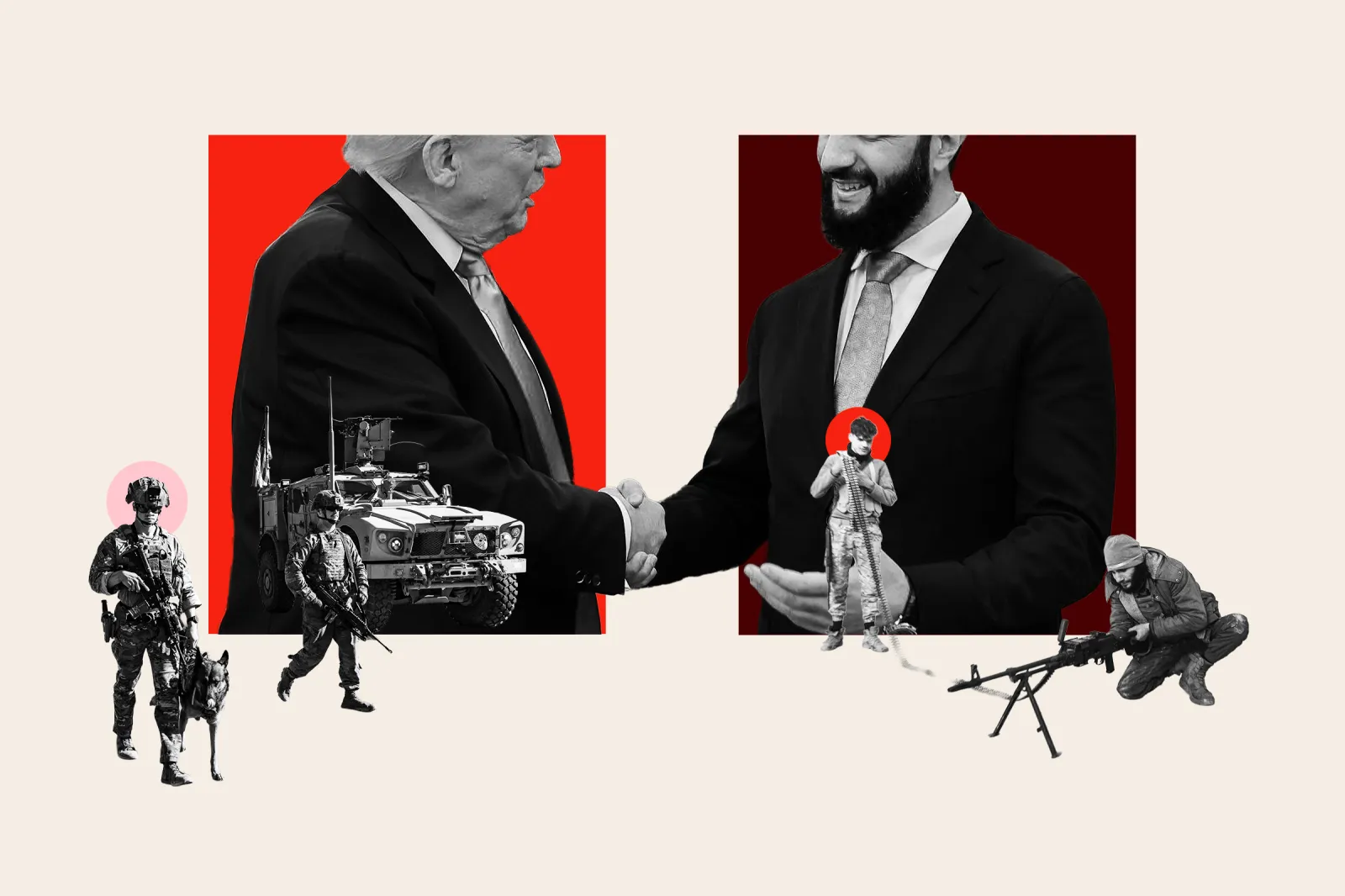
With Syria's new leadership emerging as a key partner for the White House one year after the fall of President Bashar al-Assad, U.S. troops present in the country find themselves in the midst of a complex pivot that could have major ramifications for their mission.
Breaking with the old government's resistance to the U.S. military presence, imposed a decade ago outside of any coordination with Damascus, interim Syrian President Ahmad al-Sharaa's administration is looking to build upon his budding relationship with U.S. President Donald Trump to establish security cooperation with the Pentagon. But such a move raises questions for the existing U.S. mission that operates alongside the Kurdish-led Syrian Democratic Forces (SDF), which continues to seek greater autonomy in the lands it controls in the north and east of the country.
Both the SDF and Damascus share the stated goal of fighting America's top foe in Syria, the Islamic State militant group (ISIS), but the central administration is also aiming to integrate the SDF-held lands under a unified governance. Like Assad before him, Sharaa now faces complex negotiations toward bringing these self-ruling territories under his command.
Read More on News
But unlike the predecessor he toppled in a shocking offensive in December 2024, Sharaa's efforts are garnering support from those in Washington eager to make a new friend in Damascus, even as another close ally, Israel, raises skepticism about his transformation from Islamist militant chief to pragmatic statesman.
Former officials who had a hand in charting the U.S. strategy in Syria also argue it's time for the U.S. and its traditional SDF partner to recalibrate their approach.
"It's going to be complicated, and establishing this new relationship with the regime in Damascus is a complicating factor," William Roebuck—executive president of the Arab Gulf States Institute in Washington who previously served as senior adviser to the U.S. special envoy to Syria and as ambassador to Bahrain—told Newsweek. "But in the longer term, I think it's probably a therapeutic development."
"As long as U.S. troops are in the northeast, and there's no pressure on the SDF to compromise with the regime in Damascus, I don't think they're not going to move very quickly. It's not maybe in their calculated interest to do so, and they're not very enthusiastic about it," Roebuck said. "If the U.S. moves forward with this relationship with Damascus, I think maybe it creates an environment where the SDF has to maybe reexamine their premises a little bit about the speed with which they're doing this and move with a bit more seriousness of purpose towards an offramp."
...
'It's Not Going to Last Forever'
It's not the first time that the U.S. is changing gears in Syria. When Arab Spring-era protests and fierce crackdowns by security forces first devolved into civil war in 2011, then President Barack Obama initiated a semi-covert campaign of arming and training armed opposition forces fighting to overthrow Assad only to soon face the growing issue of hardcore Islamist groups quickly rising the ranks of the rebellion.
Among those leading the charge was Sharaa, then known as Abu Mohammed al-Golani, head of the Al-Qaeda-aligned Nusra Front, later rebranded as Hayat Tahrir al-Sham. Sharaa's experience with U.S. troops at the time was on the battlefield, having been arrested as part of the insurgency in Iraq, where he forged an early partnership with future ISIS founder Abu Bakr al-Baghdadi, though later broke his affiliation in favor of Al-Qaeda and later severed this relationship too about a decade ago.
By late 2015, the ISIS seizure of vast territory across Syria and neighboring Iraq pushed the White House to shift its aid from the fractured opposition to Kurdish factions, which became united under the SDF umbrella.
The strategy also raised questions, as most Kurdish groups had open affiliations with another U.S.-designated terrorist organization, the separatist Kurdistan Workers' Party (PKK), and were also actively clashing with rebel groups that once received U.S. support. A situation emerged for a time where Pentagon-backed SDF fighters were battling once CIA-aided insurgents now primarily backed by NATO ally Turkey, demonstrating the complex and fluid nature of a civil war that drew in considerable foreign intrigue, including Iranian and Russian support for Assad.
As separate campaigns waged by the SDF and Syrian military largely defeated ISIS, both sides consolidated territorial gains, with the former establishing the self-proclaimed Autonomous Administration of North and East Syria (AANES) across nearly a third of the country. The quasi-state has remained in place since, with hundreds of U.S. troops still present there and at a separate southwest desert garrison, even after a drawdown announced earlier this year.
But Roebuck said that the arrangement was never intended to be permanent.
"The current situation where they're just there in the northeast, they're essentially running it independently almost but can rely on U.S. presence for a sort of political and even security umbrella to protect that status, it's not going to last forever," Roebuck said.
'Unrealistic' Expectations
The future of this arrangement was put to an immediate test when Syria's relatively frozen front lines suddenly erupted with the 11-day offensive that ended 50 years of Assad family rule and brought Sharaa to power. Clashes quickly erupted between the victorious rebel factions and the SDF on several fronts, resulting in a scramble from the newly sworn in Trump administration to ease the situation and push forward a deal reached in March through which the SDF would agree to integrate into the new Syrian military and bring the AANES under Damascus' rule.
Yet the deal has since been deadlocked, with the SDF's caution exacerbated by deadly clashes between state-aligned security forces and factions comprised of other minority communities, particularly Alawites in the west coast and Druze in the southwest. The lack of tangible progress has proved frustrating for Damascus as well as its close Turkish partner, both of which are calling for greater movement from the SDF.
Key officials in the White House have also voiced the need for SDF to take action on this front. Thomas Barrack, who serves as both Trump's special envoy to Syria and ambassador to Turkey, has repeatedly dismissed any notions of Syria's "federalization" as some SDF supporters have called for, not unlike the semi-autonomous entity known as the Kurdistan Regional Government established in northern Iraq after the first Gulf War in 1991 and still in force today.
James Jeffrey, the former U.S. special representative to Syria who Roebuck previously advised under the first Trump administration, asserted that it was time for the U.S. to use its leverage to break the stall on the SDF joining the new government in Damascus.
"The U.S. needs to accelerate efforts to integrate the SDF into the larger Syria, beginning with carrying out plans already developed between Damascus and the SDF to bring division and brigade sized Kurdish units as units into the Syrian army," Jeffrey told Newsweek. "Damascus in return must offer local governance and policing authorities to the northeast provinces and the rest of the country similar to what provinces enjoy under the Iraqi constitution."
"However, broad autonomy of the sort the Iraqi Kurds enjoy is unrealistic. Neither Damascus nor Ankara will accept," Jeffrey said. "Beyond that, the U.S. should continue integrating Syrian government and SDF forces into a unified counter-ISIS effort."
Overall, he saw this dual strategy as being in line with Trump's often unconventional and transactional approach to foreign policy that has thus far won significant ground with Sharaa, who has twice met the U.S. leader, most recently visiting the White House last month in a remarkable meeting between a U.S. head of state and a man considered a most wanted terrorist leader just months earlier.
"Trump believes in securing the region long term against the many forces of instability—Iran and proxies, and ISIS—by working through an eclectic gang of partners and allies despite their pasts and to some degree governance models: Turkey, Gulf states, Jordan and Egypt, Israel, and now al-Sharaa's Syria," Jeffrey said. "It's a smart strategy and proved itself in the fight against ISIS in Iraq and Syria 2014-20."

...
A New Deal With Damascus
Damascus also views an opportunity to capitalize on the positive atmosphere to find a path forward when it comes to the security situation in Syria. Mahmoud Toron, business and economic adviser to the Syrian government, spoke to the perspective of Sharaa's administration on the issue.
"Damascus hopes that Washington will recalibrate its military posture and its relationship with the Syrian Democratic Forces in a way that supports broader national stabilization rather than prolonging political fragmentation," Toron told Newsweek. "A coordinated approach—rather than an adversarial one—could help resolve the political deadlock in the northeast."
Notably, Toron argued that the space for this realignment also touches on investment opportunities, particularly as they relate to Syria's oil and gas sector that has languished over divisions and conflicts related to the long-running civil war and, as such, "a more constructive and mutually beneficial path would involve American companies participating in the rehabilitation and operation of oil and gas fields in northeastern Syria."
He pointed out that "U.S. firms possess the technical capacity and experience to restore production efficiently" and that "the proximity of U.S. forces offers a security umbrella that could protect workers and infrastructure," meaning "a formal agreement with the Syrian government would provide legitimacy to the U.S. presence while generating economic returns for both sides."
"Such cooperation could unlock significant economic opportunities, strengthen bilateral trust, and—most importantly—improve living conditions in the areas most devastated by the war," Toron said. "It would represent a rare win-win scenario: contributing to Syria’s economic recovery while allowing the United States to remain constructively engaged during a critical phase of the country’s stabilization."
Newsweek has reached out to a representative of the SDF's political wing, the Syrian Democratic Council, for comment.
Contacted for comment, a representative for U.S. Central Command (CENTCOM) that oversees the Pentagon's operations in the Middle East, including in Syria, referred Newsweek to remarks delivered virtually Wednesday by CENTCOM commander Admiral Brad Cooper during an event hosted by the Middle East Institute.
Describing how "every engagement with President al-Sharaa and other Syrian leaders has been focused on partnering in new and different ways," Cooper outlined a three-fold strategy that involved "sustaining our aggressive pursuit of ISIS in Syria," "supporting the integration of Syrian Democratic Forces with the Syrian government" and, finally, continuing "to foster collaboration with Syrian forces" commanded by Sharaa.
Cooper expressed confidence that the SDF and Damascus were engaged in "meaningful discussions" toward integration and committed to maintaining partnerships with both parties, including on security and the fight against ISIS.
Yet the northeast question remains a significant challenge to Sharaa's administration, one that continues to constitute a source of tension, including as witnessed during the anniversary of Assad's fall on Monday. Damascus accused AANES officials of banning celebrations, drawing a response from the SDF that accused the government and allied factions of espousing violent rhetoric in line with "systematic practices aimed at fueling hatred and reviving the discourse of division and threats."
"The Syrian Democratic Forces, which have protected Syria from terrorism and provided thousands of martyrs in defense of its people in all its components, affirm that the peoples of northern and eastern Syria will not be an arena for hate speech, and that any attempt to incite or destabilize will be met with a responsible and firm stance that preserves civil peace and protects the gains of all Syrians," the SDF said in a statement.
"The future of Syria will not be built by slogans of hysteria and incitement, but by partnership, mutual recognition and respect for the will of the components that have proven to be the cornerstone of protecting the country and repelling terrorism," the group added. "Any disregard for this fact is an attempt to take the Syrian scene backwards, something that our people and forces will not tolerate."

...
Overcoming 'Impediments'
The dispute goes far beyond that of rhetoric. Speaking at another virtual Middle East Institute panel that took place Monday, former CENTCOM commander General Joseph Votel, having recently returned from a visit to Syria, spoke to some of the many "impediments" that have emerged in the process.
"There are different views on the political autonomy of the Autonomous Administration and the SDF versus more of a centralized control," Votel said. "Obviously, the Autonomous Administration and the SDF want to be able to consolidate, protect their gains versus surrendering them to state authority. So, that's a big that's a big impediment."
Votel also referenced "disagreements over military integration modalities, whether the SDF will retain its cohesive formations, with command structure in place and with an identity that is not significantly different than what it is today versus more of a centralized approach," in which Damascus would have the final say on deployments, financing and other matters. He cited "ideological differences" as well, noting the SDF's "secular, gender-inclusive approach" and the government's "Islamist approach" to military formations.
Speaking to Newsweek after the event, he expressed that the U.S. would be unlikely to abandon the SDF, though he acknowledged the necessity of continuing to foster the emerging relationship with Damascus by playing a bigger part in addressing the numerous difficulties that have arisen in the integration effort.
"I think the U.S. military will continue to stay partnered with the SDF while also developing a relationship with the government in Damascus who is now a member of the coalition," Votel told Newsweek. "I expect, as we have apparently done already, we will continue to share information with the Ministry of the Interior on potential ISIS threats in government-controlled areas."
"To move forward I think we will have to step up and play a bigger role in reducing the impediments we discussed during the call—Political autonomy versus centralization; military integration modalities; how command and control will work; and, reaching consensus on some of the ideological differences," Votel said. "These are all big issues that will take time."
For now, he argued that "perhaps focusing on some of the more tactical issues—like return of ISIS fighters and family members to home nations—would be things that begin to build some trust and confidence and upon which the substantive issues can be addressed."

...
Undermined by Israel
While the SDF issue looms large over Sharaa's efforts to stabilize Syria and forge a historic partnership with Washington., a potentially even greater threat has manifested in an ongoing campaign by a more powerful U.S. ally that has sought to question the true nature of Sharaa's evolution and conduct direct strikes across his country.
Almost immediately after Sharaa declared victory over Assad, Israel began a sweeping campaign of airstrikes targeting former Syrian military sites and conducted a ground incursion to seize a "buffer zone" beyond the Golan Heights region already occupied by Israel since 1967. Israeli strikes intensified in the ensuing months as Prime Minister Benjamin Netanyahu declared that his government would protect the livelihood of the Druze minority, of which Israel also has a substantial population, amid deadly clashes that erupted in Al-Sweida and the southern suburbs of Damascus.
As with the earlier violence between the government and the SDF, the White House swiftly moved to reinstate calm. Yet attempts to reach an understanding between the two sides broke down in September, and Israel has since ramped up operations, drawing a response from Trump last week, who asserted that “It is very important that Israel maintain a strong and true dialogue with Syria, and that nothing takes place that will interfere with Syria’s evolution into a prosperous State."
Israel, which has a history of also making overtures to Kurdish factions in the region, much to Turkey's opposition, has linked its approach to Syria specifically on the Druze issue. And while some Israeli officials also view a chance to reset ties with the neighboring country with which it's been a perpetual state of war, they argue such a detente could only occur under the right circumstance.
As Israeli President Isaac Herzog recently told Newsweek, "we realize the internal tension in Syria between the factions. We’ve seen what happened in Sweida and we have certain prerequisites, for example, an open corridor, so that we can help our brothers and sisters, the Druze, if necessary."
"But on the other hand, I think it’s also a huge opportunity to change the regional map and draw a new equilibrium," Herzog said at the time. “And I think if we can reach an agreement with Syria, I would not say yet a peace agreement, but an agreement with Syria, which will follow the agreement which took place in 1973 following the war, but now a new agreement which gives more relations and contact, it would be fantastic."
For now, however, the situation remains another challenge for an administration seeking to weigh the competing interests of partners. Jeffrey noted that, currently, "the U.S. is examining how U.S. military observers could calm the tense Jerusalem-Damascus situation and end the frequent Israeli strikes into Syria."
Roebuck, for his part, argued that resolving the issue is "going to take some radical balancing of interests and also finding a way to be forceful with Israel when we disagree with their calculation of interests and the way that they're operationalizing those interests that impact on our national calculation of interests."
"They don't always overlap perfectly. And I think the Trump administration needs to be clear with them," Roebuck said. "A lot of these conversations can be private. This doesn't need to be an effort to embarrass anyone or to one up each other. But I think the Trump administration is going to have to be pretty clear."
"I've been, frankly, a little surprised at the harshness with which Israel has acted over the past year," he added. "I don't have a full grasp of what they are calculating or how they're calculating things, but it's pretty clear that they're not overlapping in their calculation of interests or political design for the region with U.S. designs and those are going to have to be worked out as partners and allies do these things.
View 0 Comments
Submit Correction
View Editorial & AI Guidelines