10
Loading video...

By Anna Skinner
Associate News Editor
0
Share
Newsweek is a Trust Project member
See more of our trusted coverage when you search.Prefer Newsweek on Googleto see more of our trusted coverage when you search.
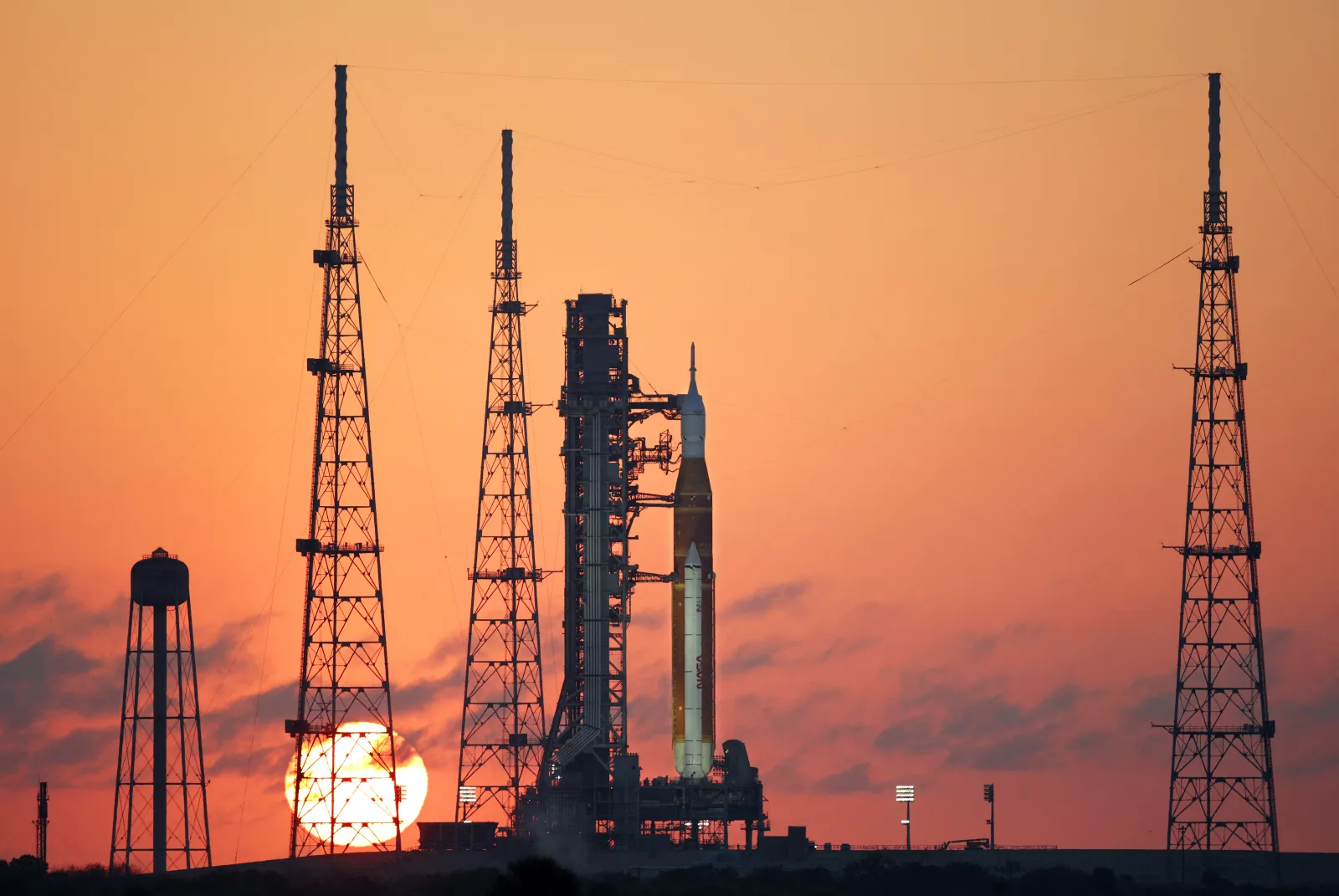
NASA is targeting a Wednesday evening liftoff for its Artemis II mission from Kennedy Space Center in Cape Canaveral, Florida, and forecasters are watching conditions closely as cloud cover and potentially high winds pose the primary weather concerns leading into launch day.
Artemis II marks a major milestone in NASA's return to deep space, serving as the agency's first crewed flight of the Space Launch System and Orion spacecraft since the Apollo era. The 10‑day mission—crewed by NASA astronauts Reid Wiseman, Victor Glover, Christina Koch, and Canadian astronaut Jeremy Hansen—will loop around the Moon to test spacecraft systems ahead of future lunar landings planned later in the decade.
Forecasters have high hopes the launch won't be disrupted by weather: Storm risk at launch time is low.
Read More on Weather
"The weather seems to be cooperating for a Wednesday launch," AccuWeather meteorologist Lydia Burroughs told Newsweek. "Showers from earlier in the day may be lingering in the area into the evening, but the risk for rain or lightning during the launch window is low,.
"Sporadic thunderstorms are possible throughout the rest of the week into Monday and may cause further delays should a later launch window be needed," added Burroughs. "However, winds remain light, with highs in the 80s and lows in the 60s."
...
What is NASA's Artemis II?
NASA's Artemis II mission is the agency's first crewed flight of the Artemis program and the first time astronauts will travel toward the Moon since Apollo 17 in 1972. It is scheduled to launch no earlier than April 1 on a 10‑day lunar flyby that will test deep‑space systems ahead of future landings.
Artemis II Launch Time: What We Know
NASA is targeting 6:24 p.m. ET on Wednesday, April 1 for the Artemis II launch. This marks the opening of a two‑hour launch window, with additional opportunities extending through April 6.
How to Watch the Artemis II Launch
NASA will offer live coverage of the prelaunch, launch, and splashdown on NASA+ (the agency's on-demand streaming service), and its official YouTube and social media channels, including X, Facebook, and Twitch.
Coverage will also be available through selected third-party streaming platforms such as Amazon Prime, Apple TV, Hulu, Netflix, and Roku, depending on the region.
In addition to live video, viewers can track the spacecraft using NASA's Artemis Real‑time Orbit Website, which displays Orion’s position relative to Earth and the moon, its distance traveled, and elapsed mission time using live data transmitted from Orion to Mission Control in Houston.
How Weather Could Disrupt Artemis II Launch
NASA has flagged cloud coverage as a primary concern for the April 1 launch window. Thick or layered clouds can violate flight rules by obscuring visibility and increasing the risk of lightning strikes triggered by the rocket’s ascent. There's an 80 percent chance weather conditions will be favorable for the event, Live Science reported.
High winds can also pose a risk to liftoff, as they can destabilize the rocket during its initial climb and interfere with safe fueling and countdown operations.
Florida’s coastal environment makes lightning risk a standard concern. If atmospheric conditions support charge buildup—even without an active storm—the rocket itself can trigger lightning, forcing a scrub.
Will Artemis II Land On the Moon?
No, Artemis II will not land on the Moon. Instead, the mission is designed as a 10‑day lunar flyby, sending its four‑person crew around the Moon and back to Earth without touching down.
"From the crew's location, the Moon will look about the size of a basketball held at arm’s length," NASA said in a webpage about the mission.
NASA structured Artemis II as a critical test flight to ensure the Orion spacecraft and its life‑support systems can safely carry astronauts into deep space before attempting future lunar landings.
The crew will loop around the far side of the Moon, reaching thousands of miles beyond the lunar surface, but the mission's purpose is to validate systems ahead of later Artemis missions, which are planned to conduct the next actual landings.
View 0 Comments
Submit Correction
View Editorial & AI Guidelines