
...

By Giulia Carbonaro in Florida
Senior Reporter
0
Share
Newsweek is a Trust Project member
See more of our trusted coverage when you search.Prefer Newsweek on Googleto see more of our trusted coverage when you search.
Florida Governor Ron DeSantis is expected to present a plan to eliminate property taxes in the state, an idea he has been pushing for since earlier this year, but has not made much progress in detailing it yet.
The urgency of reforming property taxes has been focused on helping seniors struggling with higher costs while on fixed income—but experts said that proposals are overlooking first-time homebuyers.
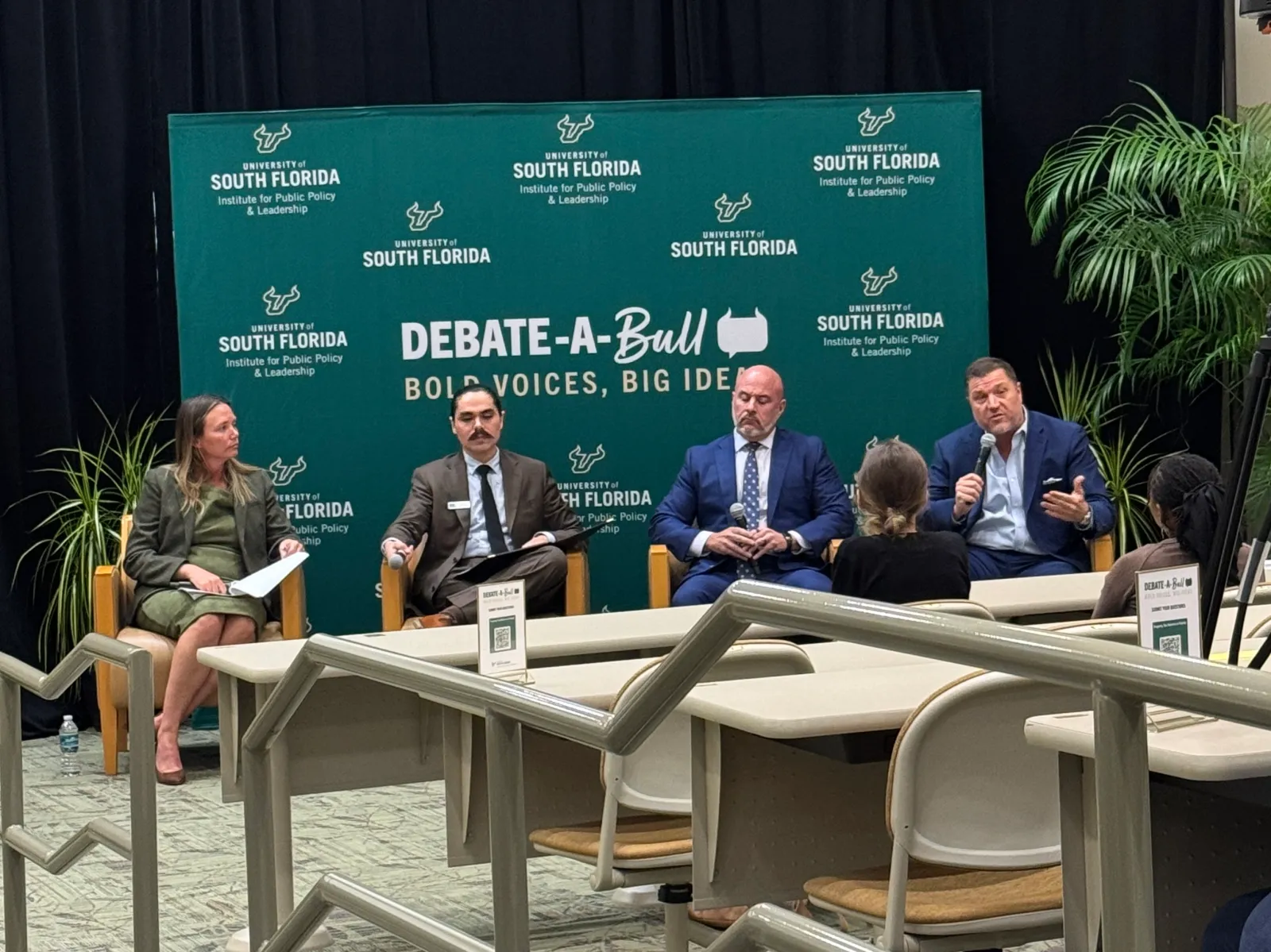
“If you bought your home 10, 15, 20 years ago, you’ve been protected from skyrocketing changes in market values,” Dr. Esteban Leonardo Santis, director of research with the Florida Policy Institute, said during the ‘Debate-a-Bull’ forum hosted by the University of South Florida (USF) Institute for Public Policy & Leadership on November 13 attended by Newsweek.
Read More on News
That is because under the Save Our Homes law the annual increase in a homestead property's assessed value cannot climb beyond 3 percent, or the annual change in the Consumer Price Index (CPI)—whichever is lower.
“Homesteads now only take about 9 percent. If you look at Save Our Homes, you are looking at a 30-40 percent cut on top. So if you add up the exemptions—Save Our Homes benefits plus your homestead—you are talking about individuals who are getting a 50 percent discount on their property tax. Which is what they were made for, perfect,” Santis said.
“But if you’re a first-time homebuyer, if you’re in the market out there, you are going to be paying higher property taxes than your neighbor,” he added. “Not everyone’s feeling the strain of property taxes the same. What are we doing for first-time homebuyers, individuals who are trying to get into a home or competing with individuals who have 50 percent benefits? This is horizontal inequity.”
...
What Are The Proposals On The Table?
The Florida House of Representatives has recently come up with as many as eight potential solutions to higher property taxes in the state, including eliminating property taxes for non-school homesteads under HJR 201.
“That’s the most costly proposal,” Santis told Newsweek after the debate. “I believe their figure is around $18 billion.”
Another proposal—HJR 205—involves eliminating property taxes for seniors, over time, while yet another would create a $100,000 non-school homestead tax exemption for residences with property insurance.
While the initial conversation around reforming property taxes—spearheaded by the governor—was focused on completely abolishing the levies, “the conversation has shifted” in recent months, Santis said.
“I think in the beginning of the year, the idea was to eliminate all property taxes. But now it seems that there’s going to be a focus on just the homesteads, perhaps, and we’ll get to see if they touch on school property taxes. But the House so far has decided to leave school property taxes alone.”
Seven out of eight of the proposals are set to appear on the 2026 general election ballot, to the dismay of Governor Ron DeSantis, who has criticized lawmakers for weakening the cause of reforming property taxes by putting so many different proposals before voters.
How Would Eliminating Property Taxes Help First-Time Buyers?
First-time homebuyers—who are typically young people—are already struggling to get on the property ladder due to generally higher housing costs, which include higher home prices, borrowing costs, home insurance premiums, and homeowners association (HOA) fees.
As of October, according to Redfin, the median sale price of a typical Florida home was $408,100, down 0.46 percent from a year earlier but much higher than before the pandemic, when it was below $300,000. Homeowners in the state also pay some of the highest home insurance premiums in the nation, according to Bankrate, with the average premium for $300,000 dwelling coverage at $5,838 a year—$3,414 more than the national average.
It is this same affordability crisis—closely linked to the housing sector, especially in a real estate-focused state like Florida—that is driving the current conversation around reforming property taxes.
...
“Around 50 percent of families [in Florida] can’t afford to live in the state,” Santis said. “They’re having to make decisions—paying for a car repair to go to work or paying a health care bill. It’s the affordability crisis that I think it’s underlying all of this—and people are looking for solutions.”
It is somewhat worse for those who cannot rely on the equity of already owning a property.
“If you’re making less than $62,000 a year, which is around 60 percent of Floridians, that’s who is struggling, and it’s going to be different,” Santis said.
First-time buyers in Florida are facing a pile-up of challenges to homeownership. “Property insurance is a huge cost, and they are having to save up more given that market values have increased so much in the state of Florida,” Santis said.
“Child care is also a huge cost. When you ask individuals what were some impediments, they’ll talk about child care, they’ll talk about student loans and rent—anything that keeps them from building up their savings.”
These, according to Santis, are “significant” challenges, “and we as a state don’t do a good job of filling in for those gaps.”
But eliminating property taxes is a tricky way of trying to improve their situation, according to Santis, who believes that Florida cannot afford the cost of eliminating property taxes—not even just for non-school homesteads.
“Any of these proposals are cost shifts. They’re going to shift the cost,” Santis said.
“So the question right now is who is going to pay for it? Some of the conversation has been around, can local governments pay for it? But ultimately, if you’re talking about a full elimination [...] you’re looking at either increasing the sales tax through percentages or having to find other ways, whether it’s increased fees at the local level, new taxes at the local level, or really service cuts,” he added.
View 0 Comments
Submit Correction
View Editorial & AI Guidelines