...

By Ellie Cook
Senior Defense Reporter
0
Share
Newsweek is a Trust Project member
See more of our trusted coverage when you search.Prefer Newsweek on Googleto see more of our trusted coverage when you search.
NATO member Finland is "very closely" monitoring Russian military activity close to the alliance's border, the deputy head of Helsinki's armed forces has said.
Why It Matters
Finland joined NATO in 2023 after Russia launched its full-scale invasion of Ukraine, ending, together with Sweden, a long-held position of neutrality in favor of the protection afforded by the military alliance. Finland shares more than 800 miles of land border with Russia, and was part of the Russian Empire in the 19th century.
Read More on World
NATO members forming the alliance's eastern flank have been sounding alarm bells over the threat Russia will likely pose in the coming years, particularly if soldiers currently fighting in Ukraine are redeployed near NATO soil. The alliance has already reported persistent Russian attacks on the alliance that fall short of overt military action, like cyberattacks and targeting of critical infrastructure.
...
What To Know
Lieutenant General Vesa Virtanen, the deputy chief of the Finnish armed forces, said that before 2022, Russia had roughly 20,000 soldiers and four standby brigades stationed close to Finnish territory. A brigade is typically between 3,000 and 5,000 soldiers.
"Now we see that Russia is building new infrastructure and bringing more troops to this region as soon as they can," Virtanen told German newspaper Die Welt. "They are reorganizing themselves."
In late 2022, then-Russian Defense Minister Sergei Shoigu said the Kremlin would overhaul Russia's military structure while pumping up the number of service members over the next few years. Parts of the plan were to split Russia's Western Military District—close to NATO's eastern flank—into two districts, Moscow and Leningrad, and to grow the size of the military. This came into force in June 2024.
When Finland joined NATO in 2023, Russian President Vladimir Putin said that reestablishing the Leningrad Military District was directly down to NATO increasing its presence on Russia's border. Finland's accession to the alliance doubled the size of NATO's border with Russia.
Divvying up the former Western Military District and its responsibilities this way helps Russia "to adopt a more effective military posture" against NATO's Baltic and Scandinavian members, Nick Reynolds, research fellow in land warfare with the Royal United Services Institute (RUSI), a U.K.-based think tank, previously told Newsweek.
The U.S.-based think tank, the Institute for the Study of War, has said the Western Military District was "stretched" between focusing on the war in Ukraine and staying strong against NATO's eastern flank.
Estonian Defense Minister Hanno Pevkur told Newsweek in November that if the fighting stops in Ukraine and Russian soldiers currently bogged down on the front lines are no longer needed there, "hundreds of thousands of troops" will be available for Putin to deploy elsewhere.
"So that means that [the] Russian army will have a lot of free force, which will be probably brought to our neighborhood," Pevkur said.
Brigades previously stationed close to Finland will become "perhaps four to five divisions," Virtanen said, with an army corps and a supporting unit.
"There will be more troops there in the future than before the Ukrainian war," the Finnish deputy chief added.
Estonia's foreign intelligence service has said Russia's reforms to the Leningrad Military District formed the 44th Army Corps and 6th Combined Arms Army's 69th Motor Rifle Division close to Estonia last year, which were quickly deployed to Ukraine. Russia has since started forming the 68th Motorized Rifle Division under the 6th Combined Arms Army, the service added.
"The fact that both an army corps and a motorized rifle division were assembled near Estonia within a single year demonstrates Russia's capacity to create large military formations in a relatively short time," the Estonian intelligence service said.
The 44th Army Corps will be permanently deployed close to Finland, it continued.
The number of Russian troops based close to Finland could double or triple compared to before the full-scale war in Ukraine, Pekka Turunen, the head of Helsinki's military intelligence, told Reuters in January.
The Baltic states of Latvia, Lithuania and Estonia have constructed fresh defenses, like mines and anti-tank obstacles, on their borders with Russian territory. Poland has also started construction of what it has called its "East Shield," costing over $2.5 billion and described by Warsaw as "the largest operation to strengthen Poland's eastern border, NATO's eastern flank, since 1945."
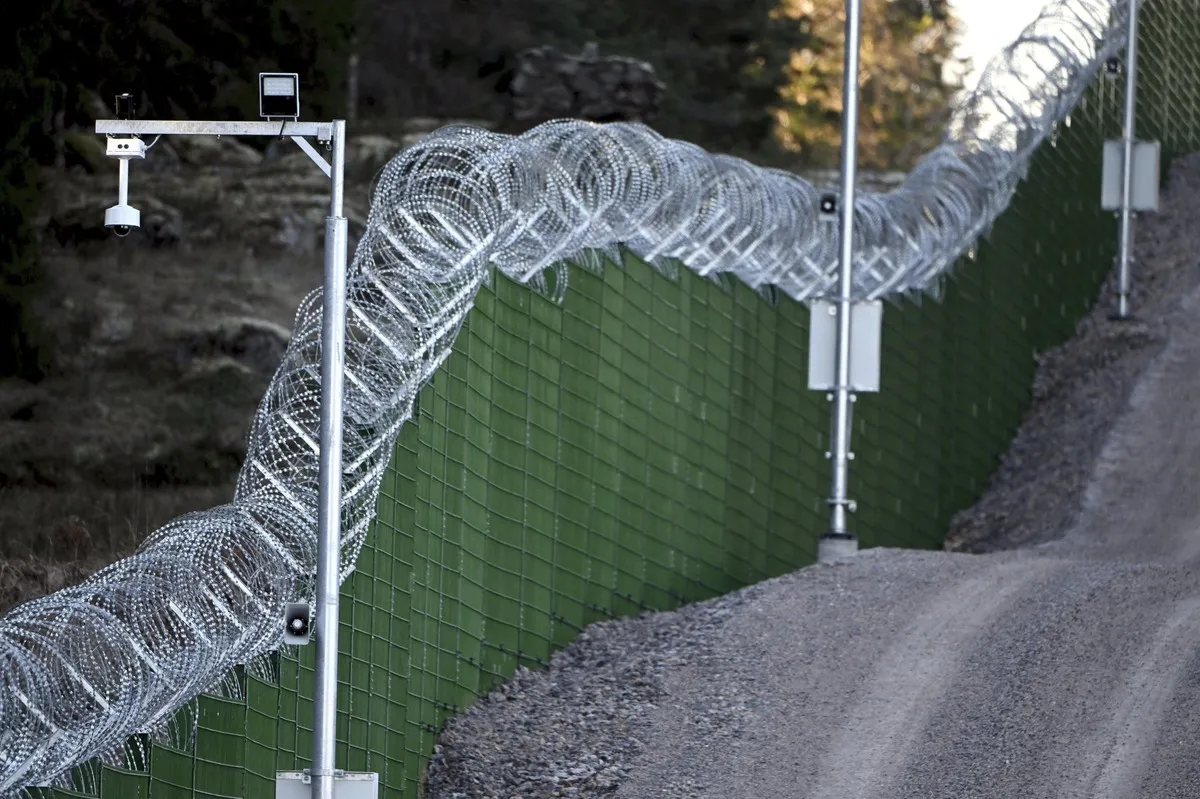
Finland started construction on a fence running along more than 120 miles of border with Russia in February 2023. Work is expected to take up to four years, according to the Finnish border guard.
Finnish broadcaster YLE reported in January that satellite imagery showed Russia had expanded military facilities near Finland, but the area was still being used mainly to support Moscow's war effort in Ukraine.
The head of the Finnish military, General Janne Jaakkola, told Reuters in early May 2024 that Russia probing the alliance's commitment to Article 5 is "always possible."
NATO relies on all of its members being committed to Article 5 of the alliance's founding treaty, which commits other member states to help out any ally that comes under armed attack, with the response they deem appropriate.
"If we take correct action and maintain unity, I consider an attack unlikely," Jaakkola said.
That unity has become strained in little under a year since the Finnish military chief made those remarks., with U.S. President Donald Trump—a longtime NATO skeptic—throwing the American commitment to Europe's security into doubt.
Public statements from senior Trump administration officials have insisted the U.S. remains invested in NATO, while demanding European members dramatically increase defense spending as Washington turns its eyes to the Indo-Pacific.
The White House has also thawed previously icy relations with the Kremlin, watched on with concern among NATO countries close to Russia that would rely on U.S. support for their militaries if Moscow did launch attacks on NATO's eastern flank.
"Russia is testing Article 5 all the time," Virtanen said, but did not expect "any imminent threat or attack."
"It is possible, but it's not likely," the deputy military chief said.
Moscow's probing is mostly focused on information attacks, GPS jamming, cyberattacks and mass migration, Virtanen said.
Russia is very adept at what is known as hybrid warfare, a term that broadly refers to tactics designed to undermine or destabilize opponents, but falling short of open conflict.
"What we see is a steady and growing pattern of hybrid attacks or incidents against NATO countries," James Appathurai, NATO's deputy assistant secretary-general for innovation, hybrid and cyber, said during an appearance at the European Parliament in January. Russia is "the main actor," the NATO official added.
"There are multiple options for Russia to test the cohesion of the alliance," Lieutenant General Jürgen-Joachim von Sandrart, the then head of NATO's Multinational Corps Northeast based in northwest Poland, told Newsweek late last year.
What People Are Saying
Lieutenant General Vesa Virtanen said: "We are following very closely what is happening on our border with Russia."
What Happens Next
Finland will continue building up its presence along its border with Russia as Helsinki quickly increases its military spending.
View 0 Comments
Submit Correction
View Editorial & AI Guidelines