10
Loading video...

By Joe Edwards
Reporter
0
Share
Newsweek is a Trust Project member
See more of our trusted coverage when you search.Prefer Newsweek on Googleto see more of our trusted coverage when you search.
The Farmers’ Almanac is predicting a fall season marked by a warm start, a cooler finish and increasingly unsettled weather across much of the U.S.
In its Fall 2026 outlook, the publication says autumn will begin with “widespread warmth” in September before a cooling trend develops and gradually spreads from north to south. By November, it forecasts cooler temperatures across most regions, with rain and storm systems becoming more common as Thanksgiving approaches.
Warm September Predicted for Much of the Country
The publication says September is expected to feel more like late summer in many areas, with warm temperatures lingering across broad parts of the country.
Read More on Weather
The outlook says the Northeast could see pleasant periods during the month, while the Southwest and much of the West are expected to remain relatively dry. The North Central states may also see several dry spells early in the season, though the Farmers’ Almanac says signs of a seasonal shift should begin appearing across northern states as September progresses.
Northern Areas Forecast to Cool First
October is expected to bring a more noticeable change toward fall weather. The Farmers’ Almanac says the North Central states and Great Lakes region are likely to move into colder, more winterlike conditions earlier than other parts of the country.
The publication says those regions could see some of the season’s earliest and most persistent chilly weather, with the possibility of snow in higher elevations by mid-October. The Southwest is forecast to begin the season with typical heat before temperatures drop more significantly during October.
The Southeast is forecast to stay warmer for longer than much of the country, with a more noticeable drop in temperatures not expected until later in fall.
Wetter Pattern Expected by November
According to the Farmers’ Almanac, colder air is expected to spread across much of the country by November, including into parts of the South. The outlook also calls for a wetter late fall, with more frequent rain and storm systems before Thanksgiving.
Northern regions are expected to see fall arrive more abruptly, with the forecast moving from a gentler start to colder and wetter conditions later on.
Regional Outlook
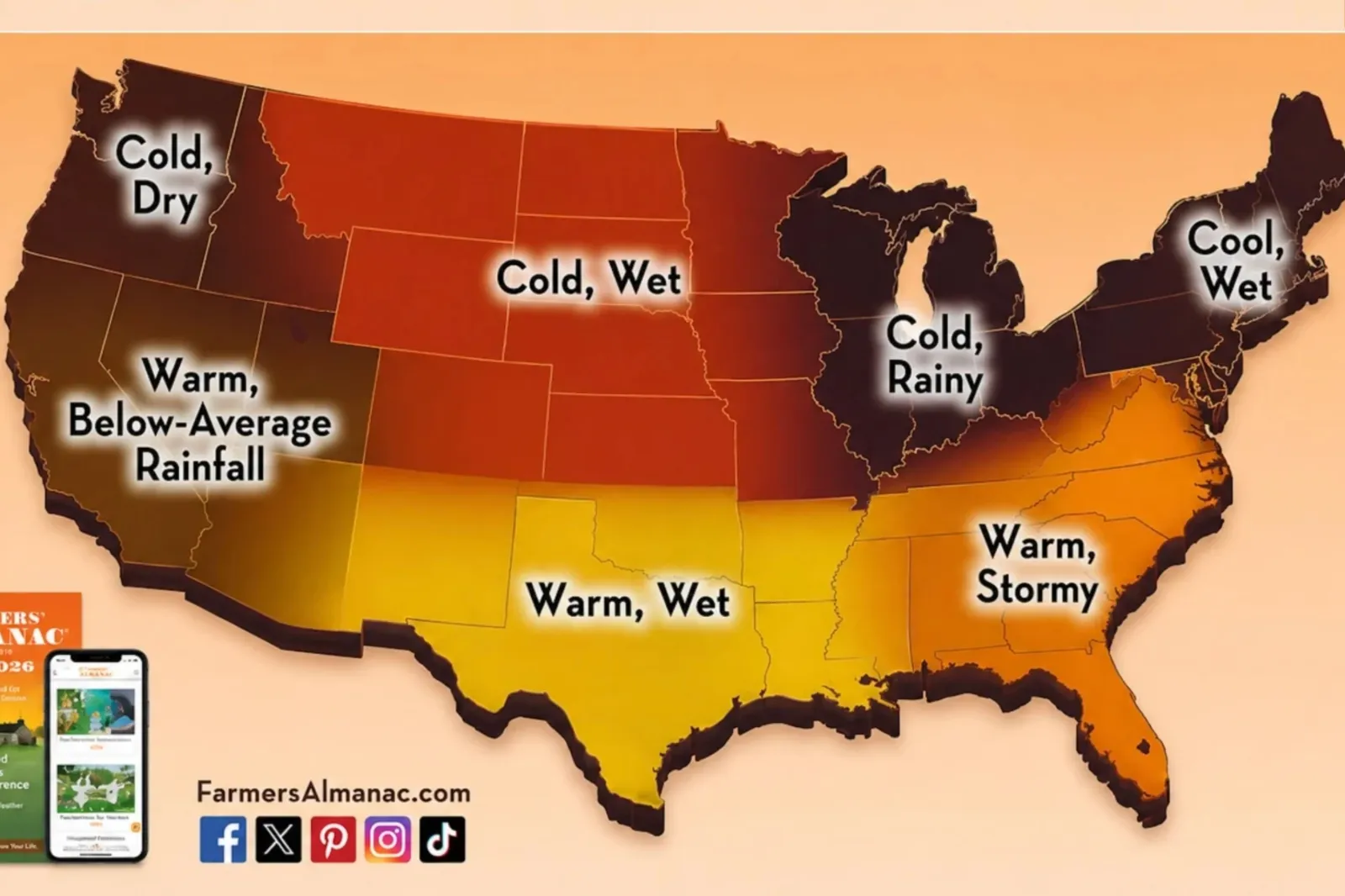
The Farmers’ Almanac also released a map summarizing its fall forecast by region:
- Northwest: Washington, Oregon and much of Idaho are placed in the “Cold, Dry” zone.
- West and Southwest: California, Nevada, Utah and Arizona fall under “Warm, Below-Average Rainfall.”
- North Central: The largest cold-weather zone stretches from eastern Idaho through Montana, Wyoming, Colorado, North Dakota, South Dakota, Nebraska, Kansas, Minnesota, Iowa and Missouri, where the map calls for “Cold, Wet” conditions.
- Great Lakes: Wisconsin, Illinois, Michigan, Indiana and Ohio are forecast to be “Cold, Rainy.”
- Northeast: Maine, New Hampshire, Vermont, Massachusetts, Rhode Island, Connecticut, New York, Pennsylvania and New Jersey are grouped in the “Cool, Wet” region. Parts of Maryland, as well as Delaware, are also included in this category.
- South Central: New Mexico, Texas, Oklahoma, Arkansas and Louisiana are shown in a “Warm, Wet” zone.
- Southeast: Tennessee, Mississippi, Alabama, Georgia, Florida, South Carolina, North Carolina, and Virginia are placed in the “Warm, Stormy” region.
...
A Farmers’ Almanac spokesperson told Newsweek the publication does not issue long-range forecasts for Alaska and Hawaii because both states have relatively stable climate patterns and highly varied terrain that can produce dramatically different weather. Instead, the Almanac said it provides climate summaries based on National Climatic Data Center data, including a five-zone breakdown for Alaska to reflect the state's diverse conditions.
Chance of Early Snow in Some Areas
The Farmers’ Almanac also said the first snow opportunities are expected in colder northern regions. Higher elevations in the North Central and Great Lakes areas could see snow by mid-October, with more winterlike conditions developing as the season continues.
What Is the Farmers’ Almanac and How Are Its Forecasts Made?
The Farmers’ Almanac says its long-range weather predictions are based on a formula first developed in 1818 by founding editor David Young. The publication describes its exact formula as a brand secret.
On its website, the Almanac says its forecasting method has included the study of sunspot cycles, solar activity, tidal forces, lunar influence, planetary positions and comparisons between past weather patterns and current conditions. It also says its forecasts are calculated two years in advance and are not updated after publication in the way that local, government or commercial weather forecasts may be revised.
Contact Newsweek editors on this story: John Fitzpatrick and Gray R. Thomas
View 0 Comments
Submit Correction
View Editorial & AI Guidelines