...

By Andrew Stanton
Reporter
0
Share
Newsweek is a Trust Project member
See more of our trusted coverage when you search.Prefer Newsweek on Googleto see more of our trusted coverage when you search.
President Donald Trump wrote that the Supreme Court’s three liberal justices “ALWAYS vote as a group” in a post on Truth Social criticizing Republican justices for not sticking together.
Newsweek reached out to the White House for comment via email.
Read More on Fact Check
The Claim
Trump has found himself at odds with the conservative-majority Supreme Court since his return to the White House. At times, some conservative justices have ruled against the president, including by striking down his sweeping tariff policy in February.
He launched his latest critique of the Supreme Court in a Truth Social post on Wednesday.
“How can the Democrats not like how the U.S. Supreme Court votes. The Democrat Justices stick together like glue, NEVER failing to wander from the warped and perverse policies, ideas, and cases put before them. They ALWAYS vote as a group, or BLOCK, even that new, Low IQ person, that somehow found her way to the bench (Sleepy Joe!),” Trump wrote.
He continued, “The Republican Justices don’t stick together, they give the Democrats win after win, like a 159 Billion Dollar pile of cash on a completely ridiculous Tariff decision, and nasty, one sided questions on the country destroying subject of Birthright Citizenship, something which virtually NO OTHER COUNTRY IN THE WORLD IS STUPID ENOUGH TO ALLOW.”
The Facts
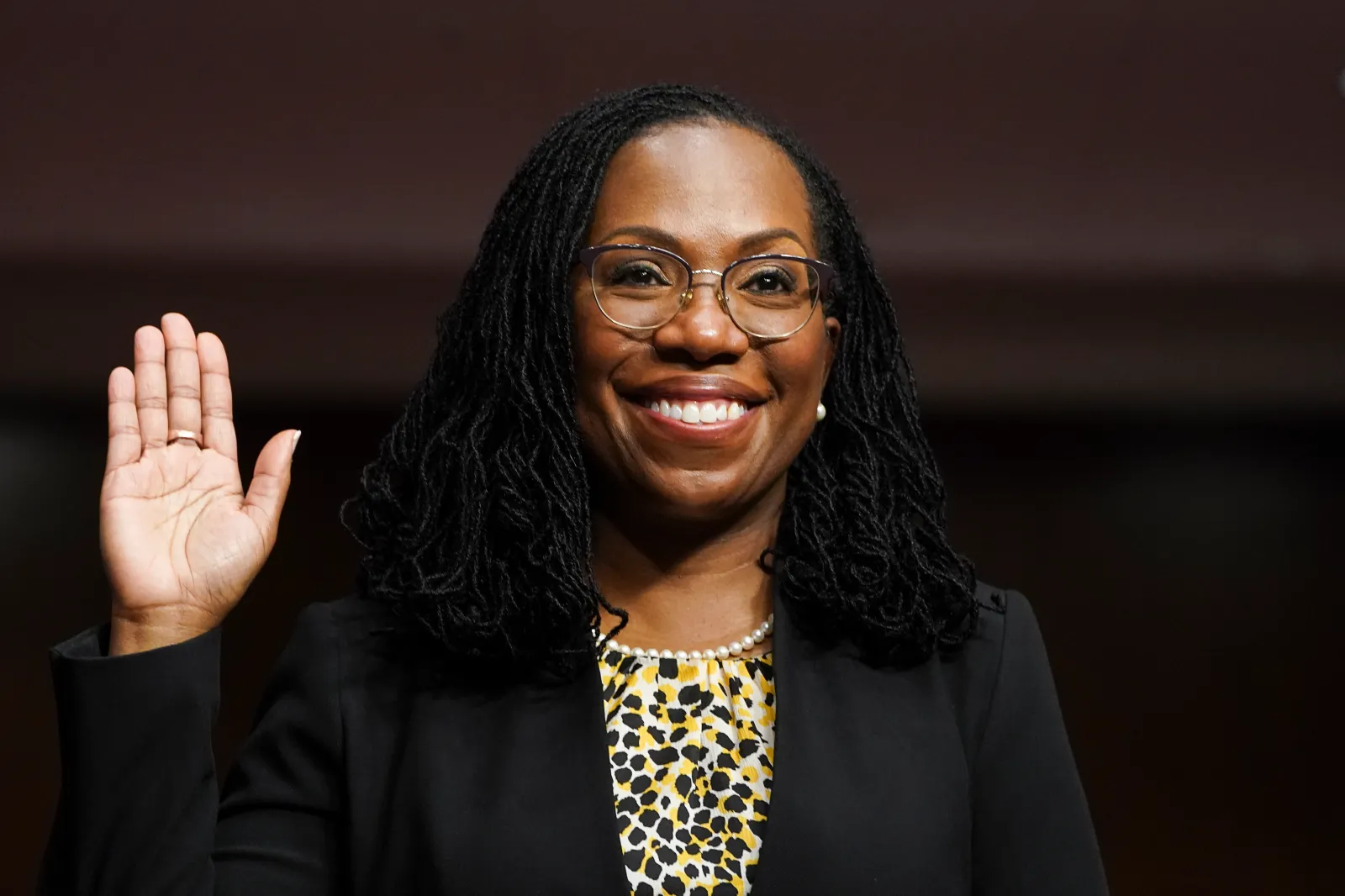
The Supreme Court currently has a 6-3 conservative majority. Justices Elena Kagan, Sonia Sotomayor and Ketanji Brown Jackson make up the court’s liberal flank, while Chief Justice John Roberts and Justices Samuel Alito, Clarence Thomas, Neil Gorsuch, Brett Kavanaugh and Amy Coney Barrett are more conservative.
The three liberal justices do side with each other more often than not. But they do disagree on some rulings. In March, Kagan and Sotomayor broke with Jackson on a case involving Colorado’s law banning conversion therapy for minors. They joined the conservative majority in ruling in favor of the challenge filed by Kaley Chiles, a licensed counselor in Colorado.
Jackson was the lone dissent in the case and argued that states have traditionally regulated the provision of medical care without incident.
...
There have been other prominent cases of liberal justices breaking from one another.
In January, Kagan broke with the other liberal justices in the case Bost v. Illinois State Board of Elections, which revived a Republican challenge to an Illinois law that allows the counting of mail ballots that arrive after Election Day. Kagan joined a concurring opinion filed by Barrett.
A Harvard Law Review study from 2022 found that Sotomayor and Kagan agreed with each other 93 percent of the time, while Sotomayor and Jackson agreed with each other nearly 88 percent of the time. Kagan and Jackson agreed with each other about 84 percent of the time.
They have been united on some of the most prominent cases. All three ruled against Trump’s tariffs earlier this year, for instance.
The Ruling
False. The court’s three liberal justices do not always vote with each other, even if they do so in the majority of cases.
Learn more about Newsweek Fact Check.

View 0 Comments
Submit Correction
View Editorial & AI Guidelines