
...

By Giulia Carbonaro
Senior Reporter
0
Share
Newsweek is a Trust Project member
See more of our trusted coverage when you search.Prefer Newsweek on Googleto see more of our trusted coverage when you search.
More than 6,600 people have contacted environmental activist Erin Brockovich about AI data centers in their communities, contributing to a growing crowdsourced effort to track the facilities emerging across the United States.
“6,615 submissions have been sent in and counting. That’s how many of you have written to us about AI data centers in your area as of May 31,” Brockovich wrote on Facebook on Monday.
The response highlights what Brockovich says is growing public concern about the rapid expansion of data centers, the energy-intensive facilities powering the artificial intelligence boom.
Read More on News
Data centers require vast amounts of electricity and water to support computing operations and cooling systems, prompting questions in some communities about their environmental and infrastructure impact.
Brockovich added: "We’ve put 3,674 of your reports on the map. Look at it. We just ADDED a page for your PHOTOS, too—link below. We update this every day. This entire effort is you. Real people, self-reporting.”

...
What Brockovich's Project Is Tracking
Brockovich has launched a website, brockovichdatacenter.com, inviting residents to report data centers that are operating, under construction or proposed in their areas. The project aims to provide greater visibility into the scale and location of facilities being developed to support AI growth.
Brockovich said the initiative was prompted by a growing number of requests from communities asking her to investigate local projects and their potential impacts.
“As of today, there have been over 40 communities from numerous States that have reached out to me personally regarding these issues,” she wrote on Facebook on April 27.
“Therefore, I thought it would be a good idea to create a self reporting map for all communities to report their information and concerns. Many of you are showing up and speaking out,” Brockovich added.
“I hope this map gives us a bird’s eye view as to the concerns and allows us all to see the bigger picture.”

...
The website features a map showing major AI data centers that are operational, under construction or proposed across the country, alongside locations where residents have submitted concerns.
Brockovich said the thousands of submissions received since the site's launch suggest the issue may be broader than many people realize.
“This issue is far more widespread and urgent than has been acknowledged,” she said.
According to the website, the map currently identifies:
- 33 operational data centers
- 53 data centers under construction
- 34 proposed data centers
It also includes 3,674 locations tied to concerns submitted by community members.
Brockovich recently expanded the project with a dedicated page displaying photographs of data centers sent in by the public.
Why Communities Are Concerned About Data Centers
The thousands of submissions received by Brockovich reflect a growing debate over the physical footprint of artificial intelligence, as communities across the country grapple with the demands of the infrastructure powering the technology.
According to Brockovich’s website, residents have raised concerns about:
- Rising energy consumption and the potential for higher electricity costs
- Water use that could strain local supplies
- Electronic waste generated by frequent hardware upgrades
- Vulnerability to natural disasters and flooding
- Pressure on local infrastructure and public resources
- Noise from round-the-clock cooling systems and backup generators
Many of those concerns stem from the rapid growth of an industry that is still in the early stages of expansion.
The Growing Energy Demands of the AI Boom
As technology companies race to build the computing capacity needed for artificial intelligence, data centers are consuming increasing amounts of electricity.
The International Energy Agency (IEA) estimated that data centers worldwide used roughly 415 terawatt-hours of electricity in 2024, equivalent to about 1.5 percent of global electricity consumption.
While still a relatively modest share of overall demand, usage has been growing by about 12 percent annually since 2019.
In the United States alone, data centers consumed 183 terawatt-hours of electricity in 2024. On a per-capita basis, the country recorded the highest level of data-center electricity consumption in the world at approximately 540 kilowatt-hours.
The IEA projects that figure will exceed 1,200 kilowatt-hours per person by the end of the decade—roughly equivalent to 10 percent of an average American household's annual electricity use.
For some communities, the debate is not only about energy demand but also about cost.
Research has suggested that the infrastructure investments required to support data centers can contribute to higher utility bills for consumers.
An analysis by the Environmental and Energy Study Institute found that utilities are increasingly seeking to recover the costs of grid upgrades and new infrastructure through customer rates.
The study said utilities requested more than $29 billion in rate increases during the first half of 2025—double the amount sought during the same period a year earlier.
Electricity prices, by contrast, had remained relatively stable for much of the decade before 2019.
Where America's AI Infrastructure Is Expanding Fastest
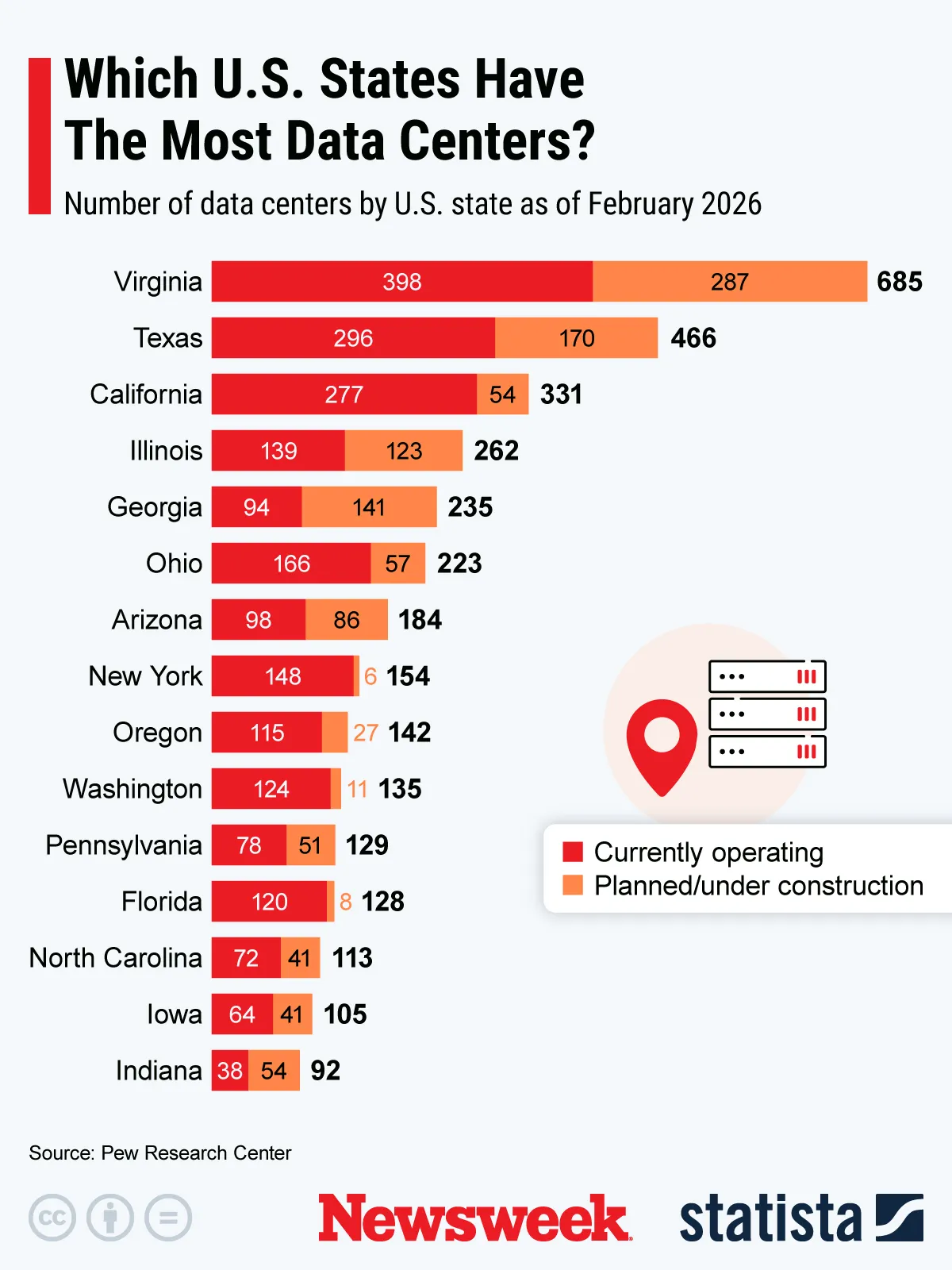
As demand for AI computing power grows, a handful of states have emerged as major hubs for data-center development.
- Virginia
Long a hub for government contractors and cloud infrastructure, Virginia—particularly Northern Virginia’s “Data Center Alley”—offers proximity to federal agencies and one of the world’s densest fiber networks. Established infrastructure reduces build times and attracts hyperscalers looking to scale quickly. - Texas
Texas combines vast, inexpensive land with a deregulated energy market that gives companies flexibility in securing large power loads. Cities like Dallas and Austin also bring a growing tech workforce and business-friendly policies that appeal to major AI investors. - Ohio
Ohio has positioned itself as a Midwestern data hub, with strong incentives and central geographic access to U.S. population centers. Its legacy industrial sites are often repurposed for data centers, offering space and existing infrastructure at competitive costs. - Arizona
Arizona’s dry climate is favorable for certain cooling technologies, while its abundant land and aggressive economic development incentives have drawn major tech firms. Phoenix, in particular, has become a key destination for new AI and cloud infrastructure builds. - Georgia
Georgia, anchored by Atlanta, offers strong connectivity as a Southeast internet exchange hub. State and local tax breaks, combined with access to both talent and transport infrastructure, have made it increasingly attractive for large-scale data operations. - Utah
Utah benefits from lower real estate costs, a stable regulatory environment, and access to renewable energy sources. Its growing tech sector, known as “Silicon Slopes,” provides an emerging talent pool to support AI-focused expansion.
Brockovich Warns Against Repeating Past Environmental Mistakes
Brockovich has also raised concerns about what she sees as unanswered questions surrounding the long-term impacts of data centers, particularly when it comes to public health.
Speaking on The Jim Acosta Show in late May, she argued that communities are being asked to accept rapid infrastructure expansion before its full consequences are understood.
“This makes me think about—even chemicals like the PFAS. You know, we put the cart before the horse and then we, the people, become the guinea pig,” she told Acosta.
PFAS, short for per- and polyfluoroalkyl substances, are a class of thousands of synthetic chemicals used for decades in products designed to be non-stick, stain-resistant and waterproof.
Often referred to as "forever chemicals," they have been the focus of growing scrutiny because they persist in the environment and can accumulate in the human body.
Long exposure to PFAS has been linked by recent studies to several adverse health outcomes and concerns, including conditions affecting the reproductive system and harming the development of fetuses. Research into their impacts is still ongoing.
“It makes me think of PFAS; the agencies were warned decades ago it could be a problem,” Brockovich said, comparing PFAS to the potential risks linked to data centers.
“So they’re like, 'OK, we’ll create some guidelines, I guess.' And then they study it, and that takes 15 years and it costs millions and millions of dollars only to find out, ‘Oh s***, Houston, we have a problem.”
“We’re setting ourselves up for that exact same scenario,” Brockovich added.
Why Companies Are Choosing These States
Despite mounting scrutiny, the same factors continue to draw technology companies to these regions:
- Large amounts of affordable land for sprawling facilities
- Access to reliable, high-capacity power supplies
- Tax incentives designed to attract long-term investment
- Faster permitting processes and business-friendly regulatory environments
Those advantages have helped turn several states into critical pieces of the infrastructure underpinning the next phase of AI growth—even as questions about the industry's environmental and economic impact continue to intensify.
Who Is Erin Brockovich?
Brockovich is best known for helping build a case against Pacific Gas & Electric (PG&E) over groundwater contamination in Hinkley, California, in the 1990s.
PG&E agreed to a $333 million settlement in 1996, which was then the largest payout in a direct-action lawsuit in U.S. history.
Brockovich's role in the case rose to international fame thanks to the 2000 film Erin Brockovich, starring an Oscar-winning Julia Roberts.
View 0 Comments
Submit Correction
View Editorial & AI Guidelines