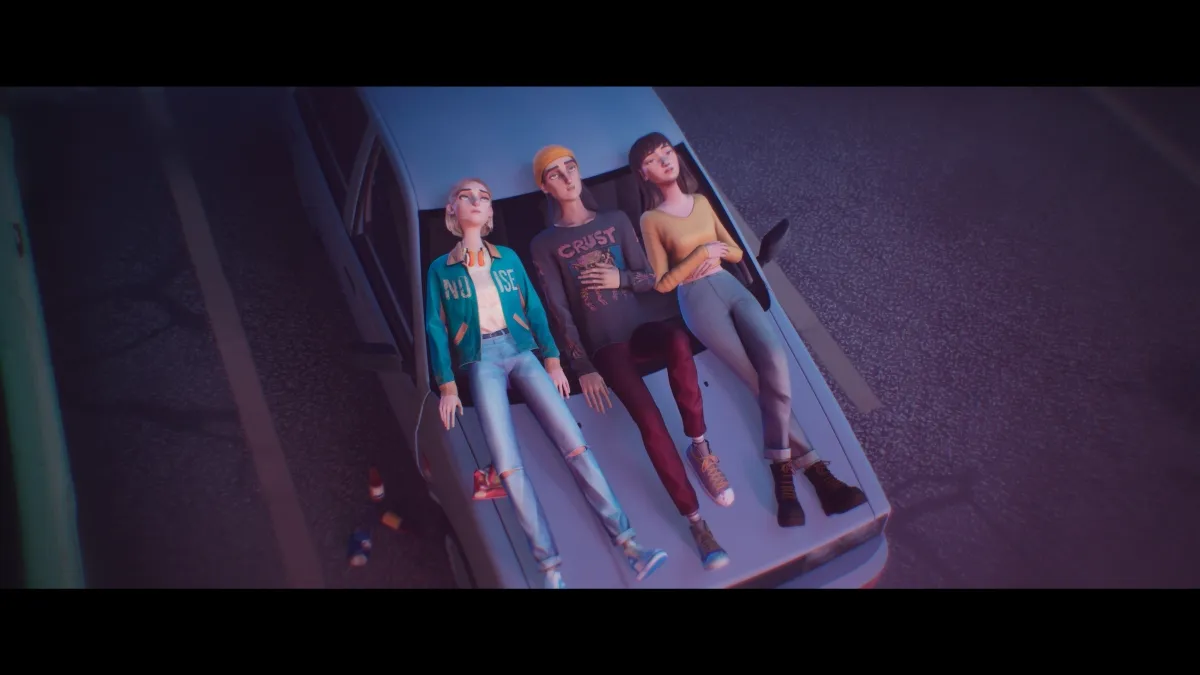
Beethoven & Dinosaur Press Kit/Mixtape Screenshot

By Zak Wojnar
0
Share
Newsweek is a Trust Project member
See more of our trusted coverage when you search.Prefer Newsweek on Googleto see more of our trusted coverage when you search.
"Mixtape," the new video game from "The Artful Escape" developer Beethoven & Dinosaur, is out in the wild and earning glowing reviews. One such review came from Newsweek. Hey, that's me! Indeed, I gave the game a glowing 9/10 score, citing its writing, musical acumen, and teenage sensibilities. It's the video game equivalent of your favorite John Hughes classic, but it's also more than that, thanks to its wall-to-wall selection of rock music and unique and charming (if somewhat minimal) gameplay scenarios.
Writer/Director Johnny Galvatron didn't initially set out to make video games. Hailing from Australia, he was a rock and roller and frontman of rock band The Galvatrons. However, after tiring of the grind of non-stop touring, Johnny switched careers and here we are. Well, that's the short version, anyway.
More News: Newsweek's Mixtape Review
Read More on Video Games
Beethoven & Dinosaur Press Kit
More News: Talkin’ Lovecraft and ‘Sucker for Love’ with Developer Akabaka
While promoting the release of "Mixtape," Johnny and Beethoven & Dinosaur producer Woody Woodward sat down with me to discuss all things rock and roll, indie gaming, and "Mixtape." We chatted for a full hour, and had a lovely time. Hopefully, you'll have a lovely time reading (a slightly edited for clarity version of) our conversation. And hey, just like with "Mixtape," maybe you'll learn some cool things along the way.
Spoilers for "Mixtape" below...
Why "Mixtape" Doesn't Have A Streaming Mode
Zak Wojnar, Newsweek: People say microtransactions and live service, that's the death of art, but there's one thing that like people don't talk about that I'm like, "No, this is the death of art!" I mean, that stuff's not great either. But this is the death of art, and it's games that have streaming mode.
Johnny Galvatron: Right.
Woody Woodward (Laughs) That's so funny.
I get the idea of, like, "We can't have this song playing on Twitch because then we might get struck or whatever."
Woody Woodward: (Laughs hysterically)
For me, when I hear that a game has a streaming mode, it's basically like they're saying, "The music in our game doesn't matter. It can be switched with something else, and no one will care." And this game just says "fu*k you" to that idea.
Johnny Galvatron: Yeah. There's a line by David Gray in "Shine," it says, "Your soul's the one thing you can't compromise."
Woody Woodward: And your licensed soundtrack.
Johnny Galvatron: Compromise for no one, that's what I say! But yeah, we knew it was going to be a thing, and someone had suggested that we try and make like an acoustic cover version, and, ehhh… I'd rather not make the game at all.
Woody Woodward: As you know, the music is a character in the game, and it just wouldn't work We entertained it for two seconds. We were like, could we do a streaming mode? And it's like, no. It just wouldn't work.
Johnny Galvatron: I did not entertain it for two seconds.
The greater Annapurna contemplated it.
Johnny Galvatron: Annapurna are very good. They never made us try and do it.
Woody Woodward: They also know that the music is a character in the game. You can't, you need it there.
Johnny Galvatron: And it was also a great help from them to get a musical director who could get us those songs and some of the adventures we went on to get those songs.
Oh yeah?
Johnny Galvatron: The funny story is that they needed to send someone up a mountain because someone who owned the rights to Plainsong by The Cure was on a retreat or something.
Woody Woodward: Like, no phone, no internet, nothing. They had to send someone up a mountain.
Johnny Galvatron: They sent someone up there to get the rights. That's probably the funniest one.
Woody Woodward: By horseback, I hope.
Johnny Galvatron: And there's one's that, I'm not allowed to say who it was, I had to talk to the artist and like sell it. Then there's Roxy Music. There's a line where Rockford goes, "Brian Ferry and Brian Eno, two of the greatest Brians, in the same band!" Well, they rung me about that song and they were like, Brian wants to know which bit of the song that line is in. I'm like, which Brian? They're like, I didn't ask. I'm like, (raises voice for comedic effect) …Which Brian?! I need to know what Brian it was! It's a cruel joke. Spoiler, it was Brian Ferry. And he was cool with it.
Storytelling, Themes, And Positive Nostalgia In "Mixtape"

Beethoven & Dinosaur via press kit
The game is such an incredible coming-of-age story. Young people, and the idea of wanting to be the main character of your own story and then learning to share that with your friends. I think that's something that Stacey learns throughout. There's the playable parts with Slater. I feel like you get more of those later on once she accepts that. Were there Cassandra parts that were cut, or is her relationship different because she joins this friendship already in progress?
Johnny Galvatron: I think it's about a couple of different kinds of friendship. To me, when I was in high school, the platonic friendships were the ones that were the most rewarding and the most crushing. They were the ones that kind of tore me apart. And we wanted to have these two different kinds of friendships. The one that Rockford has with Slater is very different than what Rockford has with Cassandra. There was an argument at one point of, who does she say goodbye to last? And she says goodbye to Slater last, which I think is the perfect end, because their friendship is so positive and hopeful and they want the best for each other. Slater's always like, if you come back, I'll be here doing my thing. They just want the best for each other. And then there's a kind of possessiveness that there is between Rockford and Cassandra.There's almost a bit of what's wrong with romantic relationships, which is that possessiveness, of not wanting them to have other friends or maybe wanting to keep them close to you. So I think it was interesting to have those two different dynamics and then for those three characters to work that out. They also have these three different philosophies about where they are in life. Rockford feels like she has a destiny, and then Cassandra, who feels like she's been thrust towards some destiny, and then Slater, who wants to appreciate the town that he lives in and find the magic in where he is. So I love that there's also that triad of different philosophies within them as well.
Maybe my favourite scene is when she sees Cass and Jenny Fu*king Goodspeed together and feels so betrayed because she has another friend and later on she kind of realizes that she's maybe been treating Cass like a project. I've been there. You've never been New York-based, right?
Johnny Galvatron: No.
Okay, so when I was very young I had a girlfriend who had an ex-husband who was known in the NYC music scene. He owned a store that a bunch of bands shopped at, and it made me so mad.
Johnny Galvatron: Yeah, oh yeah, absolutely. And you feel that, too, when you're a teenager. You feel that twice as bad. We always talk about this, everything's twice as big, everything's the end of the world when you're a teenager. And even when you're the cool kid at high school, then suddenly you're the one who wants to be hanging out with the college kids and stuff. I think that's really well explored in "Dazed and Confused," as well, the levels of the hierarchy.
Is, uh, what's his name, 'Sunglasses Mustache Guy' a McConaughey?
Johnny Galvatron: Kyle, yeah. He's our slightly less problematic McConaughey.
Woody Woodward: Did you notice on the dashboard of his car, he has, like, ten other pairs of aviators just sitting there, scattered across the dashboard? I think that sums him up.
Johnny Galvatron: "I spend a lot of time on the bench, my dude." God, it was so much fun writing dialogue for that sort of stuff. Yeah, I mean, there's a lot of different characters and a lot of different eras. I mean, we always talk about how the whole game is this kind of mixtape. The music is a mixtape.The art styles switch between black and white, there's color, there's 3D, and we're using backplates from "Seinfeld" for the driving scenes.
Yeah, I noticed that immediately. Beautiful.
Johnny Galvatron: Yeah, sick! I know, isn't it such a fun way to do it? And we have the camera going around and you can see scaffolding and lights and wires on the ground like they're in this movie set. It's just like, art of arrangement, art of collage that kind of permeates the whole game. I don't know if you felt this way, but the characters are also from slightly different years and the stuff in the bedrooms are all from slightly different years.
I was thinking on the way here, 'when is this set exactly,' and it's just this pastiche of somewhere between 1980 and now. They've got CDs, cassettes, the portable record player, the boombox, but he's got the computers making his synth odyssey, so it's timeless.
Johnny Galvatron: I think it's just about when kids define themselves by art. When I was listening to "Mellon Collie and the Infinite Sadness" and being like, do you like Smashing Pumpkins? People were like, "No," and then I'm like, "I don't want to talk to you." I was absolutely that kid. But there's also something so brilliant and naive about just defining yourself by the albums that you like, and that's the core of the story, I think, is defining yourself by art and how positive that is and how it draws you into different communities and different people.
Woody Woodward: Yeah, and the year doesn't matter. The specific year doesn't matter that much for us because it's just a cool setting to tell the story you want to tell.
Johnny Galvatron: There's good and bad ways to do nostalgia. I think the good way is when you recognize parts of yourself in people from other eras and realize that we're all the same, we all have the same problems. And bad nostalgia is like, "Remember the Tamagotchi?" That's bad nostalgia. Remember the fu*king Tamagotchi?
Woody Woodward: Look at it!
Johnny Galvatron: Look at it!
Woody Woodward: Look at it! Are you feeling something yet?
Johnny Galvatron: Feel something in your heart!
Woody Woodward: (Laughs)
When it comes to the music selection, the game has a lot of bands that I know, but not always the song that I know.
Johnny Galvatron: You got it.
Woody Woodward: We go a little deeper.
Exactly.
Johnny Galvatron: I think one of my favourite soundtracks is Donnie Darko.
Oh, I'm quite familiar with that one!
Johnny Galvatron: I love that it's, it's Tears for Fears, but it's not their biggest hit.You take a few more steps. And you have The Church and stuff like that.
Yeah, "Mixtape" has some hits, but it also goes deeper.
Johnny Galvatron: Devo's my favorite band. And having That's Good, you know, That's Good is my favorite song in the whole world. And I hear it every day, and I love it even more. But I love having just that kind of, like, a little bit of a deeper cut. And then when you rearrange the songs for what the game's going to be, and then that kind of flows and tells the story. And it's just, like, I think those secondary tracks, those slightly deeper cuts are often the ones that are going to be able to bring the narrative forward. Because, again, it is such an art of collage. And even though you have these different songs from different people and different eras and different parts of the world, you can find this through-line. And that's kind of the magic of mixtapes. Quote me.
Woody Woodward: We built the game based around the concept of, like, a mixtape start to finish. We did, like, the whole game start to finish. Like, a horizontal slice. So the whole thing was done, but obviously, in shitty quality.
Johnny Galvatron: So shitty!
Woody Woodward: But it gave us an idea of the pacing and the flow and, were these songs hitting the emotions we needed in these parts? And, were these gameplay sections in the right spots? And we could move bits around and stuff. And then once we were happy with that, we went in and, like, started bringing up quality and fidelity and all that.
Johnny Galvatron: When she sees her friend and she floats backwards to BJ Thomas…
That's in my top three moments in the game, I really love that scene.
Johnny Galvatron: Love that. Minimal gameplay input, but maximum emotional response from that minimal input.
Emotional, but also the audio every time you crash into something… I don't know if it's actually in key with the song but it just sounds so…
Johnny Galvatron: It is.
Woody Woodward: It's definitely in key!
Johnny Galvatron: And then, just when she goes through the pigeons, the song changes key. So then the chimes also change key, as well. But you've got to be on that shit! That's, some of the stuff I'm so proud of, that we had time to go in and really polish it. Like Woody said, having all the sunglasses on the front of Kyle's car. Making sure that the little chimes that you hit are in the right key.
Well, it's the difference between… One of my favorite shows is Miami Vice.
Johnny Galvatron: Yep!
You know, there are incredible episodes where the song is perfect, it's like a real fusion of music and visuals for storytelling that's unlike anything else in the world. And there are some episodes where they're like, "We got this song, throw it in there somewhere."
Woody Woodward: This is what we got this week, chuck it in. Yeah.
When the song is the centerpiece of a gameplay sequence and then it continues to play once we're back in the room, Is that a discussion with licensing of, like, when and how to, like, loop it so that it doesn't just end?
Johnny Galvatron: We don't have to talk to the artist about kind of adding reverb or looping and those sort of things. If we wanted to take the stems out and start rearranging the stems and doing the vocals and stuff, then you have to get additional clearance. But we were never in the kind of market for doing that. We were always like, leave the song as it is. If we have to loop it, we can do it seamlessly. People won't know. But we were always like, present the song as it is.
Woody Woodward: If the integrity of the song is 'as is,' then it's fine.
It would only be an issue if you did, like, the movie trailer thing.
Johnny Galvatron: Exactly, yeah, yeah. You'll actually see that. We've got a kick-ass fu*king launch trailer. It's really good.
Okay, then I can't wait to include the embed in the story! Another deep cut, maybe there's a story, because it's Australian. Yesterday's Hero.
Johnny Galvatron: Yeah!
I was initially more familiar with the Bay City Rollers version. Is there a story behind that one in particular, doing the "Ferris Bueller" chase?
Johnny Galvatron: Yeah, that's an Australian song that not many people know, and it's in my top ten choruses I wish I had written. And also, you know, I am a failed rock star, so hearing that, him being like, "I don't want to be yesterday's hero," the thing was, John Paul Young, he was a really famous teen idol in Australia, and he was on TV, so the whole thing about, like, "haven't I seen your face before? Weren't you the kid who used to live next door? Weren't you on TV every night?" And then he's like, "Yeah, and I'm just going to be yesterday's hero." And to me, I'm just like, oh, it's me. It's me. It's like when I'm watching "Steve Zissou." I'm like, I'm the sad old man.
Woody Woodward: Sitting outside with a loose bowtie outside the premiere, smoking a cigarette. Just, like, "Is this it?"
Johnny Galvatron: So that song is like, just, I really feel that fu*king song, man!
And there's the anxiety of fearing that you'll peak in high school, right?
Johnny Galvatron: That's another one, absolutely! And it's also just this ragingly rad rock and roll song. I love that song so much. And then you can hear the news report where it's like, "he collapsed at The Forum in Melbourne." And that whole bit is actually from the news from when his kind of teen career nosedived, and then he put it in the song. I like that.
Woody Woodward: How self-referential!
Johnny Galvatron: It's so dark!
Woody Woodward: And in your reference, it gives self-reference.
Johnny Galvatron: And then I'm like, oh my God, that's me.
That's how music speaks to us.
Johnny Galvatron: Yeah, yeah, exactly. And there's another song, which is another Australian song, which is State of the Heart by Mondo Rock. And Mikey, who's our 3D modeler and VFX technician, his dad is in Mondo Rock. And his dad wrote that song. And it was about his mum. And we had it in the game for like a year. And then his dad was like, "Oh no, I didn't write it about your mum. It was for someone else." And we were like, "Oh! Oh no! Someone else? It's too late, it's already in the game! Sorry, Mikey, that's not your mum! So there's a little tidbit on State of the Heart, Mondo Rock.I hope you got a discount on it.
Woody Woodward: I think we didn't.
Johnny Galvatron: As far as I'm aware, no, we didn't.
Woody Woodward: You've got to pay your dad.
Johnny Galvatron: You've got to! You can't be like, "Dad, give it to us for cheap." Not cool.
Working With Annapurna

Beethoven & Dinosaur via Press Kit
Fair enough. I played through the game in one sitting, had a tremendous time, I'm going to be playing it again. It's the kind of game you want to share with people. You want to play it with people, even though it's a single-player game. Tell me about the idea of saying, "We're not going to add a point system or a time trial system or something. We're going tomake this game replayable because it's just good."
Woody Woodward: Can you just write that?
Well, I did in the review! But was that ever a concern of like, oh, how are we going to get people to play more than once? Is that a concern?
Woody Woodward: We don't.
Johnny Galvatron: I never think about that.
Woody Woodward: Yeah, I don't think we create with that in mind. You know, we just make our weird little stuff and Annapurna believes in us and they help us out and then we just make it, you know?
Johnny Galvatron: (Laughs) Yeah!
Woody Woodward: That's pretty much it!
Isn't it nice to have a publisher who doesn't, like, grab you by the lapels and shake you around and make you do stuff you don't want to do?
Woody Woodward: They could be, like, "We need a battle pass. Put a battle pass in!"
(With supernaturally serendipitous timing, Hector Sanchez of Annapurna enters the room)
Johnny Galvatron: Have you met Hector? He's the head of Annapurna.
Hector Sanchez: Hey.
Oh, thank you for letting them cook.
Hector Sanchez: That was the hardest thing I've ever had to do. (Laughs)
Johnny Galvatron: Anyway, it was always like, no one was ever demanding that the game needs to be longer. Or asking, are we getting enough button pushes in this window of time? Do you know what I mean? We always have this theory that the game will tell you what it needs. And we're lucky enough to be in a group of people who hear the same thing when the game is being played. If something needs to get cut, it's never a really hard decision because the game will tell you it's too long.The game will tell you where the sound mix is wrong. The game will tell you where the pacing is wrong. You've just got to listen to it. If you have a team that all hears the same music, then it works very well.
I should know this. Did Annapurna publish The Artful Escape?
Hector Sanchez: Yeah.
So, and at this point, you can just say, "We did that together, so… We're cool, right?"
Hector Sanchez: Yeah, exactly.
So, have you worked with publishing partners who have not been like this?
Johnny Galvatron: I've only made video games with Annapurna.
Okay, great.
Woody Woodward: Yeah, and all of my other stuff before Beethoven & Dinosaur was self-funded indie, so…
Johnny Galvatron: I wouldn't know how to work with anyone else. I wouldn't know how to work in a studio outside Beethoven & Dinosaur. I wouldn't.
Woody Woodward: A unique collection of unique individuals.
Johnny Galvatron: Yeah, because none of us had made a video game before "Artful Escape."…
Woody Woodward: Well, some of us.
Johnny Galvatron: Of course. But we'd stolen people from VFX studios. That's so easy!
Woody Woodward: "Do you want to come out of the mines and breathe the fresh air again?"
Johnny Galvatron: One of the guys was telling us about that. He would have a Pavlovian reaction to squeaky wheels because they would take out a snack cart when they had to work overtime, and before you got told you had to work overtime, you'd hear that squeak of the wheel, coming down the hallway.
Woody Woodward: Like a horror movie.
Johnny Galvatron: And traditional artists, like Arden (Beckwith) was a traditional artist. She did all of the 2D illustration on "Artful Escape," and then she became a character modeler, and she made Rockford. So having an indie team like that, where you don't fire 100 people in between games, and you just keep your… Well, we don't have 100 people to fire.
Woody Woodward: If we fired 100 people, we'd be, like, minus 80 people. And that's way too many people to be minus!
Johnny Galvatron: It's good that we have a team that continues to get better, to become better game makers, and everyone is extremely driven on the team.
Woody Woodward: Everyone's the champion of their own little area, which I think is important.
It sounds like you're making games the way you would make music.
Johnny Galvatron: Yeah… Hmm, no. I will tell you the difference.
Okay.
Johnny Galvatron: There's this quote…
Shoot, I thought I was being profound.
Woody Woodward: I liked it!
Johnny Galvatron: (Laughs) There's this quote from one of the conductors of the British Symphony, which is about pianists, which says, they have to sit in a room with this great machine and every day prove that they are the master of it and not the other way around. And that is what music feels like to me. Music was very singular. I wasn't a very good collaborator as a musician. Video games is the most collaborative form of art, I think. It's because it's so iterative, right? Because you have so much time. Like, we worked for three years on that flying level, do you know what I mean? Everything has to be perfect and the angle has to come in and we have to have this glide here, and all that.
Woody Woodward: Like most things that look effortless, it takes a lot of effort.
Johnny Galvatron: I see our people as I go through the levels, do you know what I mean? I see Harry in that line of trees. I know he put them there. And when I fly through these particle systems, I know that that was Mikey slaving over that. And so, when we run through these levels, we see all our friends, do you know what I mean? We see the people we work with and they're going to live in there forever. And I think that's something that's super cool.
Yeah. Speaking of the art and the art style, you know, I love the 60 FPS or however much your computer can handle, but mixed with these characters who animate very…
Johnny Galvatron: Stop motion-y.
Yeah.It looks so great when the camera's moving around them and they're moving at their own speed.
Johnny Galvatron: Yeah, it's tricky. You've got to do this thing called stickering, do you know about it?
Nope!
Johnny Galvatron: If you have a character that's on a stop motion, that's on twos or on threes, it's fine if the camera's static, that'll look fine. But as soon as the camera starts to move with the character, they flicker. Thus, anyone who just plugs it in and turns it on to threes or sets an animation to three when they move the camera, it's broken. So if you have a piece of footage of "Mixtape" and you stop it, you'll see that every second or third frame, the character sticks to the camera, right? So you can have different skeletal meshes and they can be, like, either the characters or something that's moving in the air, something they're interacting with, and they'll all move and then they'll stick to the camera and they'll move for that frame and then they'll move again, stick again. And then you can have the arms moving really quickly, if you need that on ones but the rest of the body on threes.
Woody Woodwawrd: Yeah we can separate it, the limbs and all different parts to make it fit the camera in the scene and that kind of stuff.
Johnny Galvatron: And I think, with a game like this where you're flying off on these flights of fancy, that anyway you can ground it, any way you can make it feel real, is going to be a benefit to the art style. So having that kind of hand animation and then having this kind of texture base which is kind of verging on hyper-real and then you have the post-processing, which kind of bands our shadows alittle bit to give us a slight… You don't want a full cel-shade but you want to have just something that's slightly different. There's a whole bunch of things that goes into it. And then tons of lens flare and bloom! And you've got to have a touch of vignette. The lens distortion, if I'm allowed. Sometimes people turn it off.
I like chromatic aberration. I don't know why people turn that off.
Johnny Galvatron: I want to see red, blue, green.
Okay, maybe I do get why people turn it off.
Johnny Galvatron: (Laughs)
But I like it.
Woody Woodward: Depends on what game I'm playing.
Fair. Early on, there's a scene I believe it's in… Oh, it's in Rockford's room, where they have the plan for the road trip. And there's the road trip set list. There's Tom Petty, Prince, Zep, of course. I'm sure Zep was never on the table.
Johnny Galvatron: Zep was never on the table.
But are those songs that you wanted? Is that list, like, a developer Easter Egg, like your pie-in-the-sky wishlist?
Johnny Galvatron: Oh, that's a good question. I think that's a great question. I was thinking of just, like, what would Rockford make for a road trip.
I'm going to tell my editor you said I had a great question.
Johnny Galvatron: Yeah, yeah. It is good! I can totally see how that would be it. But no, we did get told, like, don't even ask for Zeppelin. Don't ask for Pink Floyd. They were, like, "I've offered them millions. Millions with an S. And they say no." And I was like, that's fine.
Woody Woodward: Rockford can make that list. She doesn't have to pay, you know. She's free to make that list.
As soon as the credits end and you turn off the computer, that's when those songs play in the story. So, you got all these songs I'm sure, you know, I'm sure there's stuff that you wanted but couldn't get. But you have this great, incredible setlist. Are you going to be releasing it as like a CD for people to buy or will it just be a Spotify playlist?
Woody Woodward: There's been some chat. We're not sure yet. Wait and see.
Johnny Galvatron: I will say that I would love to. That's my answer. that I would love to.
Woody Woodward: We'll see.
Let's jump around. Cass' dad! He's scary.
Johnny Galvatron: He's great. He was so good. JB Tadena. He's in the new David Fincher film.
Oh, really? The Adventures of Cliff Booth?
Johnny Galvatron: Yeah, he's one of the main characters. Yeah, I can pick 'em! (Laughs)
With Cass' dad, he's the closest we have to a genuine person who stands in the way. As opposed to the characters standing in their own way, learning to get out of their own way. But even he has a depth that I was not anticipating based on his first scene. When he mentions Leonard Cohen, that was great. And when he realizes that he's just going to make his daughter hate him forever if he doesn't let her off the leash.
Johnny Galvatron: Do you know where I come from with that character? One of my favorite screenplays is Cameron Crowe's "Almost Famous." And the Francis McDormand character, the mum, that could be such a plain, annoying role, being the mother who doesn't want the son to go with the rock band. It could be the most two-dimensional, horrible character. But it's not. It's one of the best characters in the film. And she has some of the most iconic lines from the film, where she's like, "Rock stars have kidnapped my child." She has all these wonderful lines and this philosophy that she goes through and she's built out so wonderfully. I think she might have been my inspiration to be like, how to do an antagonist in this kind of hangout film where the stakes are not evil. The stakes aren't world-ending. Make sure you give that character genuine depth and give them their own moments and their own special lines. And I love when he gives that Leonard Cohen line. It's probably my favorite line in the game.
Another one of my favorite lines is Slater, when they talk about growing up and he says, "We have no frame of reference," of what it's like to be older than we are. And part of why they don't have a frame of reference is because Cass' dad is so uptight. We don't know what his coming of age was.
Woody Woodward: And there's little hints to that, I think.
He surely went through the same thing that they're all going through, right? Everybody does.
Johnny Galvatron: Yeah, and you can tell he has moments of identity crisis that he's trying to keep up this image, "I'm the true blue American cop," and at one point, you can hear him in the background saying like, do you know how hard it is for me to fit in at that precinct? He's trying to fit in just the same way the kids are.
And it's not specific. It's just universal.
Johnny Galvatron: And I love that he had that music in his heart, ready to go, and he could connect with Rockford just for that second, even as he's throwing her into the cop car, you know? Love that moment. And then! And then I got to use Dare by Stan Bush from the 1986 "Transformers" soundtrack when they run away! And we got that, like, five days before we finished the game. And I was like, I sent a Hail Mary message.
Woody Woodward: It was the red phone.
Johnny Galvatron: It was the red phone! I was, like, "Hector, I need more Stan Bush."
(To Hector) Does that give you a migraine? Who gets the migraine?
Johnny Galvatron: No, not me!
Woody Woodward: Actually, it was pretty good. It was okay.
Johnny Galvatron: We had our system pretty down by then, didn't we? We were pretty good at getting songs.
Woody Woodward: And we already had Stan in there. It was just a little bit more. A little bit more Stan.
Johnny Galvatron: Can we have a little bit more? A little more Stan?
Hector Sanchez: Never get in the way of a stroke of genius.
Johnny Galvatron: God, that song fills me with joy. When you hit that home run and The Touch starts. Are you an animated "Transformers" movie fan?
I'm not, but even I know The Touch.
Woody Woodward: The prestige.
Johnny Galvatron: The prestige of The Touch.
From "Boogie Nights."
Johnny Galvatron: That's right! From "Boogie Nights" as well!
With Marky Mark, who was in the "Transformers" movies.
Johnny Galvatron: Oh my God, six degrees to Marky Mark!
The even shittier ones.
Johnny Galvatron: Oh, totally. Right, he's in like the kind of reboot ones.
Man, I remember when I finally saw part five… Hoo-boy.
Johnny Galvatron: Is that the one that Merlin is in?
Yeah.
Johnny Galvatron: (to Woody:) Did you know Merlin is in the Transformers and that it goes back in time?
Woody Woodward: …Wait, really?
My entire review of Transformers 5 is… There's a scene where they show like a stock shot of London.Yeah. Like the big ferris wheel and Big Ben, all that. And the little text at the bottom says London, comma, England, comma, UK.
(Everybody laughs at my tremendous review of Transformers 5)
Woody Woodward: Just in case you didn't know.
And I was, like, that's all I need to know about this movie.
Woody Woodward: Planet Earth.
Johnny Galvatron: And they have to show Big Ben. Love it.
And "Mixtape" is kind of the exact opposite of that because it's Anytown, USA.
Johnny Galvatron: Anytown, USA. Absolutely.
Anytown, and any year. Were there moments where you had songs that maybe were too new that you couldn't include?
Johnny Galvatron: Absolutely. And we hid one in the game, which is Remember When by Mitch Murder. It's from 2013, I think.
Woody Woodward: The future.
Johnny Galvatron: And I was thinking about it, that Rockford could go, like, "This song's from 25 years in the future, you know?"
Because she almost always does say the year.
Johnny Galvatron: That would have been great, I think.It could have been cool. I didn't want to kind of take it too much out of the story. That's like maybe a step too far. But, yeah. I love the idea that they just exist in this kind of like 80s, 90s radio station town that has no defined era. I think that's super cool about it.
Woody Woodward: And like, we didn't want to limit ourselves, to be like, these songs need to have come out in, you know, 1993 or whatever.
Johnny Galvatron: Yeah. I think it was like we were trying to set it in 1994, and then Freak by Silverchair came out in 1996. And we're like, fu*k it. It's no year.
Woody Woodward: No year. Fu*k it. It's open! And then there's late-decade stuff.You know, like the sound of the 80s didn't really happen until the end of the 80s, and the sound of what people think the 90s sounded like wasn't right until the end of the 90s. So, we just kind of mashed it all up.
Johnny Galvatron: We said, fu*k it. Yeah.
And that poor guy, he's never shown, I don't think, but the one Rockford says to Cass to, you know, "use him and lose him."
Johnny Galvatron: Oh, yeah, yeah. He's a meathead!
Yeah, because he listens to Pearl Jam and Green Day. I'm, like, come on, give him a break!
Johnny Galvatron: She's way too, like…
Snobby?
Johnny Galvatron: Absolutely, way too snobby.
Woody Woodward: It's more of a comment on Rockford than it is on Green Day.
Johnny Galvatron: Oh,absolutely. Absolutely, it's more of a comment on Rockford than it is on Green Day fans.
I get flack from my brother for like 21st Century Breakdown. He's like, "Everything up until Dookie was great. Then they sold out." But he's the real musician. I'm the poser.
Johnny Galvatron: Hey, aren't we all, you know? I love Maynard Keenan's line, he says, "I'm not a sellout. Anything I sold, you bought. I've always been selling it. I've been selling the same stuff from the first concert."
"Mixtape" After "The Artful Escape"

Beethoven & Dinosaur via Press Kit
Bring me back to right after "The Artful Escape," and you go, "What are we going to do now?"
Johnny Galvatron: Well, we go, "Ah, we just finished a game! Ah, shit, we've got to make another one! What are we going to do?"
Was the idea that you have to strike while the iron's hot?
Johnny Galvatron: It's not that. It's that you would like everyone to continue getting paid, everyone you're working with. So, Annapurna was just like, straight on, you can come and do another one. And we said, thank you very much.
Woody Woodward: We said, that would be nice.Thank you.
Johnny Galvatron: Thank you, please. Yes, please.
Woody Woodward: Thank you.
Johnny Galvatron: And then we figured out what the timeline was going to be, and then it was easy. (Laughs)
Woody Woodward: Oh yeah, it was super easy.
Not to compare making a game to making music again, because that didn't work out for me last time… But, you know, they say that you have infinite time to make your first record, and the second one… You don't.
Johnny Galvatron: It's different, isn't it? Because the second album from a musician is usually the worst one. And bands can, like, really descend hard. It feels different with video games. It feels like studios get better. It doesn't feel like they drop off as much.
Woody Woodward: You're sharpening, you're honing what you do and how you do it. You're getting better at it.
Johnny Galvatron: It's that institutional knowledge. The more your company makes, the better you will be. So I think there is a kind of inverse of how music can drop off where game studios seem to get better. And the creative voices are always like… It's like the ship of… Of…
Woody Woodward: Theseus.
Johnny Galvatron: Thank you… Can you write that I said it?
…Yes.
Johnny Galvatron: The creative team is, like, always swapping out and changing. And I think it's like, the team is bigger than any one person. And the team always seems to get better. I mean, I'm sure that you can point to some teams that lose their way. But, you know, I think…
Woody Woodward: Not us.
Johnny Galvatron: Not us! I think with video games, once you can get a couple under your belt, you can start knowing what you're doing. Well, this is just number two.
Woody Woodward: I mean, like we said earlier, everyone's like the champion of their own area and stuff. So I feel like people just want to keep getting better and becoming more of a powerhouse, you know?
Johnny Galvatron: We're all tortured.
There's a lot of, you know, DNA from "The Artful Escape" here. But there's also much more narrative. A lot more, you know, a lot more story. A lot more character. Yeah. Where it's not that "Artful Escape" is just music videos and not to be reductive towards music videos, but it takes a long time to create these characters, this world, or does it? Or do you have these slices of yourself locked in who just want to come to life in the game?
Johnny Galvatron: I think with writing, when it's great, when it's really fun, the characters just will not shut up. You know? I just remember the spark of Rockford, just seeing this girl dancing at a party. A photo of her with her eyes closed, and it just reminded me of being one of those scene kids, you know? And as soon as you start thinking about all the scene kids who you met, who you were, who came to your shows, how violent everyone was about music and how much they cared, those characters just started talking really easily.
It definitely gave me PTSD flashbacks of being a snob about music in high school.
Johnny Galvatron: Yeah, totally, absolutely.
"Oh, you're listening to that? Hmm…"
Woody Woodward: Yeah, but I mean, that's it. It's like when it was so important, and you were what you liked. You're like, oh, my Smashing Pumpkins T-shirt? Yeah, it's the fu*king best thing. Oh, you don't like it? Well, I don't like you.
Johnny Galvatron: Yeah, I don't like you or anyone you like.
Back then, I was a weird mix of The Clash and Billy Idol and Del Shannon and Elvis. Like, 50s stuff and punk stuff. And I was like, "I can see the line that connects them. You can't?"
Woody Woodward: Well, that's on them.
Johnny Galvatron: You're outside the box, all right? Don't you worry about those people inside the box. Well, it's like when I heard B.J. Thomas in the game, I was like, oh, I love B.J. Thomas, but I don't know this song. And I've basically been listening to Most of All non-stop since I heard it in the game.
Johnny Galvatron: That's awesome. That was one of the tracks where I had a different track there at first, and it was a really sad song. It was just kind of on the nose. It wasn't really doing what we wanted it to do. It was like, "This has got to be the saddest song ever. What's the saddest song ever?" And then it just wasn't working. And then we're like, well, what if we do a "Stuck in the Middle with You" from "Reservoir Dogs," where you have a horrific scene, and you put Stuck in the Middle with You to do the contrast? And then we heard that song, and it's this kind of, like, upbeat love song about meeting someone at the train station.
Now I have to look up what's older, Most of All, or Midnight Train to Georgia.
Johnny Galvatron: Oh, totally! We found when we put that song in, when it was more of an upbeat love song, that it just made it even more tragic. That was one of the songs that twisted me the other way.
Well, because it kind of reflects that theme in the game of wanting to do your own thing, but wanting to do it with the people who might not want to do it with you.
Johnny Galvatron: Yeah, yeah. And how are your ambitions going to split the friendship, and what are you going to do when you get to that precipice, and everyone moves on, and things are never going to be the same? That's what I love in John Highes films, I think, is, like, these characters are always at the point where things are about to change that can never be changed back. And that's why I think the teen years are such a fertile ground for narratives.
And speaking of John Hughes, thank you for not using the "bow chicka chicka" song during the chase, becauseas much as I love that, it would be a bit too much. Too on the nose, like you said. Was that ever…
Johnny Galvatron: Picture this, imagine me trying to get that song, and Woody holding me back, going, "No, it's too on the nose!" And I'm like, "I need it! I need it!" I thought about it, but I agreed. And Yesterday's Hero, I think, is the perfect track.
Perfect. We talked about Roxy Music… Iggy Pop, another great example. Love Iggy Pop. Didn't know that song.
Johnny Galvatron: Didn't know Candy?
Didn't know Candy!
Woody Woodward: One of his best.
Were there songs where you were just, like, "this is the song, there will be no discussion," because it was just the right song?
Johnny Galvatron: I remember, there was a time where I was searching and thinking, "What is this going to be? Where are these scenes going to be? What do I want?" And then Siouxsie and the Banshees. And I was like, oh my God, this song is a house on fire. Do you know what I mean? It's perfect.You can't have any other song.
Woody Woodward: It's just untamed.
Literally a house on fire.
Woody Woodward: Untamed and roaring, it just made sense.
Johnny Galvatron: And then just like, the 'hit' of playing the song at the end when the hands break apart. Like, oh my God, that song.
I was looking at the hands when it said "don't let go" and I didn't see the "don't" disappear. And like, I was like, okay, this is the game saying that you're gonna have to let go, but then I looked down and saw that the don't is gone… Hit me like a brick.
Woody Woodward: Emotional payoff.
And kudos for not doing the classic, you know, 'who is she going to end up with?' Or who is she gonna kiss goodbye?
Johnny Galvatron: Oh, I know, because it doesn't have that romantic element, even though I think there are like kind of… Subtext about being possessive about people and wanting the best for people and what makes a toxic relationship and what makes a very positive, hopeful one.
Woody Woodward: There was never a romantic bent. We never thought it to be romantic.
Johnny Galvatron: For me, the most harrowing relationships and the most joyful and the most important to me were always platonic in high school. I think that's just a personal reference, really, since those were the relationships that meant the most and had the most conflict and hurt the most.Yeah.
Yeah. I mean, I didn't have like romantic relationships with my friends in high school until after high school and then I ruined them.
Johnny Galvatron: Nice, classic! Absolutely classic, man, well done! I met my wife in high school. So that might be another, that might be another reason that I don't include a lot of romance in it because my romantic life has been pretty smooth sailing.
Well, aren't you just the luckiest fella?
Johnny Galvatron: Aren't I?
Um, Woody, do you have anything to add? No, I'm just kidding.
Woody Woodward: (Laughs) Well, I've been with my partner for, like, 16 years. I'm basically married at this point. So it's fine.
That's none of my business, obviously. Anyway, so you talked about the outline of the story, the horizontal slice being like a living, breathing thing. If it needs more, you can add more. If it needs less, you can cut stuff. Did you have to kill any babies?
Johnny Galvatron: No, it never felt like killing babies.To us, it's just like…
Woody Woodward: Shaving babies.
Johnny Galvatron: Shaving, yeah, maybe shaving babies.
You don't want a hairy baby.
Johnny Galvatron: No, no one wants them. And I think that it's never hard if everyone on the team agrees what the game is telling them. There was never anything like, whole songs we cut out.
Woody Woodward: I mean, sometimes we'd maybe shorten a section here or lengthen one here and stuff like that, but there wasn't ever like a big battle of, oh, we can't include this type of thing. It's, I mean, "nothing but the hits." That's the tagline!
I've done a lot of interviews, but I've never really worked in, you know, Triple A space. I just observe and gather insight and share their stories. You hear so many stories about the Triple A space, how they make the game and they're almost done with the game and then they go, we're rewriting the game. That's a lot of lost work. Tell me about getting your ducks in a row before you make your game so you don't have to re-make it.
Johnny Galvatron: One of the things we were aiming for was to make something that was like a hangout feel. Something that was about the music, the vibes, and nothing that was going to be hugely plot based.There's not, there's not some horrible antagonist that's ending the world. It's about hanging out. And the, the, going into that, the two most important things are, can you get the hanging out to be fun? And, and when you balance that with these extravagant set pieces, how is your pacing going to work? And that's the most important thing to get right in a narrative kind of game, the flow. So that was where we started. That was the most important thing.
Woody Woodward: And "The Artful Escape" helped us hone our skills regarding pacing and flow a lot as well. Because that whole game is literally just like one big flow from start to finish, you know.
Johnny Galvatron: Just enormous set pieces that took weeks to make and you run past them in three seconds.
Woody Woodward: You just blast past them and never see them again.
Speaking of flow, I definitely felt but led along in a way that I wasn't expecting. I'm thinking of the classic kind of adventure game where you see all the dots, all the points of interest in any given room. And you go, oh my God, that's a lot of points of interest. So I can hear, you know, one or two lines of the guy going, it's a box. How 'bout that box?
Woody Woodward: That's my favorite box!
And I was thinking when I first booted it up, like, all right, you know, it's kind of late. I'll kind of stick to the critical path. And it helpfully highlights them in yellow. These are the things you press to go forward. But almost immediately I was like, oh, there aren't so many dots here. And she's always got something interesting to say. So I interacted with everything.
Johnny Galvatron: Something that taught me about situational storytelling in video games is "Kentucky Route Zero." It's really great. You have your dialogue choices. And that was the game that taught me that you can show three different thoughts from a character and develop that character through the options, even though you only pick one.You know what I mean? It's telling you two other things about that character. That's what's interesting about that kind of writing. And when you do that in the kind of environmental storytelling, like you have the CD of the unused soundtrack to "Apocalypse Now," that tells you something about, you know, about Rockford. And just her looking at her family photo and saying, if my family had a TV show, our theme song would be People Are People by Depeche Mode. I love telling more about the characters. The dumbest and my most favourite line from the game…
Woody Woodward: I know what he's gonna say.
Johnny Galvatron: …is when she points at Cassandra's family portrait, which is out in the hallway. And she says about her parents, "Dad's an authoritarian hound, Mum sends her food back at restaurants. It's like Wagner and Dvorak gave birth to Bananarama."
Woody Woodward: That one's a real Johnny-ass joke.
Johnny Galvatron: That tickles my funny bone so much!
Woody Woodward: Actually, I thought you were going to say the "egg in a teflon pan" line.
Johnny Galvatron: Oh, I love that one, too. Did you click on the bed and Slater talks in an Elvis voice? Rockford asks, "What are you telling your daughter when you buy her silk sheets?" And Slater says, "She's saying you're an egg on a teflon pan, baby, time to get to slipping and sliding!"
Yeah, I do remember that. Is that quoting something, or is that just a crazy line?
Johnny Galvatron: No, I was in the recording studio and I was like, "Max, this has to sound like Elvis." And he was like, "Why?" I'm like, shut up, Max! (Laughs)
Woody Woodward: Elvis wouldn't say that! You're Elvis now.
Johnny Galvatron: Yeah, you're Elvis. And do you know why Max was so good? Because Max Korman has this thing where he will, like, talk out the scene before he delivers the line. The line is, "Hello, Rockford." And he'll be like, "I'm walking in, I'm seeing her. It's a beautiful day. Okay, cool. Okay, cool. Hey, Rockford!" That's how we'd get the line. And so I would have hours of 'salt and pepper.' We called it 'salt and pepper,' of these little things that he would say. And we use them all throughout the game. I remember one of them is when you're walking through the tunnel and through the trees, and she's talking about how loud motorbikes are annoying, and Slater just goes, "Okay, okay, okay, okay, okay." And that was like one of the ones where he was just delivering me like 25 okays.
Woody Woodward: Yeah, that was just Max getting himself in character as Slater.
Johnny Galvatron: That's a fun bit of dialogue too. That's me like trying to replicate the hangout genre. And that sort of stuff happens tons in "Dazed and Confused" and "Waking Life" and "Slacker," where someone just kind of muses about some of their philosophies of life. And they're always such wonderful dialogue pieces. So me, writing her tirade about loud motorcycles is me trying to get my cool hangout dialogue happening.
Woody Woodward: Yeah, some of the raddest lines are the ones in between like memories and stuff. Where you're just in the bedroom and you just go and talk to Cass or Slater.
Johnny Galvatron: It was so much fun to write banter for them because they're such a fun trio to bounce off each other.
Woody Woodward: Like you said, they wouldn't shut up.
Johnny Galvatron: They wouldn't shut up! I love when Cassandra's like, where do you want to go on holiday? And he's like, Pina Coladas.
Woody Woodwawrd: I think that's a drink.
Johnny Galvatron: Negroni?
What Is Australia?

Beethoven & Dinosaur via Press Kit
Okay, this is going to sound like a non sequitur, but it's not. Did you see "Elvis Presley in Concert," the new documentary, the Baz Luhrmann one?
Woody Woodward: Oh, like the film, the Baz Luhrmann film?
First there was the film, but then, earlier this year he did a documentary concert film, with footage from around 1971. It's incredible.
Johnny Galvatron: What stage of Elvis are we talking about here?
Early 70s.
Johnny Galvatron: Is he in the cape?
Not in the cape yet. He's got the jumpsuits, he's got the sparkles.
Johnny Galvatron: But he hasn't gone down that road quite yet.
Right. He still fits in it.
Johnny Galvatron: That's what I was wondering.
I can say that, as a diehard Elvis fan. He still fits in the suits. But my first Newsweek interview was with Baz. Oh, cool.
Johnny Galvatron: Aussie!
Yeah, exactly. And I'm going to ask you the same question that I asked him. What is Australia?
Johnny Galvatron: …The Baz Luhrmann film?
That's exactly what he said!
Johnny Galvatron: (Laughs)
Woody Woodward: Well, he should say that. He's legally obliged to say that.
And I have to respond, "What is Australia?"
Johnny Galvatron: I think Australia is a mish-mash of different Western cultures that has destroyed its Indigenous voice. We are all very good mimics, creatively, and that's how we begin our creative lives, because we are either trying to be some amalgamation of European, British or American. And we've hopefully come to find ourselves creatively from there.
Woody Woodward: I think Australians don't think they're as good as they are at making stuff.
Johnny Galvatron: (Laughs)
Woody Woodward: I'm serious! I'm serious.
Johnny Galvatron: I think Australia has a very strange identity crisis. I wouldn't think you would call many of us patriotic. I don't think you would call…
Woody Woodward: Australia has this thing called "tall poppy syndrome," which is when the tallest poppy always gets cut down to be as high as the rest.
Would you say they have a working-class approach to art that I would say we don't have in New York? Because all the artists I know were already born rich, or at least on first or second base.
Johnny Galvatron: If you have government subsidies, you'll find that there's a new scene coming out of different parts of England and Australia all the time. Because they have young artists who can live off of small amounts of money from the government and make art. I think that's really a fantastic thing about England and that's something that happens in Australia as well.
I'm sure you've been over this a bunch of times, but tell me a little bit about changing careers. How does one go from being a rock and roller to making games?
Johnny Galvatron: I hated touring. First of all, don't be mid-tier. Bono doesn't want to go do other things. Do you know what I mean? Be not in a very good band.That's the starting point. Be kind of average. That will really help you on your way to going somewhere else. (Laughs) Being in an average band. I toured non-stop for about three years. In those three years, I think we did more shows than any other Australian band. And we were in the worst vans, in the back of economy hotels, all together in one room. It was horrible. Harrowing. It was basically 23 hours of waiting around, as they say. And that is very much what rock and roll is. And then I came home and I was like, I never want toleave the house ever again. In a very serious way. I wrote a novel. I showed it to no one. And then I started playing a lot of indie games. I had been writing for different indie magazines when I was on tour because of that 23 hours of waiting around. So I would play games and review them for little Australian outlets. One newspaper and a couple of little magazines. So I was always interested in that. Being in video games is so much better than being in a mid-tier rock and roll band. Oh my God.
Woody Woodward: I mean, there's so much money in mid-tier music.
Johnny Galvatron: Oh, isn't there? In a rock and roll band? Oh my God.
Woody Woodward: Guitar music's back.
Johnny Galvatron: Yeah, right. And I was there just as the major music industry was dying and before streaming had come up. I was in the worst nook.
So you had the writing experience.
Johnny Galvatron: And then I was like, oh, I think I could make this very small musical iPad app. But it eventually just ballooned into something else. It ballooned into something that was bigger and we I ended up making a Kickstarter. And Annapurna saw the Kickstarter and they were like, are you going to be in Melbourne for PAX? Do you have a demo? And I was like, yes, we have a demo. We have a table. We'll see you in three months. And I'm sorry to say that I lied to Hector. I didn't have a demo or a table.
Woody Woodward: Didn't even have a table.
Johnny Galvatron: Didn't have the table.
Hector Sanchez: I knew.
Johnny Galvatron: That doesn't surprise me, actually. We had three months, and we made the demo in three months. And we'd been up for, like, two days. And I remember we got there and everyone had decorated their space and we didn't have anything. So I just went to my storage unit and got all my guitar stuff and just threw it on the table. And so it's all just sitting on guitar pedals and stuff. And it was kind of cool. And then Hector showed up, played the game… Victory.
Woody Woodward: Triumph.
And you've never looked back.
Johnny Galvatron: Never looked back! And we've built a studio of incredible artists. It's a joy to work with them. I mean… This sounds so lame, but honestly, some nights I can't sleep. I'm so excited to go back and keep working on what I'm working on. It's a great place to work, with a great team.
Probably too early to say it, but are you already working on the next thing?
Johnny Galvatron: Cricket.
Crickets?
Johnny Galvatron: No, cricket. It's a cricket game. It's a cricket game. It's a battle royale…
Woody Woodward: It's going to be a very serious battle royale cricket RPG.
Musical?
Johnny Galvatron: It's called "Century."
Century: The Musical Cricket RPG.
Johnny Galvatron: Yeah, because that's a big thing in cricket, is to get 100 runs, you get a Century. So 100 players. 50 bowlers, 50 batters.
Woody Woodward: The ball gets bigger every minute.
Johnny Galvatron: And two umpires.
And you can play with a Rock Band guitar. Five fret.
Johnny Galvatron: Yes, using the gyro in the guitar.
Are we making this game right now?
Woody Woodward: A plastic cricket bat peripheral.
Johnny Galvatron: Oh, Hector, can we do a plastic cricket bat peripheral?
Hector Sanchez: Sure.
Johnny Galvatron: Sick. The first PvP match goes for five days.
View 0 Comments
Submit Correction
View Editorial & AI Guidelines