10
Loading video...

By Mandy Taheri
Reporter
0
Share
Newsweek is a Trust Project member
See more of our trusted coverage when you search.Prefer Newsweek on Googleto see more of our trusted coverage when you search.
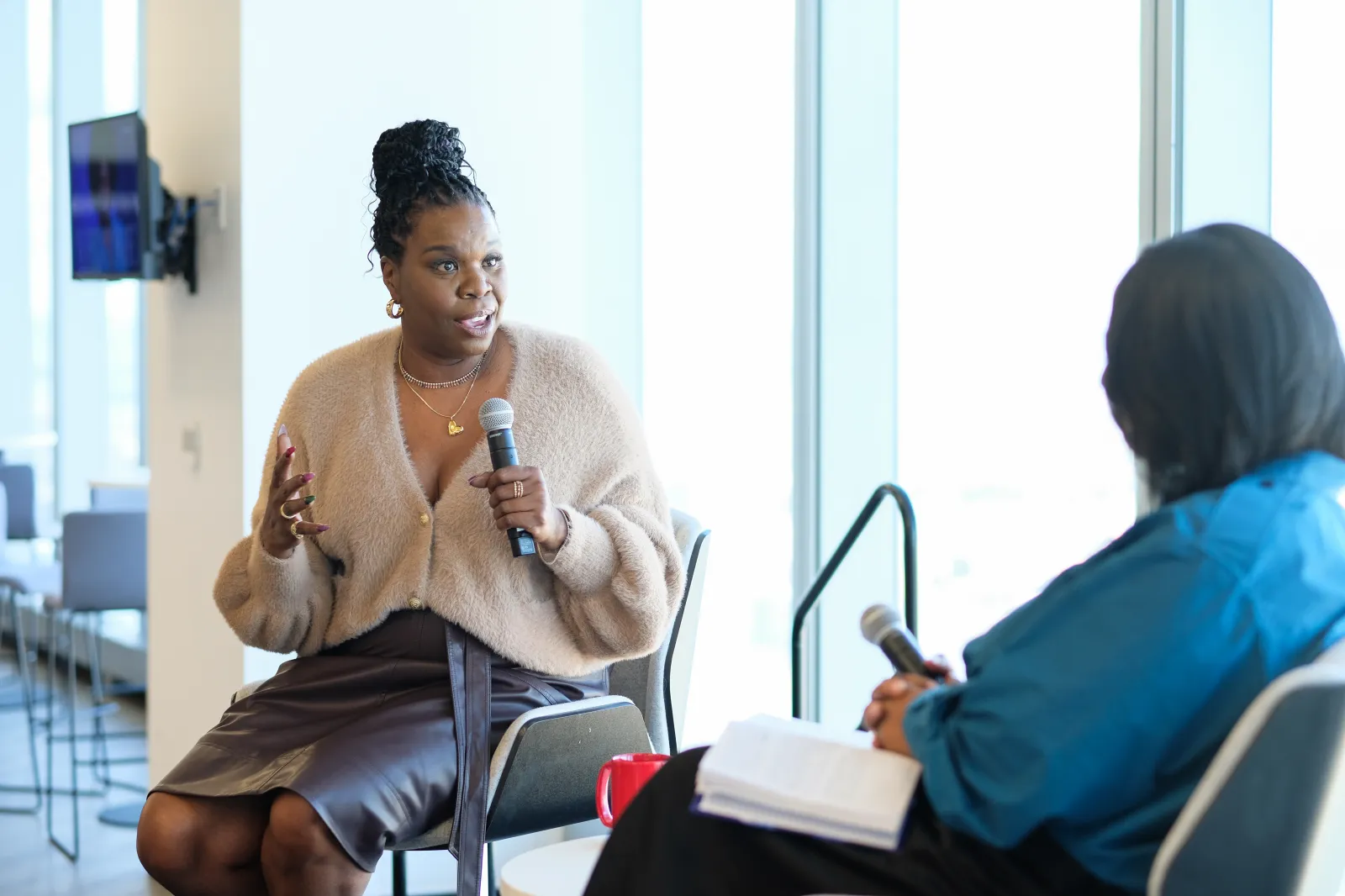
One of the few things that might rattle Leslie Jones? Heights. Still, like many obstacles in her career, she overcame it on Wednesday as she clung onto the stage’s railing 72 floors up at One World Trade to join Newsweek editor-in-chief Jennifer Cunningham for a conversation about her storied comedy career.
Jones describes her comedic voice as “loud, very loud,” and was one of the first women to break into her genre of comedy filled with cursing, wit, confrontation and vulgarities. She told Newsweek that her voice and style haven’t changed over her career, noting that if anything, “I've just become more vulnerable on stage and more open to talk about more personal things.”
Jones' new comedy special, Life Part 2, premieres on Friday, October 24, on Peacock.
Read More on Entertainment
Women in Comedy
“I’m going to be a comedian,” Jones said to herself when she was at Colorado State University. Nearly failing out of school with a 1.7 GPA, which led her to lose her scholarship and be red-shirted on the basketball team, Jones attended a comedy show and decided stand-up was exactly what she wanted to do. But, dropping out of college to pursue her comedic career, Jones’ journey to comedic success was difficult at times.
“I don’t think it is now, I think when I first came out it was [harder]” for women to have blue comedic material, Jones said, adding that “I think now it's more open for us to be just as dirty as the men.”
Jones came running out the gate into the comedy world.
“I was confused why men thought that they were the best," she said. "I was fighting with people all the time,” in an effort to garner respect, be heard, and battle misogyny.
She recited moments of frustration when she would be in a writer’s room, and she would give an idea that either no one would hear or would blatantly ignore, and then someone else would say it, getting the credit.
...
“I’d call them out,” she said. But she noted that at times, that comes with some negative connotations and a double standard, stating, “now you raise your voice, you get a little rough, now you a crazy black b****,” but when male members do it, “they’re so f****** boss.”
The hurdles for women in comedy, especially earlier on, are not lost on Jones.
“Whenever they say glass ceiling, I'll be like what ceiling is glass for a f****** woman? It's not glass, if it was glass we would be in a whole different place now wouldn't we? The f****** ceiling is made out of god**** cinder block. I done broke my f****** back a couple of times going through that motherf***** and that's real talk, real talk,” she told Newsweek.
She said that there’s a sense of quota in the comedy world.
“This is the thing that used to drive me crazy, is that if you are funny, they automatically take you, put you on this list, right? But they won't hire no other women," Jones said. "So, they would call me for a gig and I'd be like, ‘I'm booked, but let me give you some other women.'” Then, they wouldn't take them.
In addition to pushing to be included in stage lineups and receive equal pay, Jones noted that one of the biggest challenges for women comics is safety, recounting stories of showgoers coming to her hotel door.
Jones believes age is an irrelevant, undefining number for one's career, saying, “It shouldn’t matter what age that I got it—its that I got it."
She called out the industry's age bias and fixation, saying, "We gotta stop that as an industry because a lot of people give up” prematurely because they have internalized the rhetoric that age is a professional limiter.
Her advice for up-and-coming comics is to remember that the industry is hard, and “just because you did well one night, don’t think that your lessons are not coming, because music, comedy, acting, all that stuff is an entity, and you are not better than the entity. You are not better than comedy.”
Not Giving Up
While Jones took a brief break from comedy right after starting, mainly at the advice of her idol Jamie Foxx, who emphasized that you need life experience to do comedy, she hasn’t broken since, despite daunting times.
More than 10 years ago, fresh off a difficult gig and after her Saturday Night Live audition, Jones was convinced she wasn’t going to get it.
“So I just remember sitting in the hotel and my manager was like yeah they’re gonna go with Sasheer Zamata…I just knew that they was gonna pick her. So I was sitting at the end of the bed and I was like, you can’t keep doing this sh**.”
At the moment, she contemplated calling her aunt and finally going ahead and getting “that government job” that she had been trying to push on Jones. Instead, Jones took a beat—she took a shower, ate, got some rest and then woke up the next day, reminded that comedy is "what she knows" and what she loves.
“When you're feeling like that, if you know that this is what you're supposed to do in life, if you feel it from your heart, there is no real giving up. There's frustration, there's letdowns, there's disappointment.” Jones said. “So me at home quitting would have been harder for me to do that than to just go through what I wanted to go through, and you have to realize that in everything you do."
“I knew I was funny. I knew they needed me,” at SNL, Jones said, emphasizing the importance of believing in herself and persistence.
Three days later, Lorne Michaels called Jones to join the team.
Future of Late Night TV
Amid the ongoing cancellations and postponements of late-night television shows from Stephen Colbert to Jimmy Kimmel, Jones doesn't think that late-night television's fate is doomed, but "there's got to be a change."
"When you look at late night, all you see is white men in blue suits," she said, adding, "And I'm not saying that they're not bomb, I love Jimmy, I love Seth [Meyers], I love Stephen Colbert, but it's all that we've ever seen."
"We need to start feeding joy to people," Jones said, adding that "people gravitate to great shows that have heart and actual passion and live people."
In Jones’ view, the late-night "shake-up" includes "better writing," a woman host—ideally a Black woman like herself—and more “love coming through the TV.”
When asked about the new season of SNL, "when you leave SNL, you don't pay attention to what's going on," Jones said, noting that while she doesn't know all the cast members, "I do know that they don't have a Black woman on there, that's one thing that I have paid attention to."
Update 10/23/25, 3:53 p.m. ET: This article was updated for clarity.
View 0 Comments
Submit Correction
View Editorial & AI Guidelines