
By Kyle McGovern
Managing Editor, Newsweek Events
0
Share
Newsweek is a Trust Project member
See more of our trusted coverage when you search.Prefer Newsweek on Googleto see more of our trusted coverage when you search.
Ethan Hawke had to wait about a decade to begin filming his latest role. Blue Moon stars Hawke as a fictionalized version of Lorenz Hart, the brilliant lyricist who worked alongside composer Richard Rodgers before Rodgers teamed up with Oscar Hammerstein II. In this less well-known partnership, Rodgers and Hart wrote Great American Songbook standards like “My Funny Valentine,” “Manhattan” and the titular “Blue Moon.” And the film itself is the latest outgrowth of another long-running creative partnership—between Hawke and director Richard Linklater. Opening nationwide October 24, Blue Moon marks their ninth feature-length collaboration and the first since 2014’s Boyhood. Despite the lengthy layover, “We’ve been talking about making this movie that whole time,” Hawke says.
The idea for the film dates back a dozen or so years, when screenwriter Robert Kaplow originally brought the concept to Linklater. At the time, the filmmaker felt Hawke was too young to begin production; Hart was a longtime alcoholic and Blue Moon focuses on a specific moment near the end of the songwriter’s life, just months before his death at the age of 48 following a pneumonia diagnosis. After years of workshopping the material with Kaplow and periodically checking in with Hawke, Linklater finally gave the go-ahead. But even though Hawke had aged into the role of Hart, he still had to stretch to channel the weathered veteran of musical theater.
“As actors, we’re only as good as our opportunity, and I knew this was a great opportunity and that it was going to push me to the wall of my talent,” the 54-year-old tells Newsweek. “I would never be good enough to do the part justice. The part could always handle more.”
Read More on Entertainment
...
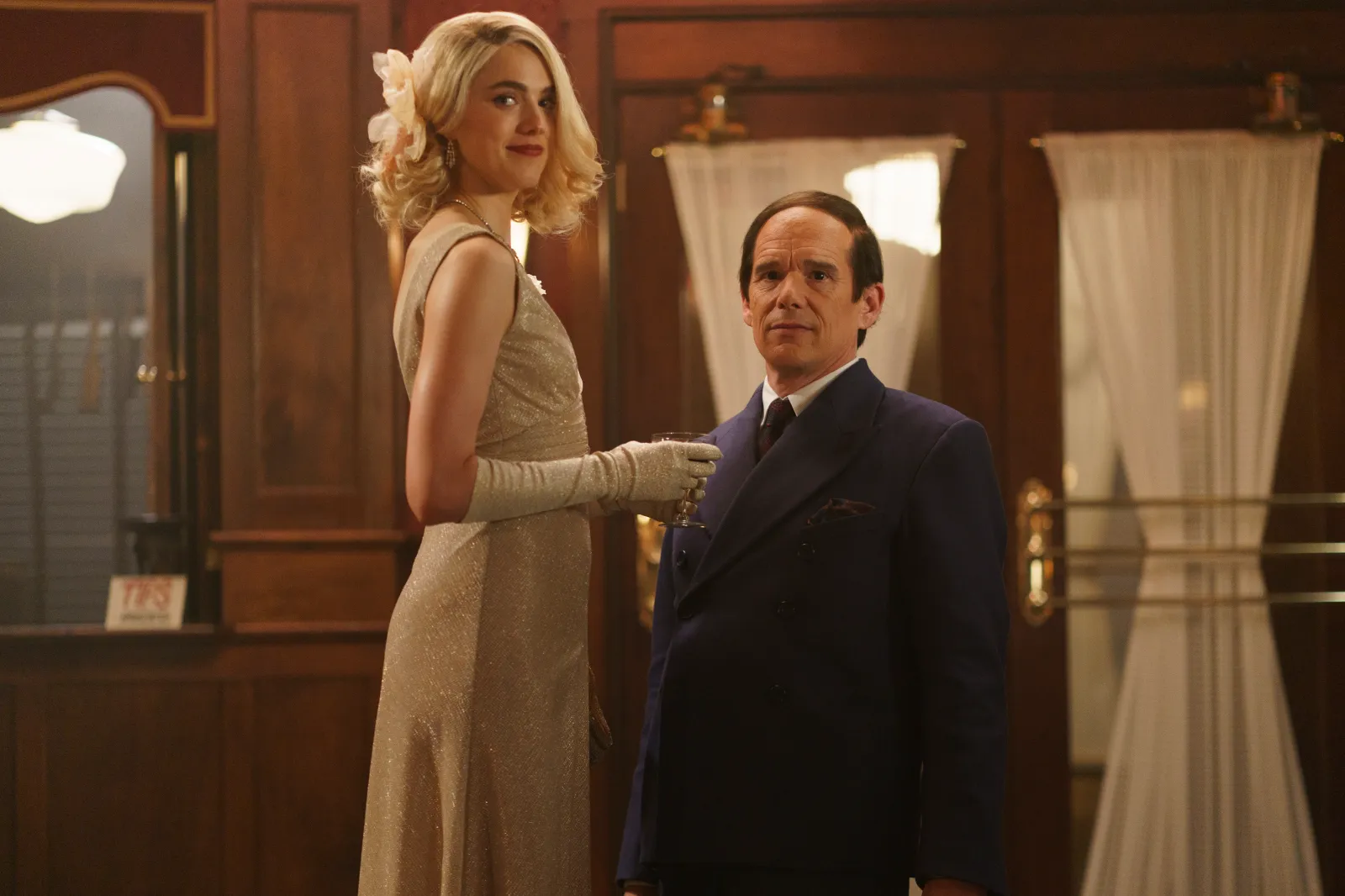
Hawke renders Hart as the most erudite barfly to buzz around mid-century Manhattan. He’s the type to trade salacious anecdotes in public, crawl into a bottle of bourbon and then emerge with either a soliloquy about the crumbling of audience standards or a turn of phrase that would’ve fit neatly into one of the classic tunes he and Rodgers spun up. The dense and demanding script requires a lot from Hawke, who is rarely out of the frame—and who appears, with the help of a shaved head and plenty of stagecraft, as balding and 5-foot-nothing.
“The downside of [Linklater’s] process is you have to be patient. The upside is you have plenty of time to prepare,” Hawke says. “I think the hardest aspect of it was, it all takes place in 90 minutes of real time at a party at Sardi’s. So, once we started rolling, there were no delays for location. There’s no delays for weather. The camera was always ready. The question [was], was I always ready?”
Despite being filmed in Ireland, Blue Moon indeed takes place almost exclusively at a re-creation of the iconic Theater District watering hole and unfolds over the course of a single night in 1943: the premiere of Oklahoma!, the first collaboration between Hart’s former songwriting partner, Rodgers (played by Andrew Scott), and Rodgers’ new lyric man, Hammerstein (played by Simon Delaney). Needless to say, the show is recognized as an instant triumph, and Hawke’s Hart can sense he’s being left behind. He realizes that his creative peak is past him, while undiscovered heights lay ahead for Rodgers and Hammerstein. In between bickering with Rodgers and pining for a young would-be protégé named Elizabeth, played by Margaret Qualley, Hart gossips to the bartender—Eddie, portrayed by Bobby Cannavale—and begs him for just one more pour.
Newsweek spoke with Hawke about the making of Blue Moon, the dynamics of his friendship and working relationship with Linklater and the prospect of awards attention. This conversation has been condensed and edited for clarity.
When the idea for the movie was first discussed 12 years ago, Linklater said you were too young to play the part. When he did finally give you the thumbs up, was there any part of you that was looking at him, like, “Are you trying to tell me something, man?”
Absolutely. The good news is you’re old enough to play Lorenz Hart. The bad news is, you’re old enough to play Lorenz Hart. Yeah, there’s a certain…I’m not playing the ingenue anymore.
What about the project spoke to you originally?
It’s a howl into the night. Every human being has wrestled with the green-headed demon of jealousy. All of us have felt that life might be leaving us behind, and the best days are behind us. I just felt like I knew this guy.
Robert [Kaplow] gave me this amazing book, A Ship Without a Sail...kind of the definitive biography of Lorenz Hart. He’s such an interesting person. It’s almost like being with [John] Lennon and [Paul] McCartney the night they break up, knowing that one of them is going to go on to create a band even bigger than the Beatles and the other’s going to die.
This might be a bit of a silly question, but, was it difficult to shave that head of hair?
No, it was easy to shave it. What was hard is to live with it. Getting coffee in the morning when you look like Bozo the Clown. Ultimately, it actually helped me because in other movies, Rick and I, we're really good friends. We would go out on the weekends or socialize. I didn't do anything but work on this. Bobby Cannavale was essential. He would come to my apartment on the weekends and just run lines with me all day long. It was boring as hell, but it was required.
"All of us have felt that life might be leaving us behind, and the best days are behind us."
The appearance of your height is a big talking point and also key to the character. I know that that was done with stagecraft, or was there something you had to do physically?
Every trick you could possibly think of, from camera angles to perspective to trenches dug in the floor, to whole shots designed around it. The history of film has been built on making men look taller than they are. And ultimately, it's really hard because people know I'm not 5 feet tall. So it's kind of like doing a magic trick when people know you're doing [one]. They don't believe there was a rabbit in your hat because they know you don't have a rabbit. You just have to make it fun to watch the magic trick.
This is the first film that you and Linklater have released together since Boyhood. Was it easy to slip back into that working relationship?
Forty-four to 54 goes by a lot faster than 24 to 34. In fact, it shocked us when we got to set and somebody said, “Wow, it’s been 10 years since you guys were on set together.” I was like, “Wow, that went fast.” We’ve been talking about making this movie that whole time. I think that he’d given me [the script for] Blue Moon before Boyhood had wrapped.

...
Was there anything new about Linklater as a filmmaker, or his process, that you observed when you got back on set with him?
When I met him—he's probably just turning 30—he was fully developed, he was fully mature. One of the remarkable things is how little he's changed. Success doesn't rattle him, failure doesn't rattle him. He is a great friend to have that way. He is more experienced now, and he knows his way around a set backwards and forwards. You could liken it to having a captain of a ship, and he's just sailed this water. It's just great leadership.
Obviously, this is a film about a creative partnership ending. And it seems like you and Linklater have a great friendship and such a great partnership, but I have to ask: Is there even a teeny-tiny part of you that gets a little possessive when you see him sparking with somebody else? Are you ever like, "I've got my eye on you, Glen Powell?"
No, you know, if I was to be totally honest, I’ve crossed that bridge already. [A] Scanner Darkly, when he worked with Keanu [Reeves], I was like, “F***, what are you doing?” And then I learned that friends are harder to find than work. And I went to the opening night of Scanner Darkly, and I loved Keanu, and I could see that Rick learned a lot from that experience and he’s my friend. We’re not like Rodgers and Hart or Lennon and McCartney, or these people who only work together. He benefits from my collaborations with other directors, and I benefit from his collaborations. But I’d be lying if I didn’t say when I was younger, I was like, “What?”
What is it that makes for such an enduring and fruitful partnership? Why do you and Linklater click so well?
Sometimes it's things grandma would tell you. “Do you have a lot in common?” We're both from Texas, our fathers were in the insurance business. We both come from a divorced background. We both love sports and movies. We have a lot of shared interests that make friendship easy. You know, when something's working, you try not to think about it. It's like trying to think about how to ride a bike. You fall on your ass. It's just fun and it seems to work, so I'm going to keep riding it.
Is there any chance that there will ever be a Before Twilight [to follow Linklater, Hawke and actress Julie Delpy's Before movie trilogy of Sunrise, Sunset and Midnight]?
Where Jesse and Céline are vampires? There’s something to me about those three films that feels complete. They really work as a unit together, and I feel happy about that. It wouldn’t surprise me at all if we did another one. I just have a feeling it would be somehow outside that trilogy. It would be a new chapter, it would be the After series or something. But I could completely imagine revisiting Jesse and Céline.

...
For a performance like this, when the tremors of awards speculation begin, how are you receiving that at this point in your career? Is part of you a little daunted, like, "Oh man, that's a marathon," or are you like, "I am interested in taking on that challenge, of being an ambassador for this production"?
Everybody likes to get compliments and have laurels on their chest. I don't know a human being that doesn't enjoy a peacock feather. But, in truth, the way the business has changed in my lifetime is, especially in independent film, if you want to get a film seen, [awards are] an avenue that can work. And one of the very few avenues open to independent film is to think of yourself as an ambassador for the film. That whole film production was geared toward Larry Hart. Everybody understood that we were actually doing a portrait of Larry Hart. Margaret's performance, Bobby's performance, Andrew's performance, in the old-fashioned [sense of the] word, they’re supporting performances, they're heightening my performance. They were all invaluable. And I was so grateful to have them. What you just said is the way that I would look at it, is to be an ambassador for the movie and this kind of movie.
In independent cinema today, you have to have a bit of a rebel streak. We're not playing toward a preexisting algorithm. It doesn't fit into any neat box—not even the awards box. There's a lot of people that are going to have big campaigns, and they're going to spend a lot of money on it and that's not going to happen [with this one]. But if we could get the right people to love the movie, awards are a great way to tell people the movie exists and it's worth their time.
View 0 Comments
Submit Correction
View Editorial & AI Guidelines