
10
Loading video...
By H. Alan Scott
Senior Editor
0
Share
Newsweek is a Trust Project member
See more of our trusted coverage when you search.Prefer Newsweek on Googleto see more of our trusted coverage when you search.
...
Andrew Garfield has never shied away from work that says something. Whether it's The Social Network, Under the Banner of Heaven or the upcoming Artificial, where the Oscar-nominated actor will play OpenAI CEO Sam Altman, Garfield has spent this stretch of his career gravitating toward roles that carry a message. "I think everyone's just called to different things," he tells Newsweek’s Parting Shot podcast.
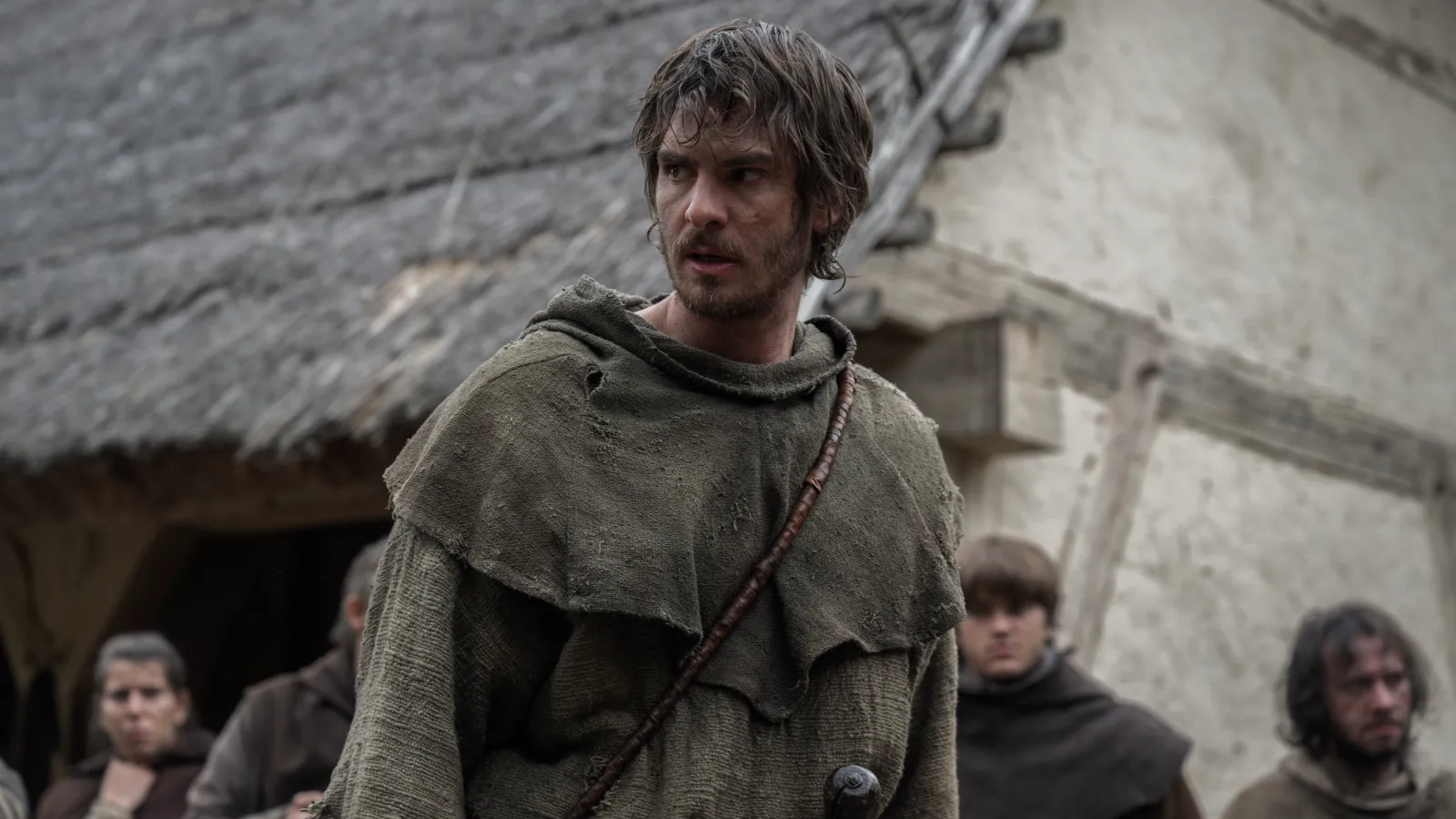
His latest film, The Uprising, is no different. A movie with a layered message about modern-day realities despite being set in the wake of the Black Death, Garfield plays a nameless ploughman in 1381 England who, like his contemporaries, is struggling economically under the oppressive rule of King Richard II. Fighting back against excessive taxation, the ploughman's actions inspire a revolt in this reimagining of the origin of the legend of Robin Hood.
Read More on Entertainment
Garfield sees the ploughman as more than one man's story. "It feels very, very prescient for today," he says. "What's wonderful about that aspect of the film for me is that it's an everyman's story. It's all of us in some secret and maybe not-so-secret way, longing to reconnect to life, to reconnect to the kind of wellspring source of life, which can be found in nature, which can be found in the flow of a river, which can be found in the hot springs coming from the Earth."
Anyone watching the film, directed by Paul Greengrass, will see the parallels to the economic struggles of modern day, and that's because in many respects the story of Robin Hood has always worked as a perfect allegory for times of financial turmoil. When prices soar, inflation hits and gas prices rise, it's hard not to place blame on those in power, on the rich, on the powerful. We may not have a modern-day Robin Hood, but films like The Uprising give us a reason to spot injustices and hold those in power accountable, and Garfield argues the accountability has to start somewhere other than the top.
"Looking to political leadership, those in power, for some kind of true recalibration and restoration of justice, restoration of meaning, of belonging, is a fool's errand," he says. "Change, it's burgeoning, it's emerging, it deeply is beginning and must [begin] in the individual. We start building something new from the outskirts in. That is not where soul and meaning and belonging and a reconnection to each other and to ourselves is going to be found. It's going to be found within ourselves first and foremost, and then if enough of us bring that deep self to the center, then we can start again."
It's these "message films" that Garfield has no plans on stopping, although they aren't necessarily his motivation. "It's mysterious to me," he says. "Paul Simon would say sometimes you can write a song about a sweater, sometimes you write a song about a revolution, sometimes you wrote a song about oppression, Venezuela, but sometimes it's just about a sweater. And I love that, but I'm also like, oh, I wish I could write a song about a sweater. So I don't struggle with it."
Just like the ploughman in The Uprising, Garfield didn't start out looking for an uprising. It just landed at his feet. The same could be said of his own work. He's just responding to the culture around him, going wherever the story takes him.
"I'm always trying to go, 'What's my note?" Garfield says. "I don't know if I'm doing it, but I definitely can feel it when I'm on the right track. And this is a project that feels very much a note that I wanted to sing."
View 0 Comments
Submit Correction
View Editorial & AI Guidelines