
...

By Sam Stevenson
Associate News Editor
0
Share
Newsweek is a Trust Project member
See more of our trusted coverage when you search.Prefer Newsweek on Googleto see more of our trusted coverage when you search.
A bipartisan Wisconsin panel has found probable cause that Elon Musk may have violated state election laws by offering million-dollar payments tied to voting, setting up a high-stakes legal test of money, speech and democracy.
Prosecutors must now decide within weeks whether to bring criminal charges that could test the limits of campaign finance and First Amendment protections.
Musk, his political action committee, and election-law enforcement nationwide could face a precedent-setting outcome shaping how money can be used in campaigns.
Read More on News
Newsweek reached out to Musk via email to Tesla and SpaceX on Wednesday morning.
Key Points
- The Wisconsin Elections Commission voted 5–1 to refer complaints against Musk to prosecutors, finding probable cause that he violated election bribery law.
- The case centers on $1 million payments and other incentives linked to the 2025 Wisconsin Supreme Court election.
- Prosecutors have 40 days to decide whether to bring criminal charges.
- The race itself broke national spending records, topping $100 million, with Musk-linked groups contributing tens of millions.
- Liberal candidate Susan Crawford defeated conservative Brad Schimel by about 10 percentage points.
Why It Matters
The decision came from a bipartisan commission, underscoring the legal seriousness of the allegation. At stake is whether financial incentives tied to political participation cross the legal line into vote-buying under state law.
...
The Legal Case Against Musk
At the center of the dispute is Wisconsin’s election bribery statute, which makes it illegal to offer “anything of value” to induce someone to vote, not vote, or support a candidate.
The Wisconsin Elections Commission concluded Musk’s conduct may meet that threshold.
According to the complaint, Musk posted on social media offering $1 million to individuals tied to voting in the state’s 2025 Supreme Court election “to induce them to vote.”
The law is broad. It defines “anything of value” as money or goods above a nominal threshold and explicitly prohibits using such incentives to influence whether or how someone votes.
If prosecutors pursue the case, the alleged conduct would be charged under a statute classified as a Class I felony, carrying a potential penalty of up to three and a half years in prison, a fine of up to $10,000, or both.

...
What Musk Actually Did
In the days before the April 2025 election, Musk and his political action committee, America PAC, announced and distributed large cash incentives tied to political participation.
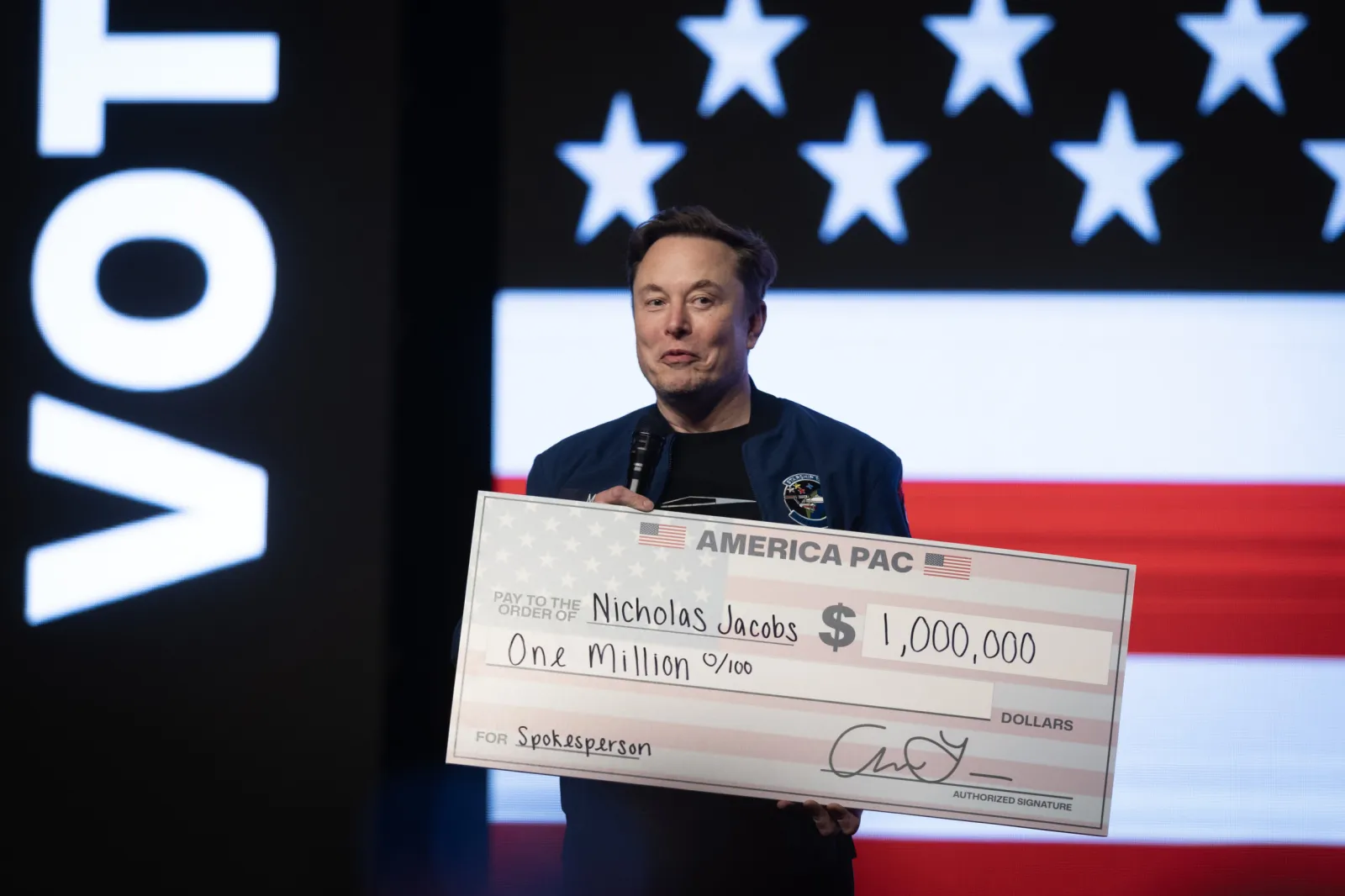
Three Wisconsin voters ultimately received $1 million payments, including at least two who were presented checks at a rally in Green Bay.
The initiative was part of a broader effort by Musk-backed groups, which also offered smaller payments—such as $100—to individuals who signed petitions opposing “activist judges” and referred others to do the same.
Critics argue that tying money to actions that require voter eligibility or participation effectively creates a financial incentive linked to voting behavior.
Musk and his allies have countered that the payments were tied to petition activity and political advocacy, not voting itself.
Political Speech or Vote Buying?
Musk’s legal team has framed the initiative as protected political speech under the First Amendment.
That argument hinges on how courts interpret the nature of the payments:
- If the money is seen as compensation for advocacy or petition signing, it may fall within protected political activity.
- If it is interpreted as an inducement to vote—or to reward voting—it could violate state law.
This distinction has been debated in similar controversies. Linking cash to voter registration or petition participation can approach or cross legal boundaries, particularly when eligibility depends on voter status.
A $100 Million Race
The legal dispute cannot be separated from the unprecedented scale of the election itself.
The April 1, 2025, Wisconsin Supreme Court election became the most expensive judicial race in U.S. history, with more than $100 million spent.
Musk was one of the largest contributors, with his network of PACs and affiliated groups spending tens of millions to back conservative candidate Brad Schimel.
Despite that investment, Schimel lost decisively. Susan Crawford won roughly 55 percent of the vote to Schimel’s 45 percent, a margin of about 10 percentage points that preserved a liberal majority on the court.
The election also drew unusually high turnout for a spring judicial contest, with more than 2.3 million ballots cast—another signal of the race’s national significance.
Why The $1 Million Giveaway Caused Alarm
What made this case unusual—even by modern campaign finance standards—was the scale and structure of the incentives.
Traditional campaign activity includes spending on ads, canvassing, and voter outreach. Offering direct cash payments to individuals tied to participation in an election is far rarer and raises immediate legal red flags.
Election law distinguishes sharply between encouraging civic participation and offering material incentives to influence it. Wisconsin’s statute reflects that line, explicitly banning payments aimed at inducing electoral behavior.
For critics, the $1 million checks represented a step beyond persuasion into direct inducement. For defenders, they were a novel form of political engagement designed to generate attention and activism.
...
5 Possible Outcomes
1. No Charges Filed
This is the most immediate decision point.
The Elections Commission cannot prosecute; it can only refer cases. The Brown County District Attorney will decide whether the evidence supports criminal charges.
Prosecutors may decline if they believe the case would be difficult to win or risks infringing on constitutional protections.
The ambiguity around whether the payments targeted voting or petition activity could weigh heavily.
2. Criminal Charges Brought
Prosecutors could pursue a felony case under Wisconsin’s election bribery law.
That would not mean Musk is guilty—it would simply initiate a criminal proceeding that could test the boundaries of election law in court.
Given the statute’s penalties—up to three and a half years in prison and financial fines—the stakes would be unusually high for a political spending dispute.
3. Charges Filed, Then Dismissed
Even if prosecutors act, courts could throw out the case.
Judges might find:
- The payments were not conditioned on voting
- The statute does not apply to the conduct described
- Or the law, as applied here, violates First Amendment protections
Courts often scrutinize election laws closely when they intersect with political speech.
4. A Lengthy Constitutional Battle
A prosecution involving one of the world’s wealthiest political donors would likely trigger a protracted legal fight.
At issue would be core constitutional questions:
- How far can the government regulate incentives tied to political participation?
- When does campaign spending become unlawful inducement?
Legal scholars have increasingly warned that innovations in campaign tactics are outpacing existing law. This case could force courts to clarify those boundaries.
The timeline could stretch months or even years, especially if appeals reach higher courts.
5. Civil Cases Continue Regardless
Separate lawsuits are already underway challenging the legality of the payments, including claims that they may constitute an unlawful lottery or violate election statutes.
Even if criminal prosecutors decline to act, those civil cases could proceed and produce rulings that shape future campaign conduct.
Could This Set A Precedent?
This case may ultimately hinge less on Musk personally and more on the broader system.
If prosecutors decline or courts rule the payments are protected speech, it could open the door for similar tactics—effectively normalizing large-scale financial incentives tied to political engagement.
If the conduct is deemed illegal, however, it could establish a clear limit on how far wealthy donors can go in directly incentivizing voters.
Given the increasing role of state supreme courts in deciding national issues—from abortion rights to election disputes—the stakes extend well beyond Wisconsin.
What Happens Next
The Brown County District Attorney now has 40 days to determine whether to bring charges.
That decision will shape the immediate trajectory of the case. But the broader legal and political debate—about money, influence, and democracy—will likely continue regardless.
At a moment when outside spending is reshaping judicial elections, the outcome may define the rules for the next era of campaign strategy.
View 0 Comments
Submit Correction
View Editorial & AI Guidelines