...

By Anna Rahmanan
0
Share
Newsweek is a Trust Project member
See more of our trusted coverage when you search.Prefer Newsweek on Googleto see more of our trusted coverage when you search.
For Elisha Wiesel, son of Holocaust survivor and Nobel laureate Elie Wiesel, the date that changed Jewish life in America was not October 7, 2023; it was October 8.
“I think, to me, October 8 is the real pivot in antisemitism in this country,” Wiesel told Newsweek. “That’s the moment when all our friends and neighbors and people we thought were allies switched from understanding that Jews were under physical attack to seeing us as the enemy.”
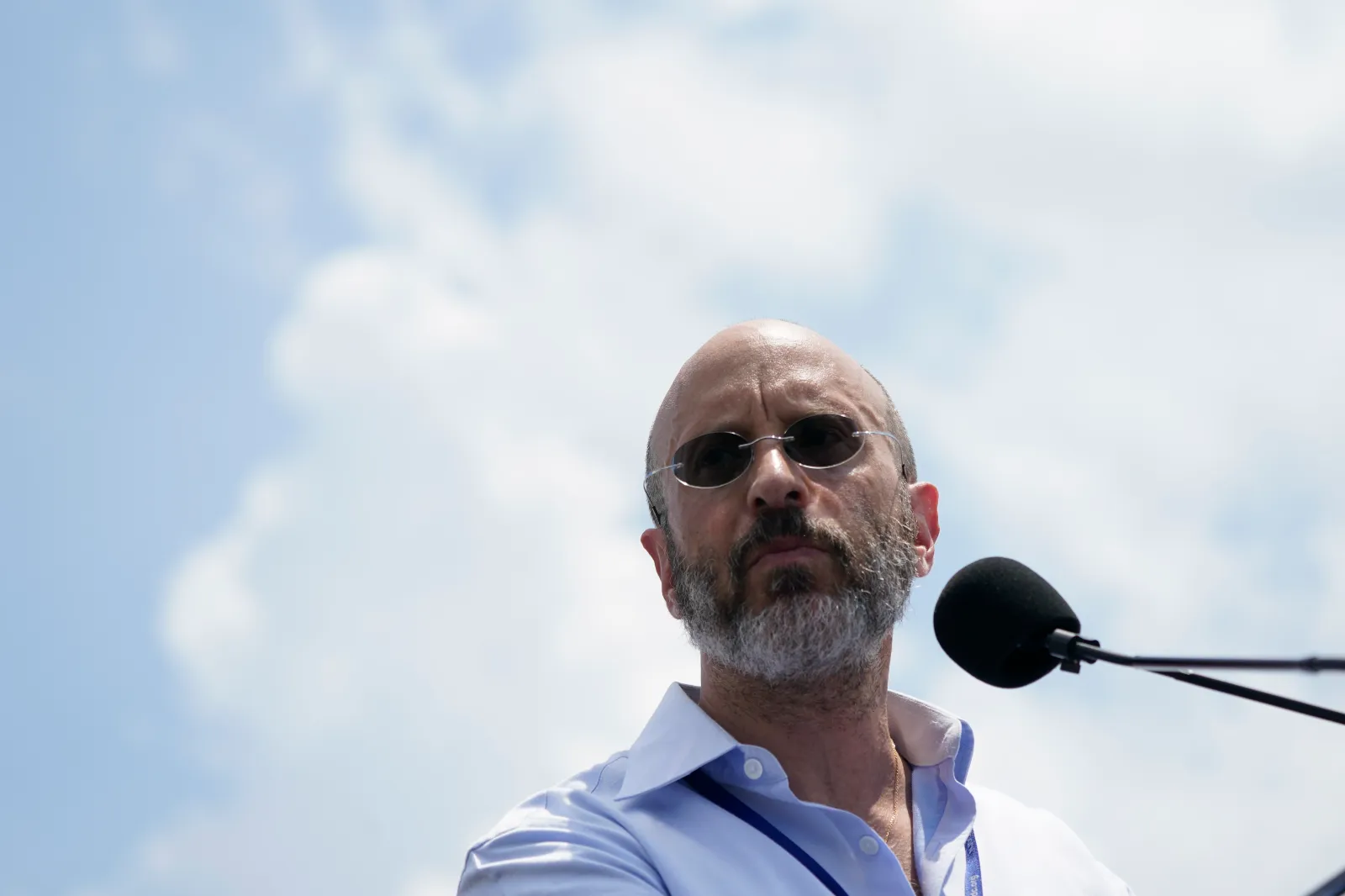
Wiesel spoke to Newsweek on the afternoon before the 2026 Elie Wiesel Prize in Ethics Awards Ceremony, held Tuesday night at the Mandarin Oriental in New York City. The annual prize asks young people to wrestle with questions of conscience, responsibility and moral courage—the ideas around which his father built much of his life’s work.
Read More on News
This year’s theme, “Silence, Conscience, and Responsibility,” makes the timing particularly fitting: Elisha Wiesel believes the years since October 7, when the Palestinian militant group Hamas attacked southern Israel, killing 1,200 people and taking over 200 hostages, have revealed not only a resurgence of antisemitism, but a failure by some of the people and institutions entrusted with remembering where silence and indifference can lead.
Wiesel has spent much of his life in the shadow of, and increasingly the stewardship of, his father’s legacy. Elie Wiesel, the author of Night, devoted his life to bearing witness to the Holocaust and warning what could happen when hatred was permitted to metastasize alongside indifference.
“My father said antisemitism has never gone away,” Elisha Wiesel said. “But I’ve never seen it like this.”
His diagnosis is stark: “We are less safe than when my father was alive.”

...
What troubles him is not simply the rise in antisemitic incidents, but what he sees as a failure of the very education and institutions that were supposed to make another eruption of antisemitism harder.
“We in the Jewish community went all in with Holocaust education,” Wiesel said. Yet, he argued, the empathy that project cultivated “does not seem to have really translated.”
“They have empathy for the dead Jews, not the living ones,” he said, quoting a line by American novelist and literature professor Dara Horn.
For Wiesel, that contradiction helps explain why October 8 matters so much. October 7 showed that Jews could still be slaughtered for being Jews. The reaction that followed, he believes, showed how quickly sympathy could curdle into suspicion of Israel and, eventually, of Jews themselves.
He describes the accusations now aimed at Israel as part of an ancient pattern.
“Our enemies have always spread lies,” he said, pointing to a piece his father wrote in A Jew Today in 1978 about Jews being accused of the very things done to them. “They attack our children, and we were accused of stealing Christian children in the Middle Ages. They are corrupt and accuse us of being corrupt.”
Now, he said, Jews are being described as genocidal after October 7 (the death toll of Israel's subsequent military campaign in Gaza has surpassed 74,000, according to the Associated Press, citing the Gaza Health Ministry).
Wiesel also thinks Jewish institutions need to become considerably less timid.
“I think this is one of those cases where we have to learn how to help ourselves a little better,” he said.
He pointed specifically to institutions devoted to Holocaust memory, arguing that organizations willing to take moral positions on atrocities elsewhere should not retreat from the contemporary debate surrounding Israel.
“Institutions have to rise to the occasion,” he said.
Related Story

The Righteous Racism of British Greens Is a Warning to America | Opinion
Some of his criticism is directed inward.
Wiesel believes Jewish communities have allowed an increasingly common depiction of Jews as uniformly white and colonial to go insufficiently challenged. Jewish education, he argued, cannot end with Holocaust museums and books about prejudice. Young Jews should be encountering Jewish communities in Israel and around the world and understanding that Jewish identity does not fit neatly into America’s racial categories.
The same concern extends to politics.
“We are also a divided people,” he said.
Wiesel believes the partisan sorting of Israel has increasingly encouraged American Jews to understand themselves through party affiliation before Jewish identity.
“Somewhere between Obama and Trump, it became more and more clear that the Republicans were going to stand with Israel and Democrats were going to question it,” he said, while describing former President Joe Biden as “tremendous for much of his term for Israel.”
“A little bit of what’s happening is that people view themselves through the lens of, ‘Am I blue or red?’ not, ‘Am I Jewish or not?’”
His warning is sharper still: “If you belong to a political party first before you belong to your people or your own country—Democrats first, and then American or Jew is somewhere down the list—then it’s a problem.”
Nowhere has that anxiety felt more immediate to him than on American college campuses.
Both of Wiesel’s children are college age. One was on campus during the wave of pro-Palestinian encampments that followed October 7.
“The environment that was going on had made it more likely, not less, that one of my kids will be making aliyah,” he said.
Wiesel commended the Trump administration for taking complaints from Jewish students seriously, particularly amid encampments and protests that some Jewish students said made them feel unsafe.
“I give a lot of credit to the Trump administration for having a look at what was happening to Jewish students on campus,” he said. “Thank God the Trump administration took their concerns seriously.”
For all of his alarm, though, Wiesel does not speak about October 7 only as a story of Jewish retreat. He believes it also awakened something.
“October 7 was a transformative day,” he said. “It is one of those days, if you had a heart, you will never forget where you were when you first heard the news.”
He remembers frantic calls to relatives in Israel. He normally does not use his phone on Shabbat, he said, but that morning his family needed to know where everyone was. And for his own children, the stories they had grown up hearing suddenly acquired a different meaning.
“Everybody in my family said, ‘Wow, Grandpa was talking about the Holocaust, and this is real. They really hate us, and they will really kill us if they get a chance,’” he said.
Wiesel believes some Jews have responded by distancing themselves. But many others, he said, now understand their Jewish identity more deeply—including his children.
Still, his final thought is not one his father would have found unfamiliar.
“I hope we come out of this massive wave of October 8 antisemitism stronger as a people and stronger as Americans too,” Wiesel said. “I think a whole new wave of activists has been created, and I hope they all find their way to contribute so their kids will be proud of them the same way we were proud of our parents.”
View 0 Comments
Submit Correction
View Editorial & AI Guidelines