...

By James Rushton
Reporter
0
Share
Newsweek is a Trust Project member
See more of our trusted coverage when you search.Prefer Newsweek on Googleto see more of our trusted coverage when you search.
Scientists from the National Autonomous University of Mexico (UNAM) documented a number of changes inside Mexico's El Chichón volcano during monitoring between June and December 2025.
El Chichón's last eruption in 1982 was one of Mexico's deadliest volcanic disasters, killing at least 1,900 people. So any renewed activity at the volcano—even minor, often "harmless" changes—demands close monitoring given its catastrophic history.
What Did Scientists Find Inside El Chichón Volcano?
Researchers from UNAM documented several key changes.
Read More on News
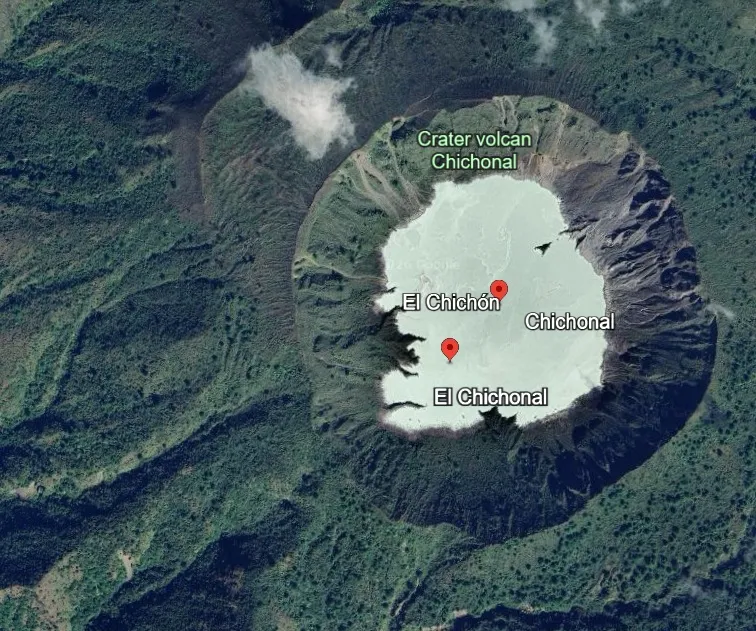
The crater lake: Normally green and filled with algae, the lake turned grayish—indicating higher sulfate and silica content from changing underground fluid circulation.
Temperature increases: The lake bed and crater floor showed elevated temperatures above normal background levels.
Gas emissions: Instruments detected hydrogen sulfide and carbon dioxide accumulating near the crater. While these gases can be dangerous in high concentrations, they're common in hydrothermal systems and don't signal an eruption by themselves.
Strange sulfur formations: Scientists observed unusual hollow sulfur spheres forming in liquid sulfur pools within the crater, highlighting active sulfur deposition processes.
Low seismic activity: Earthquake monitoring showed minimal activity, supporting the conclusion that magma wasn't flowing toward the surface.
...
The Smithsonian's Global Volcanism Program (GVP) has documented El Chichón's long-term crater-lake and hydrothermal variability, providing context that current changes can occur within an active hydrothermal system independent of new magma intrusion.
Volcanologist Patricia Jácome Paz of UNAM said the observations aligned with hydrothermal processes rather than rising magma: "The observed behavior is consistent with hydrothermal processes or minor steam-driven explosions."
In a December 2007 bulletin discussing tremor, gas fluxes and crater-lake dynamics, the Smithsonian GVP described ongoing hydrothermal rumbling at El Chichón's crater as "associated … with the hydrothermal system."
1982 El Chichón Eruption
The 1982 eruption produced powerful explosive activity that devastated communities and infrastructure in southern Mexico, with ash clouds and pyroclastic flows forcing mass evacuations and causing widespread economic and environmental damage.

...
On March 28, 1982, just before midnight, El Chichón exploded without warning, sending ash 20 kilometers (12 miles) into the air. This initial eruption killed 10 people, owing to a church that collapsed during initial earthquake tremors and fires from falling ash. Following that, authorities allowed locals and residents to return.
On April 3 and 4, 1982, two massive eruptions followed at El Chichón, with pyroclastic flows obliterating villages within 8 km of the crater, skyrocketing damages and the death toll.
It is estimated that El Chichón's eruptions in 1982 caused $55 million in damages to crops, homes and industry. The eruptions destroyed nine villages and killed at least 1,900 people.
According to NASA, it is also estimated that the volcanic emissions warmed the stratosphere by 4 degrees Celsius (7.2 degrees Fahrenheit).
Since the 1982 incident, only the 1985 Nevado del Ruiz eruption in Colombia—which killed about 23,000 people—has surpassed the impact of El Chichón's eruption.
The devastation of Guatemala's 2018 Volcán de Fuego eruption is disputed. Official Guatemalan figures list 194 to 201 confirmed deaths and 260 missing. Scientific studies suggest at least 430 deaths, and local estimates run much higher.
Below, using data compiled by the United States Geological Survey and the Smithsonian GVP, Newsweek has listed some of history's deadliest eruptions.
15 Deadliest Volcanic Eruptions in Human History
What Happens Next
UNAM researchers are applying drones, satellite remote sensing and on-site instruments to track thermal anomalies, gas plumes and ground deformation to detect any changes promptly.
Scientists emphasized that while current signals are hydrothermal, volcanoes can remain dynamic for decades after major eruptions, making continuous monitoring essential for hazard assessment and public safety.
The Smithsonian GVP has reported that future activity at El Chichón could involve intracrater processes tied to shifts in lake chemistry, degassing or phreatic explosions, though no such development was indicated in their prior assessments—further underscoring the importance of sustained surveillance.
In a polarized era, the center is dismissed as bland. At Newsweek, ours is different: The Courageous Center—it's not "both sides," it's sharp, challenging and alive with ideas. We follow facts, not factions. If that sounds like the kind of journalism you want to see thrive, we need you.
When you become a Newsweek Member, you support a mission to keep the center strong and vibrant. Members enjoy: Ad-free browsing, exclusive content and editor conversations. Help keep the center courageous. Join today.


View 0 Comments
Submit Correction
View Editorial & AI Guidelines