...

By Carrie Anderson
0
Share
Newsweek is a Trust Project member
See more of our trusted coverage when you search.Prefer Newsweek on Googleto see more of our trusted coverage when you search.
From Union forces deliberately burning forests and fields during the Civil War to the U.S. destroying forests and cropland in the Vietnam War, environmental destruction has been long been used as a means of terror in conflict, as well as a consequence.
The ecological damage caused by war can be vast and enduring, creating cascading socioeconomic consequences, experts say, yet it continues—despite international legal protections.
“Wars cause a much more complex set of environmental harms than most people realize,” said Asmeret Asefaw Berhe, professor of soil biogeochemistry and the Ted and Jan Falasco chair in Earth Sciences and Geology at the University of California, Merced.
Read More on Environment
...
“There’s the physical disruption of soil structure from explosions, and the compaction that comes from heavy machinery like tanks moving across the land. Then there’s chemical contamination from detonated explosives and from unexploded remnants of war, including landmines, which leach heavy metals and compounds like TNT into the soil over time. And all of this is on top of the intentional or collateral destruction of forests, grazing lands and agricultural fields that happens during active conflict,” Berhe told Newsweek.
Neta Crawford, co-founder of the Costs of War project at Brown University and professor of international relations at Scotland’s University of St Andrews, pointed to international legal protections for the environment in conflict, including the Environmental Modification Convention and Additional Protocols to the Geneva Conventions of the late 1970s—the latter prohibiting attacks on infrastructure essential to civilian survival. Current conflicts are testing those protections.
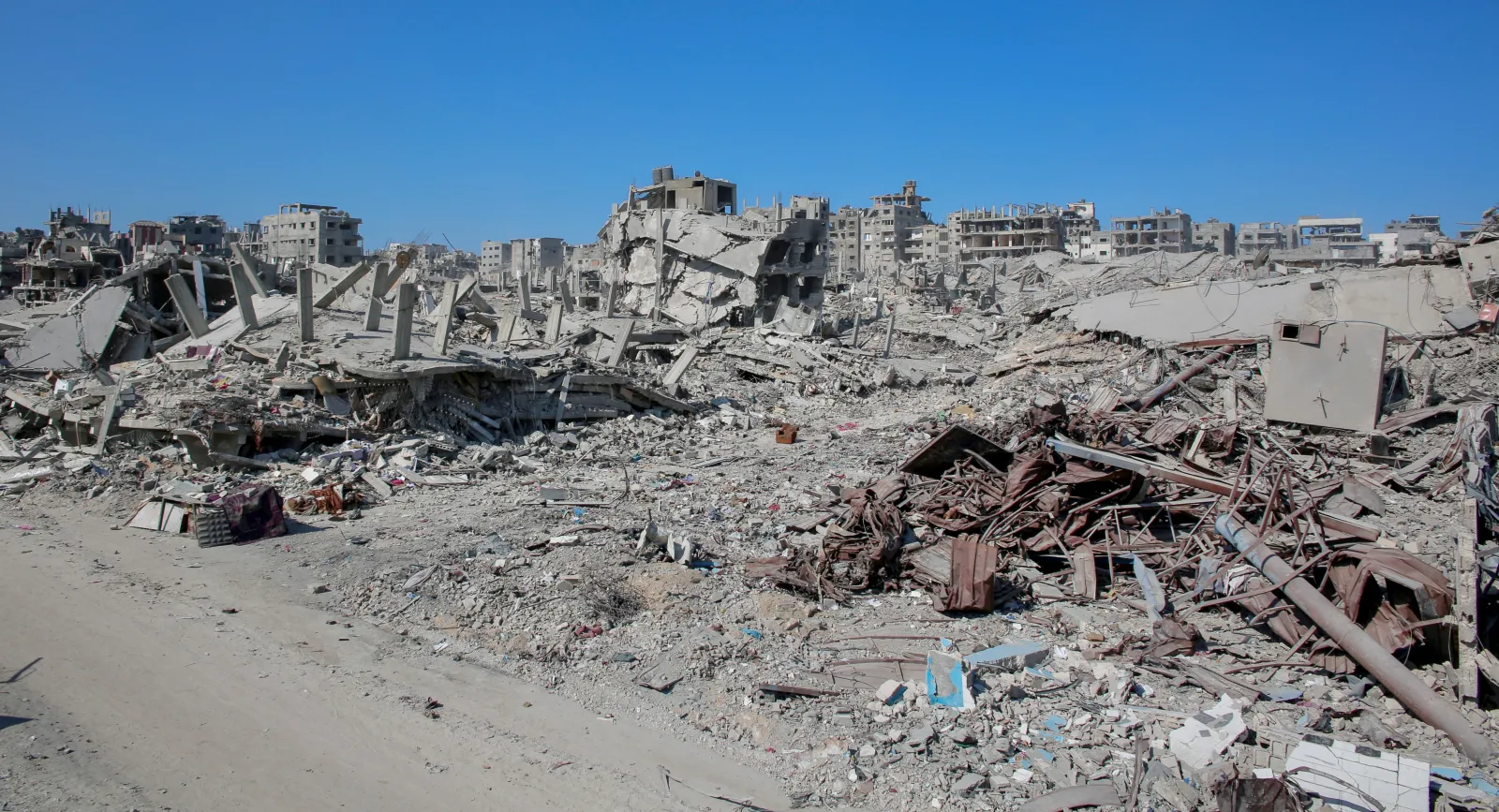
“So you don’t poison wells. You don’t destroy dams. All of that is illegal,” she told Newsweek. “And nevertheless, it happens. The Russians destroyed the [Kakhovka] dam in Ukraine, flooding lots of farmland. I think the key here is that it’s foreseeable, foreseen and sometimes intended…. Weakening your adversary for the next war.” A 2025 assessment by the United Nations Environment Programme—relying largely on remote sensing and satellite imagery—found that by September 1 that year, the escalation of war in Gaza since October 2023 had caused severe and compounding environmental harm.
UNEP estimated that around 78 percent of structures had been damaged or destroyed, producing over 61 million tons of debris, much of it potentially contaminated with asbestos, heavy metals and unexploded ordnance. Water and sanitation systems had collapsed, while the report said that 97 percent of tree crops, 95 percent of shrubland and 82 percent of annual crops had been lost, effectively crippling food production.
In Ukraine, a 2022 UNEP preliminary review documented early damage to industrial, energy and wastewater infrastructure, alongside pollution risks from oil fires, shelling and military debris, and impacts on forests, farmland and protected areas. Subsequent assessments, including a 2023 study of the Kakhovka dam breach, indicate that much of the environmental damage is likely to be long‑lasting or irreversible.
More recent analysis by the Conflict and Environment Observatory shows the toll is deepening in Ukraine. The group monitors conflicts using satellite imagery, open-source intelligence and partner field reporting to document how wars damage ecosystems, infrastructure and the natural resources civilians depend on.
“Every conflict has a different environmental footprint,” CEOBS director Doug Weir told Newsweek. “For Gaza it was the severity of damage, which was akin to a scorched earth policy. Not only the massive damage to urban areas and to environmentally sensitive facilities but also to the life support system for the Strip, including agricultural land, orchards and water infrastructure. In Ukraine, it’s the geographic scale of damage, the damage and disruption to industrial and energy sites, and to the slow-moving destruction of landscapes from a front line hundreds of kilometers long.”
Asked whether a similar scale of damage would likely be observed in Iran, Weir said: “The true picture of damage will take time to emerge. What seems clear is that Iran’s capacity to address environmental harm will be heavily impacted by the war, and it seems likely that the authorities will end up even less open to the conditions necessary for effective environmental governance.”
Toxic Legacies
Berhe has identified five interconnected categories of war-driven soil damage: access denial, loss of biodiversity, microrelief disruption, chemical contamination and loss of productivity. Her research has focused particularly on the environmental consequences of landmines, which “go well beyond the humanitarian impacts they’re usually associated with.”
“Landmines destabilize soil structure, strip away topsoil and vegetation and leave the soil exposed to erosion, all of which drive down land productivity. As munitions and their casings corrode, the chemical contamination can persist for decades…. And weapons that never detonate still cause harm through their presence alone. The fear of landmines prevents people from accessing land they need for farming, water or conservation.”
Globally, she said, landmines are estimated to have denied access to or degraded over 347,000 square miles of land.
And while cities can be rebuilt, the destruction of soil is not so easily reversed. “Rehabilitating or forming new soil is extraordinarily slow. Forming just one inch of topsoil can take over a thousand years,” said Berhe, who has traced these issues across countries including Angola, Afghanistan, the former Yugoslavia, Iraq, Cambodia, Vietnam and Mozambique. “In each case the pattern is consistent: soil structure gets destabilized, livestock are killed, agricultural productivity drops and poverty and malnutrition get worse,” Berhe said.
Dr. Marcos A. Orellana, the United Nations’ special rapporteur on toxics and human rights, also drew attention to the release of substances from buildings affected by conflict. “Hospitals are a poignant example here because they typically hold hazardous medical substances and waste, and through the debris generated from damaged or destroyed infrastructure that contained hazardous materials in the original construction,” he told Newsweek.
“This latter example is apparent in the conflicts in Ukraine and Gaza, where the destruction of buildings has released large quantities of asbestos…into the environment.”

...
One example of enduring toxic effects of war is Vietnam. Between 1962 and 1971, U.S. forces sprayed millions of gallons of herbicides across parts of the country, targeting dense forests and cropland used by North Vietnamese and Viet Cong fighters. The most widely used, Agent Orange, was designed to strip vegetation and destroy food sources—but it contained a highly toxic dioxin byproduct that can persist in the environment. “Agent Orange spray planes and storage depots at three former U.S. airbases left the soil contaminated with dioxin, which became a danger to people in surrounding communities,” Charles Bailey, former director of the Aspen Institute’s Agent Orange in Vietnam program, told Newsweek.
He noted that the U.S. sprayed Agent Orange over an area “nearly the size of Massachusetts,” and veterans and thousands of Vietnamese people still have ill health and disabilities linked to it. “Efforts are underway to clean up the dioxin residue of Agent Orange at former U.S. airbases and neutralize the unexploded bombs that continue to contaminate landscapes and kill people indiscriminately in Vietnam, Laos and Cambodia. All of these postwar efforts are costly and time-consuming and they require cooperation between former combatants,” Bailey said.
“The U.S. full spectrum response to the legacies of the Vietnam war took decades to mount but has now become the foundation of the comprehensive strategic partnership signed with Vietnam in 2023,” Bailey said. “The U.S. began working with Vietnam only in 2007 specifically on the dioxin legacy of Agent Orange.”
Since 2007, Bailey said, Congress has appropriated over $500 million to provide direct assistance to people in eight heavily sprayed provinces and to clean up the heavily dioxin-contaminated soils.
Accountability Gap
One environmental challenge that has been hard to track is emissions linked to war. A study led by climate researcher Lennard de Klerk found that greenhouse gas emissions from four years of Russia’s war in Ukraine reached 311 million tonnes of CO2 equivalent—“comparable to the annual emissions of a country like France,” he told Newsweek. This consists of emissions from factors including military fossil fuel consumption, forest fires, destruction of energy infrastructure, longer flight routes due to airspace closures and postwar reconstruction.
Stuart Parkinson, executive director of Scientists for Global Responsibility, noted that there is a lack of direct data because governments sought reporting restrictions on military emissions under the 1997 Kyoto Protocol. He led a 2022 study which estimated that the carbon footprint of military activities was about 5.5 percent of global greenhouse emissions, with an uncertainty range of 3.3 percent to 7 percent. “However,” he said, “our estimate does not include war-related emissions—so the global total of military and war-related is probably even higher.”
Orellana last year presented a series of recommendations in a report to the U.N. General Assembly on Military Activities and Toxics. Highlighting three of “critical importance,” he said states: must strengthen international and domestic legal and accountability frameworks to protect human rights that are adversely affected by toxic military releases; should explore the possibility of developing “a new international instrument to address toxic remnants of war, which would stipulate responsibilities for states as well as mechanisms for data-sharing, clean-up, remediation and victim assistance”; and should “support the inclusion of the crime of ecocide in the Rome Statute of the International Criminal Court, in a formulation consistent with human rights.”

...
‘Nature is Far More Resilient’
Some analysts are wary of overstating the ecological fallout of war, however. “Modern war can certainly damage the environment, but neither to the extent that activists suggest nor is the damage permanent,” Michael Rubin, director of policy analysis at the Middle East Forum and a former Pentagon official, told Newsweek.
“World War I battlefields like Verdun still show the scars of war, but nature is far more resilient than many environmentalists believe.” And, he said, nature sometimes offers “positive surprises” after conflict: “Sunken ships become the foundation for coral reefs. Decades of civil war in the Democratic Republic of Congo has led to its jungle slowly reclaiming roads, towns and villages that had long ago been cut into it.” Rubin added he has visited dozens of bases across the U.S. while teaching for the Army, Marines and Navy and observed them becoming “mini-refuges for flora and fauna.”
“The real problems are avoidable like burn pits and toxic dumps. U.S. radioactive waste still pollutes parts of Greenland, for example. But while war cannot pause so Greenpeace and the Sierra Club can certify everything is clean, militaries can commit to contribute to clean-up after the conflict ceases,” Rubin said.
For Weir, it’s “primarily an issue of political will.” He continued: “There is legal precedent out there, for example the [United Nations] Compensation Commission following the 1991 Gulf War, but as we are seeing at the moment with the effort to hold Russia accountable for the damage its war is causing in Ukraine, issues like the use of frozen Russian assets are political questions.”
In the meantime, the focus of war will likely continue to be on immediate impacts. “I think it’s a human tendency to focus on lives lost,” said Crawford. “I also think that the environment is a system and it’s complex. If you look at the short run, you might see the consequences of the destruction that the Iraqis did to the Kuwaiti oil fields in 1991 and say, ‘OK…they caused massive oil spills.’
“The complexities of the ripple effects are just harder to imagine.”
View 0 Comments
Submit Correction
View Editorial & AI Guidelines