...


By Hollie Silverman and John Feng
0
Share
Newsweek is a Trust Project member
See more of our trusted coverage when you search.Prefer Newsweek on Googleto see more of our trusted coverage when you search.
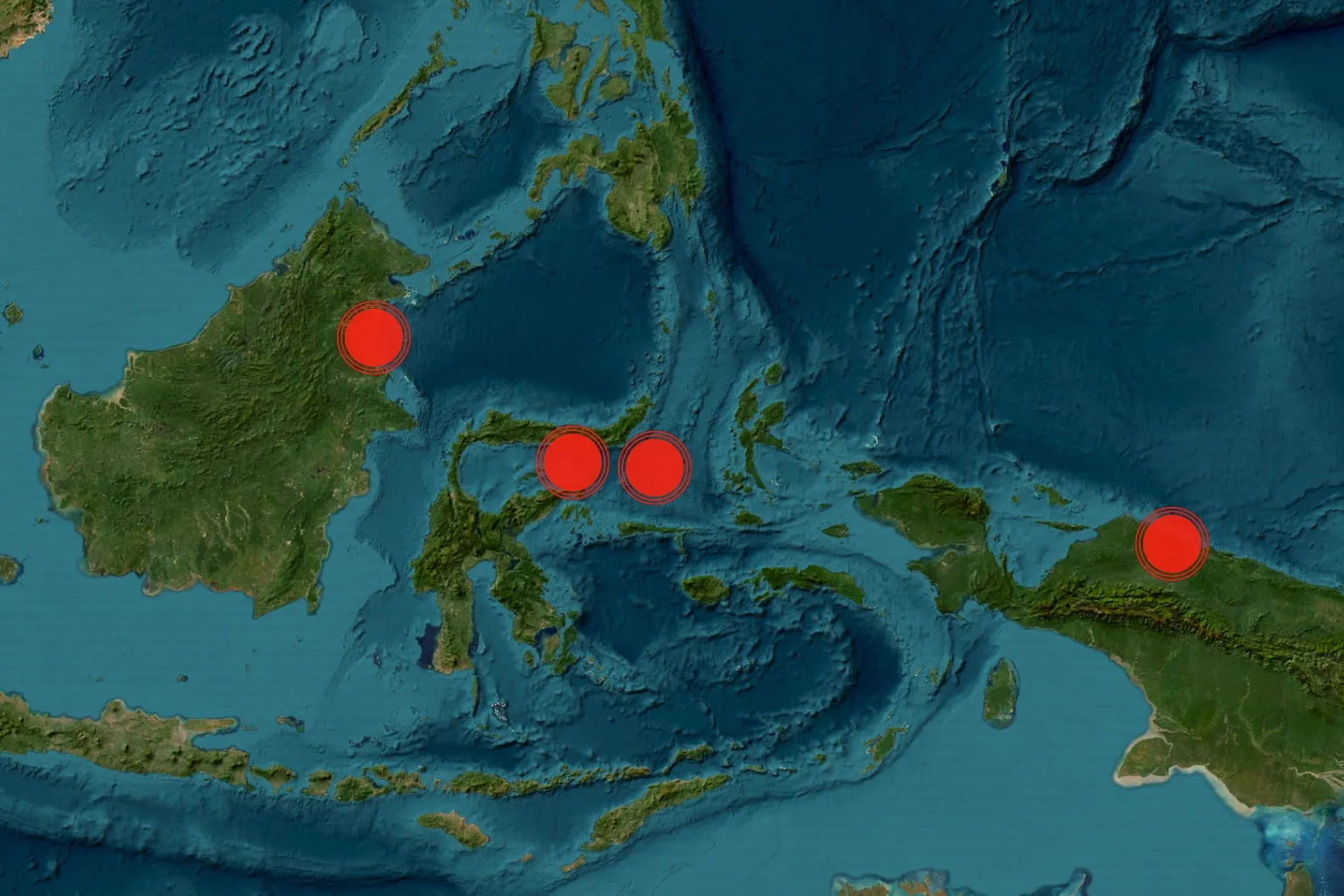
The Indonesian coast was struck by four earthquakes over the past 24 hours, according to the United States Geological Survey (USGS).
The quakes ranged in strength from a magnitude of 4.7 up to 5.9, which is considered a strong earthquake capable of causing significant damage. The 5.9 magnitude earthquake struck late Tuesday, approximately 40 miles, or 65 km, from Gorontalo at a depth of nearly 70 miles, or about 110 km, according to the USGS map.
Another quake struck just two hours earlier at a strength of 5.0 magnitude in the Papua Province of Indonesia, about 110 miles (178 km) west-northwest of Abepura. On Wednesday, two more earthquakes struck the coastline, both at a 4.7 magnitude.
Read More on World
No injuries or damage were reported, and no tsunami warnings were issued.
Why It Matters
Indonesia sits atop the Pacific Ring of Fire, a tectonic zone marked by frequent and sometimes devastating earthquakes and volcanic activity. The country is highly vulnerable due to its position at the convergence of several major tectonic plates, including the Indo-Australian, Pacific, and Eurasian plates.
Indonesia has a history of catastrophic quakes, including the 2004 Indian Ocean disaster, making continuous seismic monitoring and preparedness crucial for minimizing casualties and infrastructure damage.
...
What To Know
The USGS earthquake monitoring map recorded four seismic events along Indonesia's coastline on November 4 and 5.
While the magnitudes and epicenter depths varied between the events, three of the four occurred offshore, limiting the immediate impact on populations but highlighting the area’s constant tectonic activity.
Indonesia’s tectonic complexity results from the convergence of multiple plates.
Most earthquakes occur along subduction zones, where the Indo-Australian Plate dives beneath the Eurasian Plate. These areas can generate powerful megathrust quakes and tsunamis.
Strike-slip and transform faults also contribute to the seismic risk profile. The geological setting means that moderate and strong earthquakes are frequent, and the region is among the world’s most active, as highlighted by decades of seismic history and recent similar shocks in the region.
Indonesia’s string of quakes follows an uptick in global seismicity, with similar episodes recently reported in the Caribbean, Afghanistan, and Russia’s Kamchatka Peninsula. Twenty-two earthquakes were recorded in the Kamchatka region within a single day in early November 2025, demonstrating the potential for earthquake swarms in highly active zones.
These clusters underscore the importance of continuous monitoring in places like Indonesia, where densely populated coastlines and infrastructure are within reach of major tectonic hazards.
While Indonesia’s latest quakes did not generate tsunami alerts, past events have shown that similar offshore earthquakes can trigger destructive waves. Preparedness, such as implementing early warning systems and community drills, remains a top priority for reducing loss of life—particularly in tsunami-prone communities.
What People Are Saying
USGS Earthquake Center's website: "Volcanic arcs and oceanic trenches partly encircling the Pacific Basin form the so-called Ring of Fire, a zone of frequent earthquakes and volcanic eruptions."
What Happens Next
Seismic monitoring in Indonesia will continue, as aftershocks and additional events remain possible following a sequence of significant quakes. Local and international agencies are expected to assess potential impacts on infrastructure and prepare for possible tsunami warnings.
Updates from the USGS and Indonesia’s local seismological agencies are anticipated as information is refined and new data is released.
Update 11/5/25, 2:11 p.m. ET: This article was updated with additional information.
View 0 Comments
Submit Correction
View Editorial & AI Guidelines