...

By Jasmine Laws
Reporter
0
Share
Newsweek is a Trust Project member
See more of our trusted coverage when you search.Prefer Newsweek on Googleto see more of our trusted coverage when you search.
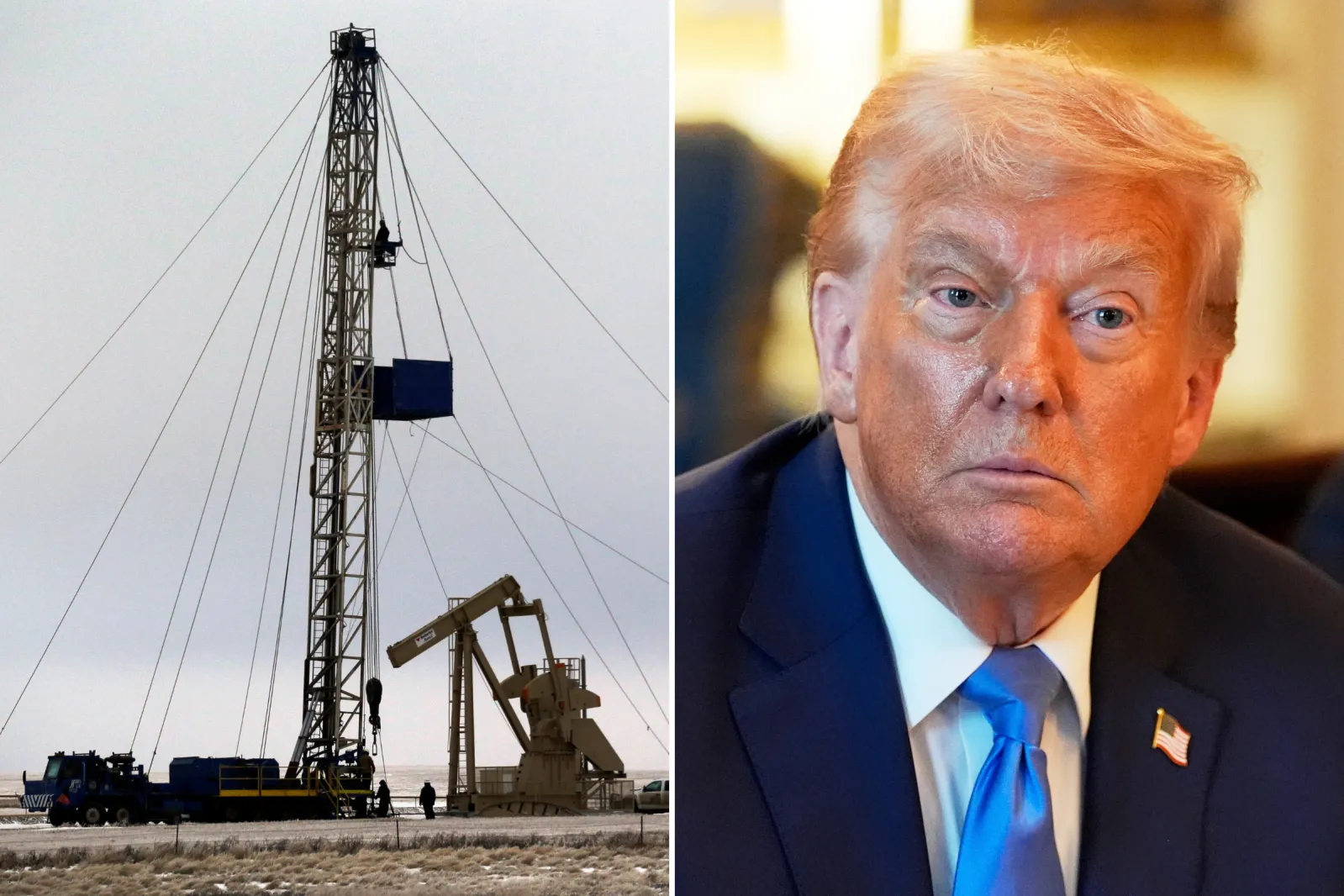
A slump in active oil and gas rigs across the United States has undercut President Donald Trump's rallying cry to "drill, baby, drill," raising economic and political stakes for his administration.
Despite Trump's aggressive push for domestic fossil fuel expansion—including an official declaration of a "national energy emergency" to fast-track drilling—the U.S. rig count has now fallen to its lowest level in nearly four years, according to a report by Baker Hughes, the energy technology company.
It showed that the rig count was 539 on July 3, down by 47 compared to this time last year.
Read More on News
While the gap between Trump's promises and the drilling reality threatens to become a flashpoint in the energy debate, executives and analysts say that market forces lie at the heart of the rig decline: flagging oil prices, investor pressure for financial returns, and technological shifts that allow producers to extract more oil with fewer rigs.
U.S. crude oil prices have slid into the $60s per barrel—down roughly 15 percent since Trump returned to office—potentially making some wells unprofitable.
"Many factors influence rig counts, including but not limited to federal policies on new drilling. Commodity prices for oil and gas are a major factor and those have largely been in decline during 2025," Joseph A. Schremmer, director of the Oil & Gas, Natural Resources, and Energy Center at the University of Oklahoma, told Newsweek.
"Although prices have ticked up in recent weeks, there remains a great deal of uncertainty about future prices, which may keep drillers on the sidelines."
...
The irony is that while Trump celebrates lower gas prices for American consumers, as he did on Truth Social before July 4, those lower prices may undermine one of his key campaign commitments.
"Oil companies love a pro-industry president and they like less regulation but they do not like low oil prices because the economics of oil production at low prices tends to favor the Middle East countries," John S. Dzienkowski, a professor of law and chair in lawyering and the legal process at the University of Texas at Austin, told Newsweek.
"Presidents love low energy prices because it brings down inflation as so many goods in our economy are transported and manufactured with oil and gas energy," he added.
"Thanks to President Trump's bold leadership, the United States is more energy dominant than ever – as is evident by the record U.S. crude oil production in April and relative stability of energy prices during and after the recent 12-day conflict in the Middle East," Ben Dietderich, press secretary and chief spokesperson at the Department of Energy, told Newsweek.
He added: "With today's modern drilling technologies, the number of rigs does not necessarily correlate to energy production levels."
Newsweek has contacted the White House via email for comment.
'Drill, Baby, Drill': What the Data Shows
Trump had promised to increase domestic oil and gas production throughout his election campaign, and since taking office has indicated he wanted to get crude prices down to $50 per barrel or lower. This would be a boon for American consumers, translating to cheaper gasoline and heating costs**.** However, $50 oil would be a double-edged sword: while it might delight drivers, it threatens drillers' profits.
The economic ripple effects of lower prices may already be visible. The U.S. total rig count on July 3 of 539 was lower than the number of rigs operating on October 15, 2021, which was 543.
This dip means the nation has fewer rigs now than during much of the post-pandemic drilling rebound during the administration of former President Joe Biden. The rig count had climbed steadily throughout 2022 as prices surged, peaking at well over 700 active rigs. Since late 2022, the trend reversed.
In fact, as reported by Baker Hughes, U.S. drillers have now cut rigs for seven consecutive weeks as of early July. Not since late 2023 has the rig count fallen for so many weeks in a row. Each idle rig signals reduced spending and drilling in shale patches from Texas to North Dakota.
As revenue per barrel fell, U.S. operators shifted strategy: instead of expanding output, many are funneling profits into stock buybacks, dividends, and debt reduction.
The oil and gas rig count declined by about 5 percent in 2024 and 20 percent in 2023, according to Reuters.
According to the Dallas Fed Energy Survey, the company outlook index in the oil and gas sector was still negative, with expectations of decline. In the second quarter of 2025, U.S. oil and gas executives reported slight declines in production and employment, according to the survey. The survey's uncertainty index jumped 4 points to 47.1.
Indeed, nearly half of oil and gas executives responding to the survey say their production would decline significantly if oil fell to $50 a barrel—the very price Trump has touted as a goal.
Paradoxically, U.S. oil production is still on track to set new records even as rig activity wanes. The Energy Information Administration (EIA) projects crude output will average 13.4 million barrels per day in 2025, edging above 2024's all-time high of 13.2 million. The apparent contradiction—fewer rigs yet more oil—reflects years of efficiency gains.
Oil companies have become adept at squeezing more barrels from each well. Many of the rigs currently active are drilling top-tier locations in prolific basins like the Permian, yielding high initial production.
"Another important factor to consider is that more and more of our drilling capital is put to drilling horizontal wells," Schremmer said.
"A single rig can drill multiple horizontal wells from the same surface location, requiring fewer rigs to produce the same amount (and even more) of oil and gas compared with vertical drilling. Increasing efficiencies in the length of horizontal laterals and completion techniques probably also reduce the number of new wells needed to achieve the same level of output."
In other words, drilling technology and high-productivity shale formations are allowing companies to do more with less.
"Often established wells can continue to produce and be profitable when the price of oil is around $35 to $40," Dzienkowski told Newsweek.
He added that new drilling in the U.S. and the "more extensive use of new technologies" requires a price of crude oil that is between $60 and $70 a barrel—which is "particularly true for oil produced with hydraulic fracturing technology."
"Our lower oil prices today are similar to what they were in 2021 and thus the investment monies do not over invest in new projects," Dzienkowski said. "I would say that major oil companies have moved back to the U.S. and have decided some areas of the world have too much risk and this also makes the U.S. competitive marketplace more risky for smaller companies."

...
The EIA's forecast shows that output is less tightly coupled to rig count than it once was. Still, this projection carries an assumption: that prices remain high enough and geopolitical conditions stable enough to allow these gains. Should demand rise unexpectedly or supply disruptions occur, the current low rig count could constrain the ability to ramp up production quickly.
Multiple factors have combined to push prices down. One of these is surging output globally. In early May 2025, oil briefly hit its lowest price in four years after OPEC and its allies (OPEC+) surprised the market with an accelerated output hike for the summer, a move Trump himself had previously called for. Around the same time, the White House's moves to double certain import tariffs stoked fears of a global economic slowdown, weighing on demand outlook. Geopolitically, the Middle East tensions—including conflict involving Israel and Iran—have also injected volatility.
Trump's promise of a drilling boom was aimed at delivering low fuel prices and energy independence for the United States. However, it has even had implications on the energy policies of other countries.
Trump withdrew the U.S. from the Paris climate agreement upon taking office in January 2025, arguing that unleashing domestic fossil fuels is more urgent than cutting emissions. That move reverberated abroad: Indonesia quickly signaled it might follow suit, with the president's climate envoy asking, "If the United States does not want to comply, why should a country like Indonesia comply?"
The Political Battle Ahead
After successfully passing through Congress last week, Trump's "Big Beautiful Bill" will now end federal support for solar and wind power, paving a clear space for more fossil fuel production, signifying the president's clear and continued aim to expand domestic production of oil and gas in the country.
The legislation—a sprawling tax and energy package—removes key incentives for renewable energy that were put in place under Trump's predecessor. It repeals or phases out billions in clean energy tax credits from the 2022 Inflation Reduction Act, including credits for utility-scale wind and solar projects and consumer purchases of electric vehicles.
In tandem, the bill opens the door for expanded oil, gas, and coal development: it mandates new lease sales on federal lands and waters, streamlines permitting for pipelines, and curtails environmental reviews that Trump has blamed for "red tape." The White House touts the measure as a course correction. Trump celebrated the bill's passage on May 22, 2025, calling it "arguably the most significant piece of legislation that will ever be signed in the history of our country."
The American Petroleum Institute, which represents the oil and gas industry, welcomed it as a step to "restore American energy dominance."
"By preserving competitive tax policies, opening lease sales" for oil and gas drilling and advancing permitting reforms, the legislation "is a win for our nation's energy future," API President Mike Sommers said, according to the Associated Press.
The economic and political consequences will unfold in the months ahead. The U.S. energy sector may get a short-term boost as regulatory hurdles for oil and gas projects are lowered. But if oil prices remain middling, even friendly policies might not compel companies to significantly ramp up drilling. Conversely, the rollback of renewable incentives could slow the growth of clean-tech industries, potentially impacting jobs and investments in solar panel manufacturing, wind turbine production, and electric vehicles.
Politically, the stage is set for a larger battle over America's energy future.
Update 07/14/25, 3:20 a.m. ET: This article has been updated with comment from Ben Dietderich, press secretary and chief spokesperson at the Department of Energy.
View 0 Comments
Submit Correction
View Editorial & AI Guidelines