
By Alex Harrington
Sports Contributing Writer
0
Share
Newsweek is a Trust Project member
See more of our trusted coverage when you search.Prefer Newsweek on Googleto see more of our trusted coverage when you search.
Dyson built its home appliance empire on the idea that premium engineering justifies a premium price. For years, that argument held up, partly because there wasn't much serious competition at the spec level. Then a team of engineers launched Dreo in 2021 with a basic thesis: legacy brands were coasting on reputation while consumers wanted more. Four years later, that bet is looking pretty good.
Dreo claims the top spot as the No. 1 Household Fan Brand on Amazon U.S. for three consecutive years, per Stackline data.
Its tower fan line alone pulled in over $50 million in global sales in the past year.
Read More on Tech
Those are not the numbers of a brand punching above its weight. Those are the numbers of a brand that has already won the volume argument. The remaining question is whether the products are genuinely competitive with Dyson on performance - or whether Amazon reviews and aggressive pricing are doing most of the heavy lifting.
Where Dreo Actually Has Dyson Beat
On raw airflow specs, there's a real gap.
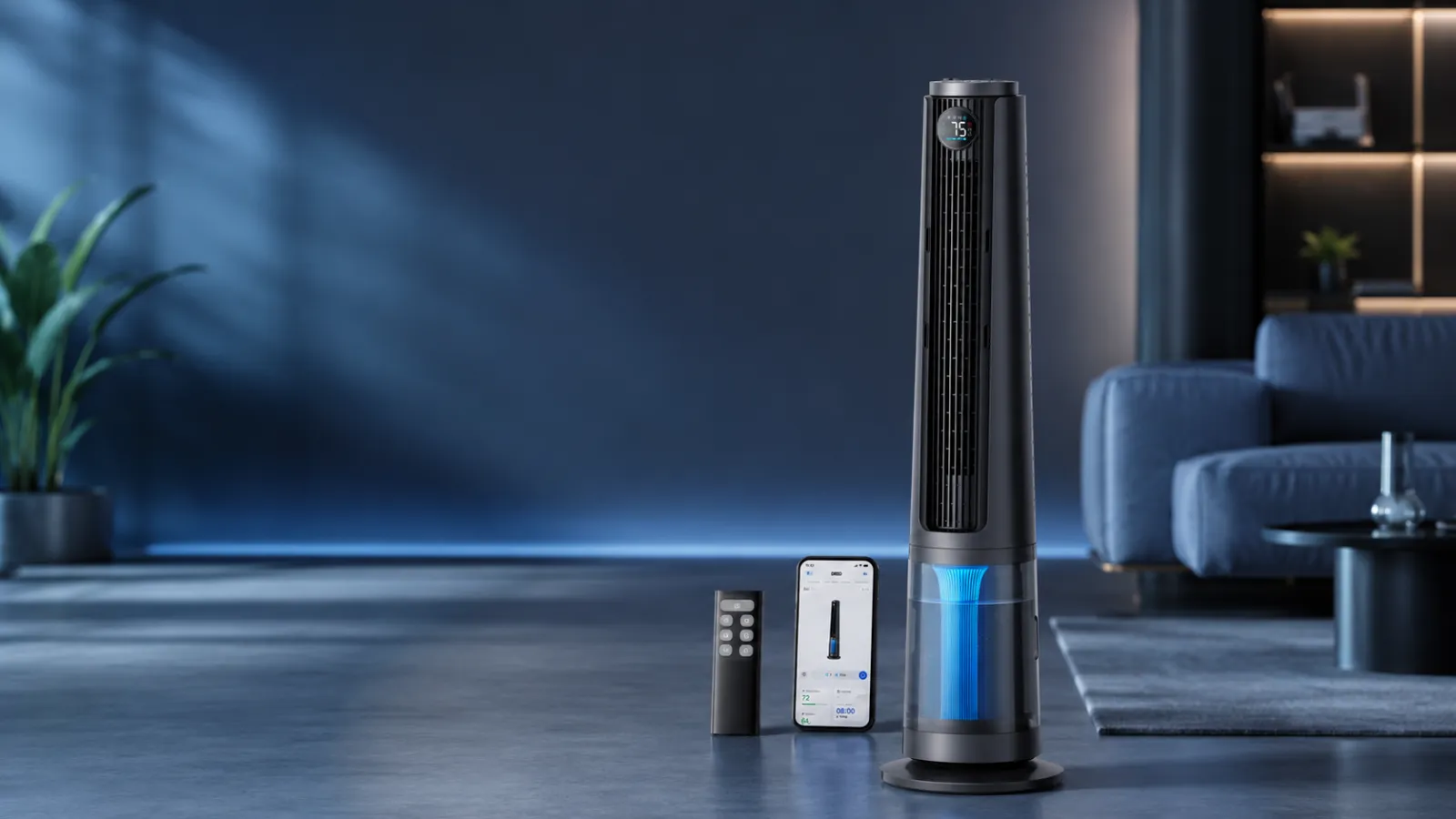
Dreo's MC710S purifier tower fan claims an ultra-long 40-foot range and a dual H13 True HEPA filtration system capable of trapping up to 99.97% of particles as small as 0.3 microns. It also offers 12 wind speeds, three purification levels, and three oscillation settings.
To compare, the Dyson Purifier Cool tops out at 10 cooling settings. Noise is another area where Dreo has measurably pulled ahead. The TurboPoly Fan 508S runs at 20dB while still delivering a powerful airflow, and features a 3D oscillating design that moves air throughout a room.
Testing from Tom's Guide found it quieter than a Dyson even at maximum speed. The price difference between the two brands is incredible, too - around $129 for the Dreo against $400-plus for the equivalent Dyson.
Dreo's 2026 lineup pushes the spec sheet further in a completely different direction.
The TurboCool Misting Fan 765S introduces an indoor ultrasonic misting system, a genuine first for living room tower fans. It uses dual mist boosters to propel ultra-fine water vapor that evaporates instantly, actively dropping room temperatures by up to 10°F (6°C) without leaving furniture or carpets damp.
The technology solves the long-standing limitation of misting fans being strictly confined to outdoor patios.
Dyson's equivalent high-end play for 2026 - its Find+Follow Purifier Cool - focuses instead on using an AI vision system to physically track your location around the room, but it retails at $850 compared to the Dreo's $200.
By 2026, the comparison has changed from who has the better tracking tech to two entirely different philosophies on what a premium fan should actually do: Dreo is actively refrigerating the air, while Dyson is hyper-optimizing who the air is pointed at.
Where Dyson Still Beats the Competition
The specs don't tell the whole story. Where high-end Dyson purifiers offer HEPA H13, K-Carbon, and SCO filters, Dreo's MC710S provides only the H13 HEPA filter alongside a foam pre-filter.
That matters if you care about VOCs and formaldehyde, not just airborne particles.
Dyson units break down air quality data by gas, particle type, and VOC levels, while Dreo currently offers only a basic µg/m³ reading.
Build quality and design are the other honest caveat. Independent reviewers have noted that negative Dreo reviews frequently point to a cheap-looking plastic exterior. Dyson's products cost more partly because the materials and fit-and-finish are in a different bracket - and for a device sitting in a living room, that still matters to a significant chunk of buyers.
What Dreo has done well is price the trade-off correctly. If you want strong airflow, low noise, smart home integration, and HEPA filtration at a fraction of Dyson's ask, the specs are now competitive enough that the British brand's premium requires real justification. If you want granular air quality data, robust VOC filtering, and a product that looks the part in a well-designed room, Dyson still earns its price. The gap has closed plenty, just not all the way.
A definitive verdict requires hands-on time with both - but on specs alone, Dreo has earned that test.
View 0 Comments
Submit Correction
View Editorial & AI Guidelines