10
Loading video...


By Hollie Silverman and Peter Aitken
0
Share
Newsweek is a Trust Project member
See more of our trusted coverage when you search.Prefer Newsweek on Googleto see more of our trusted coverage when you search.
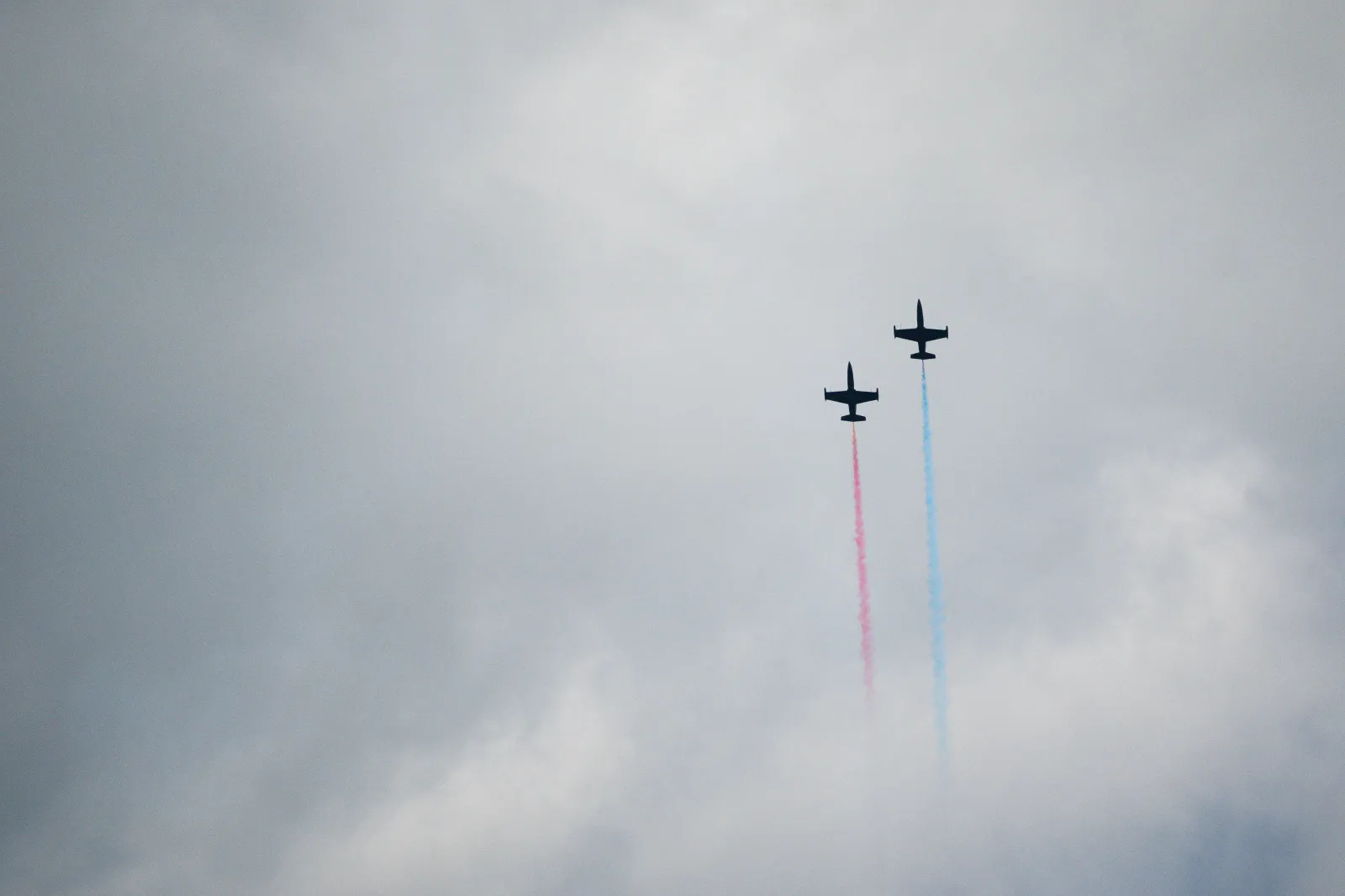
Dramatic video captured the moment two Navy aircraft collided during an airshow in Idaho on Sunday, sending debris falling to the ground and prompting a rapid emergency response.
The incident occurred during the Gunfighter Skies Air Show at Mountain Home Air Force Base. In video posted to social media, the two jets—identified as Navy Super Hornets/Growlers—appear to have been flying in tandem when one lost altitude, striking the lower aircraft and causing the pair to spiral downward. The show's website lists the "Vikings" Growler Demo Team as one of the scheduled performers.
Read More on News
Four crew members successfully ejected from the jets and are reportedly in stable condition. Kim Sykes, marketing director for Silver Wings of Idaho, told the Associated Press the collision happened about two miles northwest of the base. While she did not witness the impact itself, she reported seeing smoke rising from the site shortly after.
Following the incident, Mountain Home Air Force Base went into immediate lockdown. Base officials confirmed that emergency responders are on the scene and an official investigation is underway. "More details will be released as they become available," the base stated in a social media post, while also thanking guests for their patience that allowed first responders to work quickly.
At approximately 1:20 p.m. local time, the Mountain Home Police Department announced that the remainder of the airshow had been canceled. Authorities continue to urge the public to avoid the area and refrain from traveling toward the base.
Newsweek reached out to the National Transportation Safety Board (NTSB) and Federal Aviation Administration (FAA) by email Sunday for comment.
What Is a EA18-G Growler?
The EA‑18G Growler is a standard fighter airframe, based on the F/A‑18F Super Hornet, but restructured around electronic warfare instead of weapons, making it different than a strike fighter. The jet is designed more for jamming and disrupting enemy radar and communications rather than dropping bombs or winning dogfights.
Unit procurement cost has generally fallen in the range of roughly $60–70 million per aircraft depending on the year, configuration, and included systems, with one documented figure of about $68.2 million in the early 2010s and similar estimated values in more recent assessments.
These figures typically cover the base airframe and core electronic warfare systems but can vary significantly based on upgrades, avionics packages, and mission‑specific equipment, with electronic attack capabilities—such as jamming pods and sensor suites — representing a major share of overall cost.
The Growler benefited from being derived from the Super Hornet, allowing it to move from development to operational service relatively quickly. Initial development was authorized in 2003, with test aircraft entering production in 2004, first flight in August 2006, and the first production aircraft delivered in 2008.
Full-rate production followed shortly after initial operational capability in 2009, demonstrating a development-to-deployment cycle of roughly six years from early production to operational use.
Production has continued since the mid‑2000s, with the aircraft remaining in manufacture and upgrade cycles into the 2020s, reflecting an extended program timeline driven by incremental modernization rather than a fixed end date.
...
View 0 Comments
Submit Correction
View Editorial & AI Guidelines