
...

By Hugh Cameron
Reporter
0
Share
Newsweek is a Trust Project member
See more of our trusted coverage when you search.Prefer Newsweek on Googleto see more of our trusted coverage when you search.
Following President Donald Trump's announcement of reciprocal tariffs on dozens of America's trading partners, many questioned how the administration had calculated the rates at which to levy each countries' imports.
Rather than a complex sum, however, it has been observed that the White House used a relatively simple formula to determine the rate at which American products were tariffed in other countries, relying on this method to arrive at the final figure.
Why It Matters
The reciprocal tariffs, and the flat 10 percent duty applied to all imports, have already been decried as unjustified by some world leaders, others vowing to respond with retaliatory measures of their own.
Read More on Politics
As some economists have warned, the new tariffs could add further strain to American trade and the U.S. economy more broadly, which was already facing the threat of a recession.
What To Know
Trump's speech in the White House Rose Garden gave little insight into how the U.S. had calculated the rate at which American exported goods were being tariffed by other countries, nor how the administration had calculated a reciprocal, but "kind" rate with which to counter this.
...
A 17 percent "reciprocal" duty on imports from Israel was also baffling, as the country had recently reduced its taxes on U.S. imports to effectively nil.
The White House said on Wednesday that the measures were in response to countries' own sets of tariffs, as well as "harmful policies" such as currency manipulation, industrial subsidies and other structural barriers to free trade.
"We will calculate the combined rate of all their tariffs, nonmonetary barriers and other forms of cheating," Trump said on Wednesday.
However, once the list of new tariff rates was revealed, many pointed out that the figure for "tariffs charged to the U.S.A." could be derived from simply dividing the country-specific trade deficit by the value of its exports to the U.S. and expressing it as a percentage. This led to speculation that Trump's economic advisers had used this one-step formula to expedite the introduction of the duties in time for Liberation Day.
The chart below, based on 2024 data from the U.S. Trade Representative's Office and the Census Bureau, shows ten countries with which the U.S. has run significant trade deficits, alongside the tariff rates reportedly charged to the U.S. and the reciprocal rates now in place.
Countries Hit With Reciprocal Tariffs
As seen on the chart, the tariff rates supposedly applied to the U.S. are almost identical to the trade deficit divided by the level of exports as a percentage. The final reciprocal rate also closely mirrors this figure divided by two.
The Office of the U.S. Trade Representative released its own methodology following Trump's speech, in which it stated: "If trade deficits are persistent because of tariff and nontariff policies and fundamentals, then the tariff rate consistent with offsetting these policies and fundamentals is reciprocal and fair."
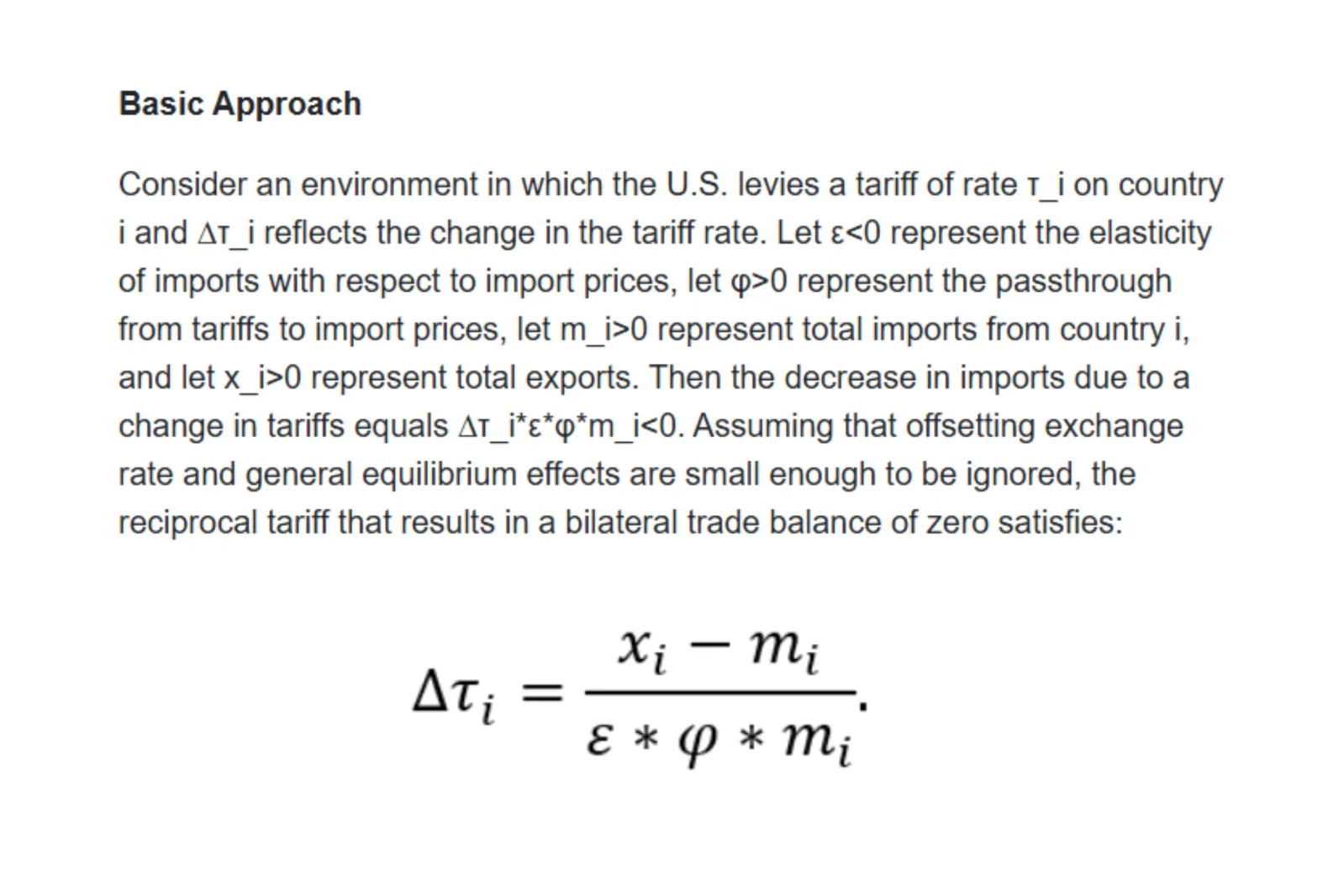
...
The New York Times, citing comments made by officials prior to Trump's speech, reported that the figures were calculated by the White House Council of Economic Advisers. One official explained that the calculations were based on the belief that trade surpluses with the U.S. reflect a combination of unfair trade practices and "cheating" directed at the U.S.
Newsweek has reached out to the Office of the U.S. Trade Representative outside of regular business hours for comment.
What People Are Saying
Financial journalist and author James Surowiecki, via X: "Just figured out where these fake tariff rates come from. They didn't actually calculate tariff rates + non-tariff barriers, as they say they did. Instead, for every country, they just took our trade deficit with that country and divided it by the country's exports to us."
"It's also important to understand that the tariff rates that foreign countries are supposedly charging us are just made-up numbers," he added. "South Korea, with which we have a trade agreement, is not charging a 50 percent tariff on U.S. exports. Nor is the EU charging a 39 percent tariff."
Emily Kilcrease, former deputy assistant U.S. trade representative, told The New York Times: "It was always going to be a really difficult exercise to come up with a very precise reciprocal tariff rate. Given what seems to be their desire to get something out quickly, it appears what they've done is come up with an approximation that is consistent with their policy goals."
The Office of the U.S. Trade Representative, in its "Reciprocal Tariffs Calculations" fact sheet, wrote: "Reciprocal tariffs are calculated as the tariff rate necessary to balance bilateral trade deficits between the U.S. and each of our trading partners. This calculation assumes that persistent trade deficits are due to a combination of tariff and nontariff factors that prevent trade from balancing."
Bill Adams, Chief Economist for Comerica Bank, in comments shared with Newsweek following the tariff announcement: "Tariff increases in the second Trump administration likely amount to a roughly 25 percent tax increase on the $3.3 trillion of U.S. annual goods imports, equivalent to a tax hike of 2-3 percent of U.S. That's equivalent to more than doubling the effective federal corporate tax rate.
"If tariffs stay in effect as announced, foreign sellers will likely absorb some of the cost, as will American importers. But even so, the increase will likely cause a 3 percent to 5 percent cumulative incremental increase in consumer prices above the trend rate of inflation over the next year."
What Happens Next?
In response to the latest tariffs, world leaders have pledged to enact their own retaliatory measures on U.S. imports. President of the European Commission, Ursula von der Leyen, stated that the continent is preparing "countermeasures to protect our interests and our businesses if negotiations fail."
View 0 Comments
Submit Correction
View Editorial & AI Guidelines