
...

By Giulia Carbonaro
Senior Reporter
0
Share
Newsweek is a Trust Project member
See more of our trusted coverage when you search.Prefer Newsweek on Googleto see more of our trusted coverage when you search.
President Donald Trump praised the astronauts aboard NASA’s Orion spacecraft after it made a "textbook touchdown" and returned safely to Earth on Friday night.
"Congratulations to the Great and Very Talented Crew of Artemis II," the president wrote in a late night post on Truth Social. "We’ll be doing it again and then, next step, Mars!" he added.
How Was the Artemis II Crew’s Return to Earth?
The Artemis II concluded its historic mission when it splashed down in the Pacific Ocean off the coast of California on Friday night, at 8:07 p.m. EDT.
Read More on News
"What a journey," said Artemis II commander Reid Wiseman following a ten-day lunar flyby mission which swept around the far side of the Moon.
It took about 13 minutes for Orion's capsule to decelerate from roughly 25,000 mph to 17-19 mph.
The return was considered the most dangerous stage of the mission—much more risky than the scheduled 40 minutes during which the four astronauts, traveling behind the Moon, completely lost contact with Earth.

...
But NASA described their descent as a "textbook touchdown," despite reporting a communications problem with the crew after that. "They’re all in excellent shape," said an announcer during the splashdown’s livestream.
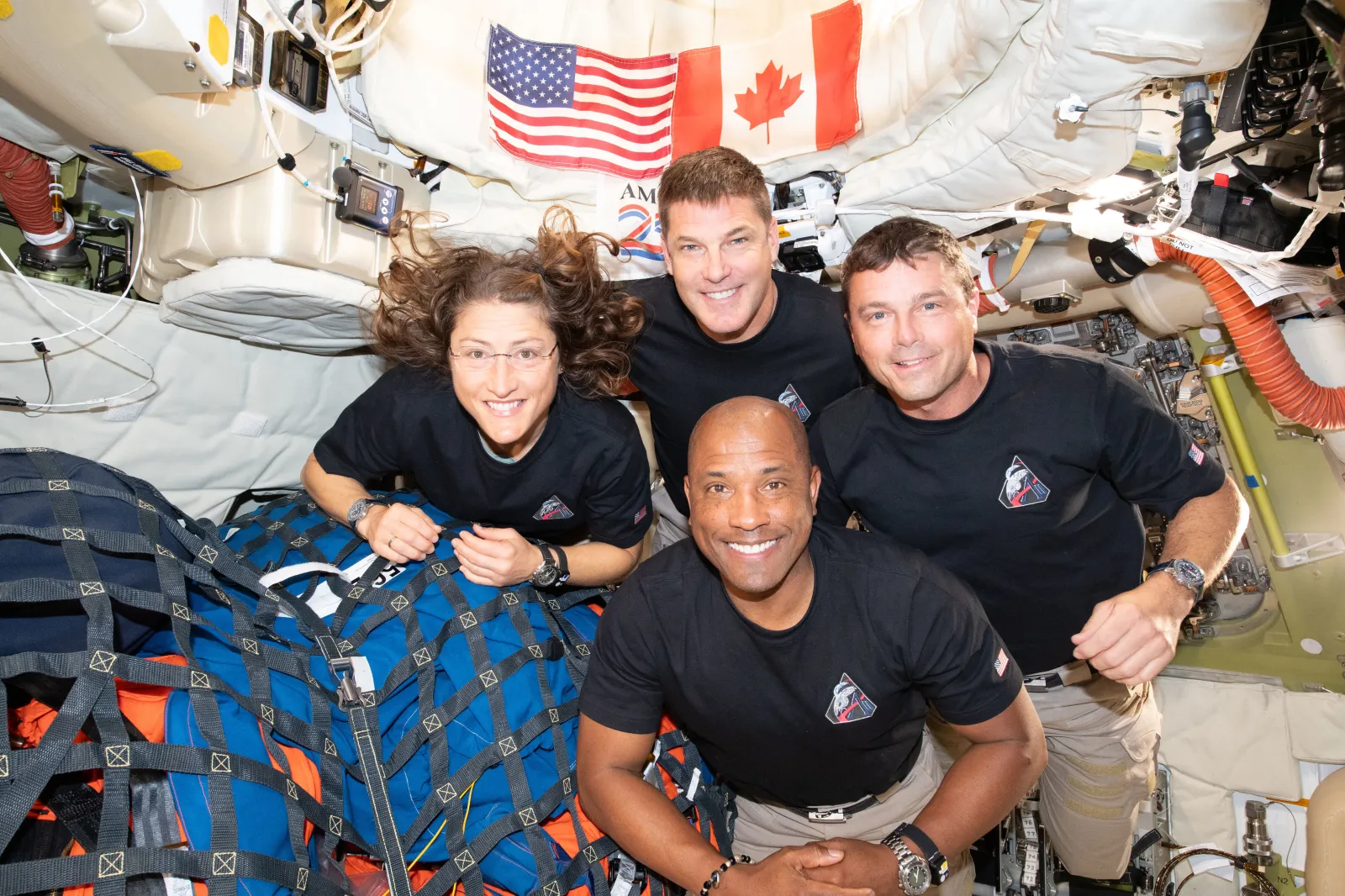
The four astronauts—Wiseman, Victor Glover, Christina Koch, and Jeremy Hansen—were picked up approximately an hour after splashdown and flown to the U.S.S. John P. Murtha, a Navy dock ship.
Aboard, the astronauts were set to undergo post-mission medical evaluations, NASA said, before returning to shore to board an aircraft bound for the agency’s Johnson Space Center in Houston, Texas.
How Did Trump Greet Them?
In a post on social media following the astronauts’ return, Trump wrote: "The entire trip was spectacular, the landing was perfect and, as President of the United States, I could not be more proud!"
The president had expressed similar feelings during his call with the four astronauts on Monday, after they ventured further from Earth than any human had previously done, on the sixth day of their mission, 248,655 miles away from our planet.
...
Again on his post on Friday night, he invited the astronauts to meet him at the White House. "I look forward to seeing you all at the White House soon," he wrote.
The president added that the U.S. will return to the Moon—“We’ll be doing it again," he wrote—and after that will embark on a mission to Mars. The red planet—and the possibility of establishing a human colony on it—has been a longstanding goal for his former close ally, Elon Musk.
...
Jared Isaacman, the NASA Administrator, seemed to share the same enthusiasm on Friday night, though his was limited to lunar missions.
"Childhood Jared right now can’t believe what I just saw," he said on-air while describing the splashdown.
"This is just the beginning," he added. "We are back in the business of sending astronauts to the Moon, bringing them back safely."
What Comes Next?
The Artemis II mission was a resounding success for NASA.
Artemis III is scheduled for mid-2027. Originally, the mission was supposed to land astronauts on the Moon's south pole, but its goal has changed and is now set to test docking between the Orion spacecraft and commercial lunar landers from firms such as SpaceX and Blue Origin.
There is no set mission to send humans to Mars, at the moment. In a 2020 update, NASA said that "Mars remains our horizon goal for human exploration because it is one of the only other places we know where life may have existed in the solar system."
The agency is advancing technologies to send astronauts to Mars as early as the 2030s, it said.
View 0 Comments
Submit Correction
View Editorial & AI Guidelines