...

By Newsweek Editors
0
Share
Newsweek is a Trust Project member
See more of our trusted coverage when you search.Prefer Newsweek on Googleto see more of our trusted coverage when you search.
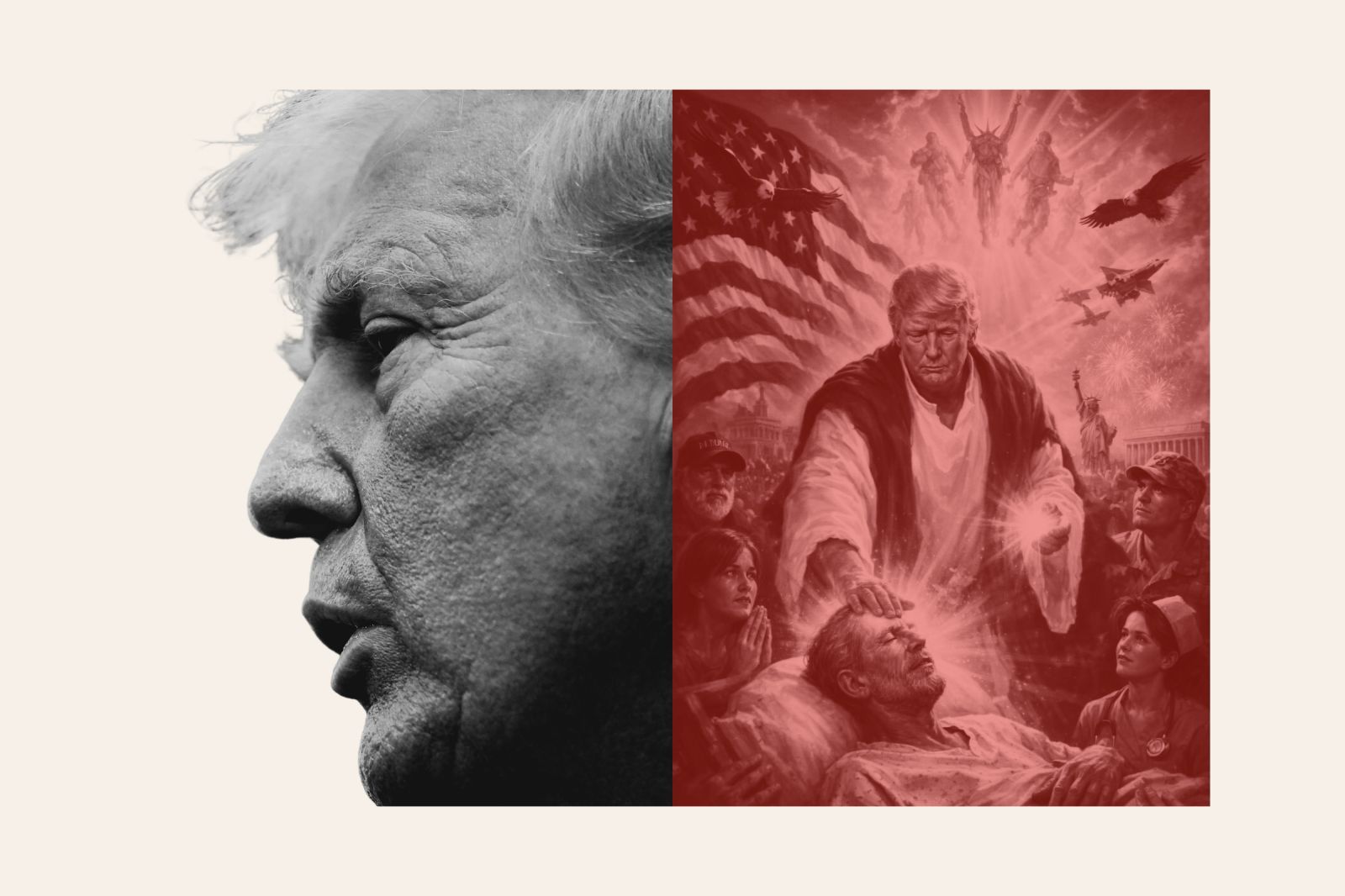
President Donald Trump's surreal Truth Social post depicting himself in a Christ‑like healing pose sparked a predictable backlash from the faithful, even those within his own MAGA movement.
The image leaned heavily on Christian visual language—robes, radiant light, a healing touch—inviting direct comparison to Jesus, and accusations of blasphemy from those who made their feelings clear: Trump is not the Messiah, he's a very naughty boy.
But if Trump is trying to construct his own deistic mythology, then he's reaching for the wrong god. He should look to the Classics instead.
Read More on Analysis
What the Jesus Comparison Gets Wrong
The sharpest contrast between Trump and Jesus—of many—is nonviolence.
In the Gospels, Jesus repeatedly rejects force. He rebukes a disciple for using a sword, preaches loving enemies, and refuses political power even when it is offered.
His authority rests on moral example, restraint, and voluntary sacrifice, promising eternal peace and salvation for those who follow him.
Trump's policy at home and abroad is built on the opposite premise: Peace through strength.
And strength, to Trump, is military and economic dominance, as well as the deterrence of genuine threats backed up by a willingness to hit harder than opponents.
This philosophy is at play in Iran, where Trump has sought to overwhelm the regime in Tehran with military strength to force it to abandon its nuclear program, curtail its missile capabilities, and cut off its network of militias in the Middle East.
Trump may see the outcome of this as healing, and that he has the humility and grace preached by Jesus to offer his opponents a bountiful reward for making peace with him.
But the violent means sit awkwardly with the teachings of Jesus.
They do, however, chime well with one bearded and wrathful god of yore in particular: Zeus.
Authority First
Zeus, the Ancient Greek god of thunder, is the ultimate hard power realist.
He rules from his throne atop Mount Olympus because he defeated his rivals, not because he is virtuous.
After overthrowing his father Cronus, Zeus establishes order through power rather than moral instruction.
He is not a role model; he is a victor.
It's a familiar appeal to authority for watchers of U.S. politics.
Trump portrays himself as strong because he is a winner, while denying the validity of his defeats as fraudulent.
He and MAGA say they win elections and political fights by crushing enemies and imposing outcomes, all while demanding praise and thanks from the American people.
Legitimacy, as with Zeus, flows from conquests rather than strict teachings.
Big ratings, vast crowds, court victories, dominance over rivals, fomented by Truth Social posts hurled down from the White House like bolts of lightning.
Trump is the personal arbiter of the system, not a strict set of ideological benchmarks against which consistency is measured.
What he says, goes, even if MAGA is increasingly testing that unspoken rule.
Temperamental and Performative
Zeus is famously volatile and mercurial.
He hurls thunderbolts in anger, punishes mortals impulsively, and stages dramatic interventions to remind everyone who is in charge. The power is theatrical.
Trump's public style follows a similar pattern: outbursts, sudden escalations, public feuds, lurid nicknames, and headline‑grabbing gestures.
Authority is asserted through spectacle. Calm process signals weakness; dramatic action signals control.
See how Trump is managing internal dispute within MAGA about the Iran war, dramatically banishing his critics like Tucker Carlson and Megyn Kelly.
Or how he threatened to destroy Iranian civilization if his deadline passed—a shocking and, critics said, genocidal threat—in an attempt to force Tehran to back down.
Zeus does not whisper. Neither does Trump. They roar like thunder and expect obedience in reply.
Power Legitimized After the Fact
In Olympian mythology, order follows force. Zeus creates stability by defeating chaos instead of negotiating it. Justice then flows from power already established.
Trump's worldview often echoes this logic; that peace comes from real strength, that rules matter only if they can be enforced by those powerful enough to do so, and that outcomes validate methods.

...
From Venezuela to Iran to Cuba, from trade wars with China to standoffs with NATO allies, Trump is trying to impose his vision of justice using the weapon of hard American power.
Success retroactively justifies the approach, even if Trump, not a man who accepts losses, redefines what winning looks like depending on the outcome.
This is not the Sermon on the Mount. It is the rule of Mount Olympus: might first, order second.
Serial Boundary‑Crosser
Zeus is notorious for ignoring rules that bind others. He violates oaths, disguises himself, intervenes selectively, and pursues personal desires without regard for limits imposed on gods or mortals alike.
The message is clear: laws exist for those without supreme power.
Trump's relationship with norms and rules follows a similar pattern.
He regularly challenges boundaries—legal, procedural, rhetorical—arguing that exceptional threats justify exceptional behavior, and tying his effectiveness as a disruptive leader to stepping outside of stultifying convention.
Long-standing global institutions like the United Nations or the World Health Organization are tossed aside along with their rules, so Trump can operate with near-total freedom of options, no matter the consequences or complaints from allies.
Domestically, he stretches the limits of executive power, trying to outmaneuver the federal courts and enforce his will through diktat, be it with tariffs, immigration rules, war, and more.
Constraints are portrayed as tools of weak opponents—see White House complaints about lawfare and "activist judges"—not obligations of strong victors.
Trump doesn't feel bound by old rules or conventions, or by what a U.S. president ought to do, intervening in areas where his predecessors never dared to, or thought it inappropriate to do so.
He sets his own standard, come what may.
Loyalty and Hierarchy Above All
In Greek mythology, gods fall not for immorality but for disobedience.
Zeus punishes challenges to his authority more harshly than ethical lapses: Loyalty is the organizing principle of Olympus.
Trump's political universe works very similarly, treating loyalty as a filter to keep the MAGA movement pure. MAGA also uses Trump's top-down authority as a means of holding its coalition together as tightly as possible.
Personal loyalty to Trump is prized; dissent is treated as betrayal. Allies are rewarded for fidelity, critics are cast out regardless of prior service.
Like Zeus, Trump tolerates flaws but not defiance, and his vengeance against perceived traitors is furious.
Why Zeus Still Isn't Enough
There is one problem in particular with the Zeus comparison: Olympus is stable.
Zeus ultimately maintains a settled order, which justifies the caprice. But Trump's mythology is more unsettled, closer to permanent conflict than final victory.
His politics thrive on disruption, not equilibrium, and the U.S. is in a state of tumult over a number of issues spanning politics and economics.
Trump is Zeus with a modern twist: authority without resolution, power without closure.
Still, even if Trump wants his disciples to think otherwise, Olympus explains more about his presidency than Calvary.
Hey gang, Carlo Versano here. I hope you enjoyed this article. As Newsweek's Director of Politics and Culture and editor of the 1600 newsletter, I'm keen to hear what you think. Now, Newsweek is offering a new service to allow you to communicate directly with me in the form of a text message chat. You can sign up and get a direct line to me, as well as the reporters who work for me. You can shape our coverage.
As a Newsweek member, we're offering this service to you for free. You can sign up below, or read more about how it works here. Let's talk!
View 0 Comments
Submit Correction
View Editorial & AI Guidelines