...

By Newsweek Editors
0
Share
Newsweek is a Trust Project member
See more of our trusted coverage when you search.Prefer Newsweek on Googleto see more of our trusted coverage when you search.
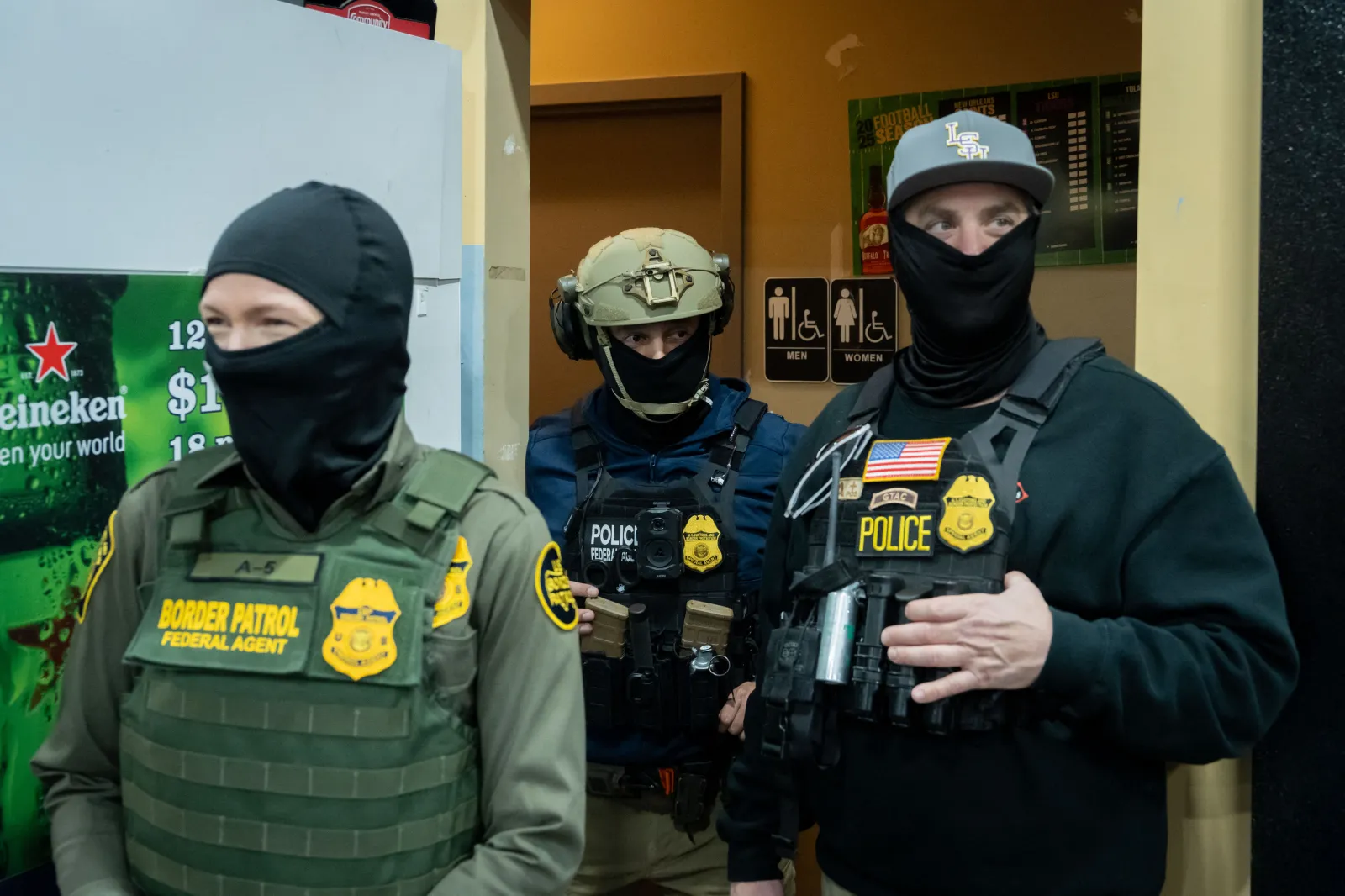
You've probably seen the clips on social media: black windbreakers, guns, masks—a stereotypical U.S. Immigration and Customs Enforcement raid in 2025. Yet the real growth engine of immigration arrests under the second Trump administration looks nothing like that. It looks like paperwork—hundreds of local memoranda under section 287(g) of the Immigration and Nationality Act. In plain English, 287(g) lets ICE sign agreements that deputize local officers—after ICE training—to perform specific federal immigration duties: serving detainers, preparing immigration charging documents, even making field arrests under ICE supervision (the "Task Force” model), as well as jailhouse screening and warrant service. That is fueling the surge.
The Department of Homeland Security says the country signed more than 1,000 of these partnerships this year. Newsweek analysis of its participation spreadsheet (1,004 unique agencies across 40 states) shows how fast this has snowballed: nearly nine in 10 agencies first signed in 2025, and one in five first signed since September 1. Nearly two-thirds now hold the most expansive Task Force authority—the roadside, boots-on-the-ground version, not just jailhouse screening. And the map tilts heavily: Florida alone accounts for 42.4 percent of all Task Force-level agencies, with Florida and Texas together supplying a majority.
Common Knowledge
To the right, this is how the system should work: local muscle helping federal law. DHS heralded the 287(g) partnerships as giving locals the tools to arrest "the worst of the worst.” ICE likewise says the program protects "the homeland through the arrest and removal of aliens who undermine the safety of our nation’s communities.” Florida frames the build-out as a model. "Deportations can be carried out more efficiently, making our communities safer as illegal aliens are removed,” Governor Ron DeSantis said as he announced new agreements for state police, wildlife officers and the state guard to execute 287(g) duties.
Read More on News
The left likens it to a dragnet. The ACLU says the administration is turning "local police and sheriff’s departments into arms of its deportation machine," with Task Force powers acting as a "force multiplier." The Immigrant Legal Resource Center warns that reviving Task Force—field enforcement at traffic stops and checkpoints—"increases the risk" that minor encounters slide into deportation and corrodes community trust.
Uncommon Knowledge
What is clear is that the surge is real and gathering pace. DHS’s September milestone of over 1,000 doesn't look like a plateau. Around a fifth of all agencies first signed after Labor Day. And the default in 2025 isn’t the old jail-only model; it’s Task Force. Nationally, 62.1 percent of agencies in the file have Task Force as their highest authority; in Florida it’s practically universal at 96.4 percent.
Where these agreements are signed, the money follows. ICE says that Florida now has roughly 325 287(g) agreements—a 577 percent increase since Inauguration Day—plus tens of millions in equipment and transport funds directed to local partners.
A few places now drive an outsize share of the national totals. The Associated Press found that one county jail—Benton County, Arkansas—produced more than 450 ICE arrests from January to mid-October, over 4 percent of all 287(g) arrests nationwide in that window.
And the uniforms aren’t always what you think. Documents obtained by WIRED show the Louisiana Department of Wildlife and Fisheries—yes, game wardens—used a 287(g) Task Force agreement to assist in at least six detentions where the underlying wildlife encounter produced no criminal charges, and even joined operations with U.S. Customs and Border Protection and the U.S. Coast Guard that weren’t spelled out in the agency’s ICE pact.
What this all shows is a sprawling, fast-growing web of local agreements built for speed. The human outcomes, rightly or wrongly, flow from that structure. As of November 16, 73.6 percent of people in ICE detention had no criminal conviction; 41,641 were booked in October alone, according to TRAC Reports.
When Benton County alone supplies one in twenty-five 287(g) arrests, and when three-quarters of detainees lack a criminal conviction, the enforcement reality depends less on a border fence or a raid than on a sheriff’s pen—and, occasionally, a wildlife warden’s boat.
If you’re enjoying Uncommon Knowledge, please share. If you have suggestions for future editions or feedback, email subscriber.feedback@newsweek.com. We want to hear your voice.
View 0 Comments
Submit Correction
View Editorial & AI Guidelines