...

By Dan Gooding
Associate News Editor
0
Share
Newsweek is a Trust Project member
See more of our trusted coverage when you search.Prefer Newsweek on Googleto see more of our trusted coverage when you search.
President Donald Trump shared a message Wednesday ahead of the planned Artemis II mission around the moon, saying, "God bless our incredible Astronauts."
Posting to Truth Social ahead of the Wednesday evening launch, the president praised the work of NASA and those who had worked to send a manned mission further than any before it.
President Trump said that "for the first time in over 50 YEARS, America is going back to the Moon!" ahead of the mission, which will not see a lunar landing, but a loop around the moon.
Read More on U.S.
"Artemis II, among the most powerful rockets ever built, is launching our Brave Astronauts farther into Deep Space than any human has EVER gone," Trump wrote. "We are WINNING, in Space, on Earth, and everywhere in between — Economically, Militarily, and now, BEYOND THE STARS. Nobody comes close! America doesn’t just compete, we DOMINATE, and the whole World is watching. God bless our incredible Astronauts, God bless NASA, and God bless the Greatest Nation ever to exist, the United States of America!"
Artemis II is the first time astronauts have headed beyond low Earth orbit since Apollo 17 went to the moon in December 1972. At that time, Richard Nixon was president.
The mission is designed to test the Orion spacecraft and life‑support systems with a crew onboard, paving the way for future lunar landings this decade. NASA officials say Artemis II is a critical step toward establishing a sustained human presence on the moon and eventually sending astronauts to Mars.
Is Artemis II Landing on the Moon?
Artemis II will not include a lunar landing. Instead, the mission is a lunar flyby that will take the crew around the far side of the moon before returning to Earth. NASA has said the goal is to thoroughly test spacecraft systems and crew operations in deep space before attempting a landing on a future Artemis mission.
“Orion is developed to be capable of sending astronauts to the Moon and is a crucial step toward eventually sending crews on to Mars,” NASA said on its website. “The Orion spacecraft will serve as the exploration vehicle that will carry and sustain the crew on Artemis missions to the Moon and return them safely to Earth.”
...
When Is the Artemis II Launch?
The launch will be from Kennedy Space Center in Florida, at 6:24 p.m. ET. There is a two-hour window to allow for any delays.
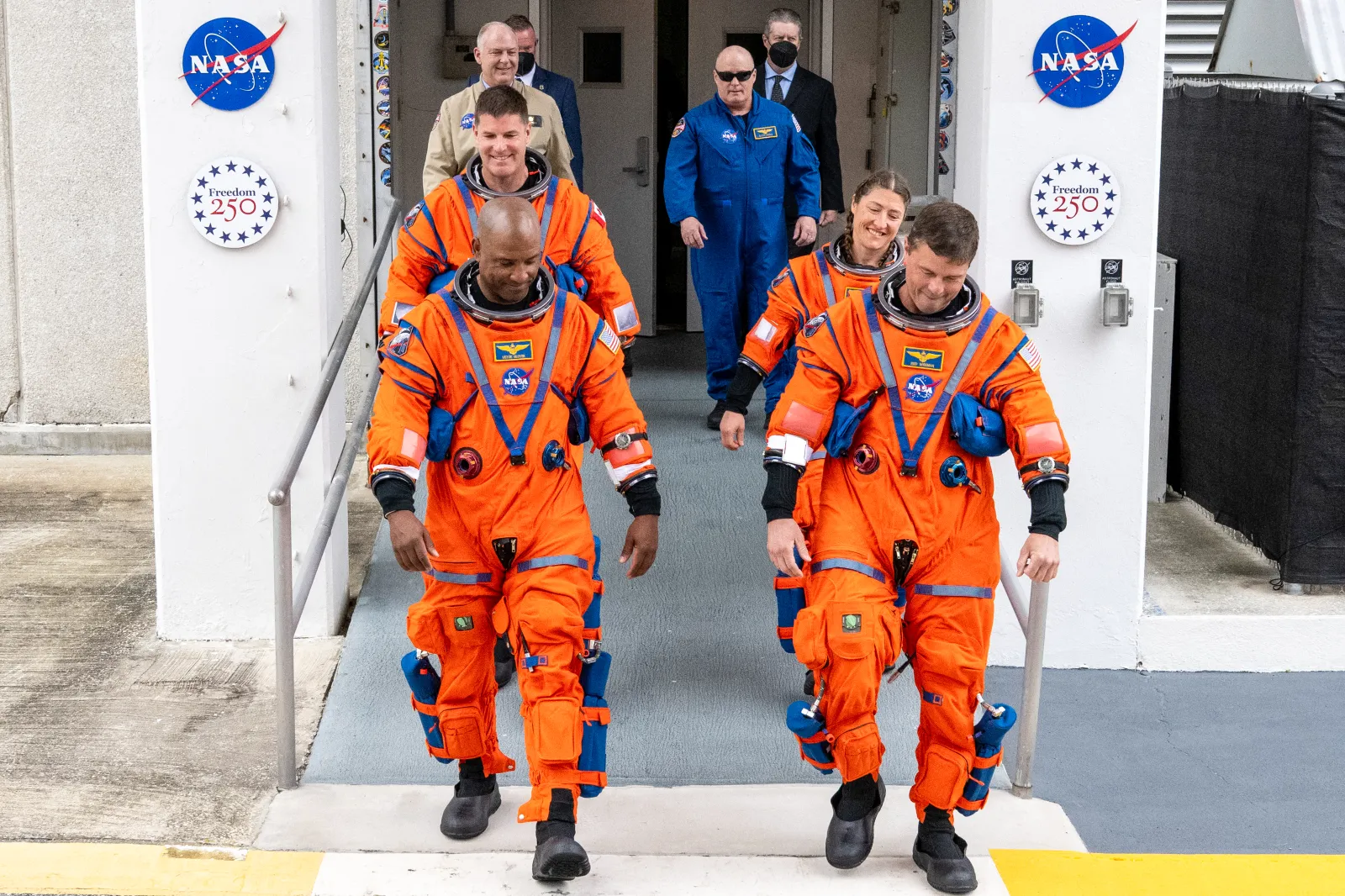
As of 3:41 p.m. ET, the four astronauts—Reid Wiseman, Victor Glover, Christina Koch and Jeremy Hansen—were on board the Orion capsule.
After arriving at the launch pad, the group rode an elevator up to the capsule before signing their names in the so-called white room, where they stage for boarding. If all goes to plan, they will remain in the capsule for 10 days.
After liftoff, Orion will enter high Earth orbit before firing its engines to break free of Earth’s gravity and head toward the moon.
The crew will swing around the far side of the moon on a free‑return trajectory, traveling roughly 250,000 miles from Earth. This distance will be farther than any human has gone in more than five decades before the spacecraft turns back toward the Pacific Ocean.
Update 4/1/26, 3:54 p.m. ET: This article was updated with additional information.
View 0 Comments
Submit Correction
View Editorial & AI Guidelines