...

By Mandy Taheri
Reporter
0
Share
Newsweek is a Trust Project member
See more of our trusted coverage when you search.Prefer Newsweek on Googleto see more of our trusted coverage when you search.
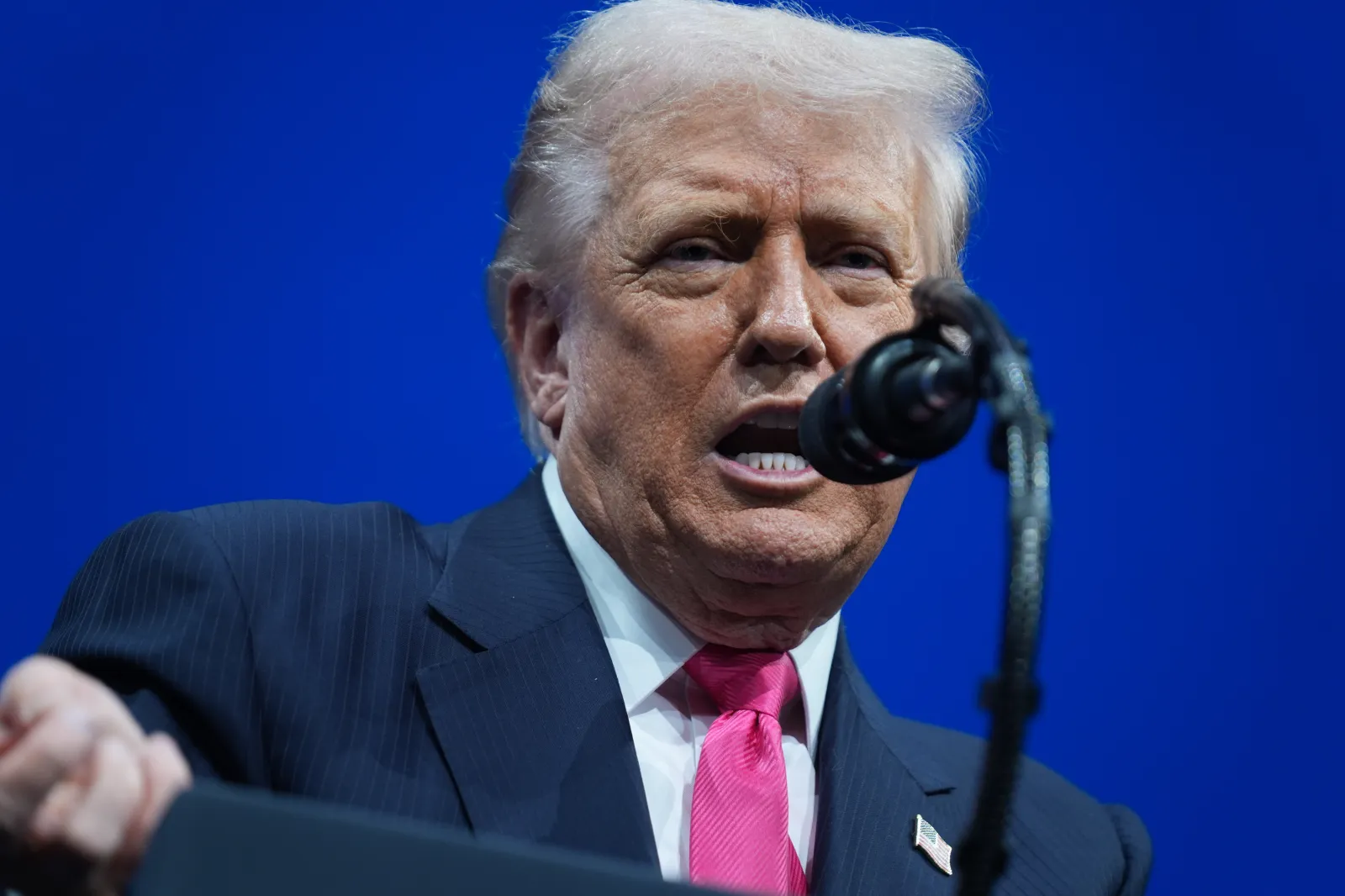
President Donald Trump’s call for a federal standard on artificial intelligence regulation, seeking to prevent states from imposing their own restrictions on AI, has drawn backlash from some Make America Great Again (MAGA) supporters, as well as Democrats.
Why It Matters
Big Tech firms have supported Trump’s presidency with contributions to his campaign, his inaugural fund and events at his properties.
Read More on Politics
The president is reportedly weighing an executive order on the matter, with Reuters reporting that it would direct U.S. Attorney General Pam Bondi to establish a task force on challenging state measures as well as directing the Federal Trade Commission to issue policy statements on the matter.
MAGA has recently had some splinters over the Jeffrey Epstein files and foreign policy, with a monumental break between Trump and Representative Marjorie Taylor Greene. Greene has served as one of Trump’s most influential surrogates, amplifying his message across the hard-right base and shaping grassroots activism.
...
What To Know
On Tuesday, Trump wrote on Truth Social: “Investment in AI is helping to make the U.S. Economy the “HOTTEST” in the World — But overregulation by the States is threatening to undermine this Growth Engine,” arguing that some states are embedding “DEI ideology into AI models,” that in turn, produce “Woke AI.”
He called for a nationalized regulation, saying: “We MUST have one Federal Standard instead of a patchwork of 50 State Regulatory Regimes. We can do this in a way that protects children AND prevents censorship!” The regulation at the time was suggested to be part of the National Defense Authorization Act, although it is reportedly being weighed as a standalone executive order.
Several Republicans have spoken out against the potential move, including Florida Governor Ron DeSantis, who said the plan was "federal government overreach." More broadly, several MAGA leaders have expressed dismay about the president's AI push and tech policies, with Steve Bannon having previously said that the pursuit of AI intelligence was akin to "summoning the demon," and Arkansas Governor Sarah Huckabee Sanders writing over the summer in opposition to the AI moratorium in the "Big, Beautiful Bill" to "drop the preemption plan now and protect our kids and communities."
The White House's push on AI comes as Trump hosted several top tech leaders this week, including Elon Musk, Nvidia CEO Jensen Huang and Open AI President Greg Brockman, among others.
Currently, all 50 states have various AI-related legislation to regulate the fast-growing technology, including dictating ownership of content, commitment to protections and safety protocols.
This summer, the Senate voted 99-1 to strip a provision that would have imposed a 10-year moratorium on state regulation of artificial intelligence. The president announced his 28-page AI plan in July.
What People Are Saying
Representative Marjorie Taylor Greene, a Georgia Republican, on X on Thursday: “There should not be a moratorium on states rights for AI. States must retain the right to regulate and make laws on AI and anything else for the benefit of their state. Federalism must be preserved.”
Governor Ron DeSantis, a Florida Republican, on X on Tuesday: “Stripping states of jurisdiction to regulate AI is a subsidy to Big Tech and will prevent states from protecting against online censorship of political speech, predatory applications that target children, violations of intellectual property rights and data center intrusions on power/water resources. The rise of AI is the most significant economic and cultural shift occurring at the moment; denying the people the ability to channel these technologies in a productive way via self-government constitutes federal government overreach and lets technology companies run wild. Not acceptable.”
Senator Josh Hawley, a Missouri Republican, who, along with Senator Mark Warner, a Virginia Democrat, introduced AI-Related Job Impacts Clarity Act, in a November 5 press release: "The American people need to have an accurate understanding of how AI is affecting our workforce, so we can ensure that AI works for the people, not the other way around."
Senator Chris Van Hollen, a Maryland Democrat, on X on Thursday: “Must be a total coincidence this announcement came the day after these guys were seen at Trump’s ritzy dinner party. Trump doesn’t have this authority. States are filling the void left by the federal govt’s failure to create an accountability structure for AI companies.”
Teamsters Union, on X on Thursday: "Right now, Big Tech lobbyists are trying to sneak language into the National Defense Authorization Act (NDAA) that would prohibit states from passing laws to restrict artificial intelligence (AI). This is no different than the bad AI legislation that Teamsters got removed from the One Big Beautiful Bill this summer by a 99-1 vote in the Senate. If it is included in the NDAA, Big Tech's legislation would prohibit states and localities from passing laws that restrict AI used in autonomous vehicles, worker surveillance, hiring decisions, and more. This would kill the Teamsters ongoing work in state legislatures across the nation to protect our members from the threat of unregulated AI."
Senator Ed Markey, a Massachusetts Democrat, on X on Tuesday: "First, Donald Trump sided with his billionaire Big Tech buddies and endorsed the AI regulation moratorium. Now, MAGA Republicans are trying to sneak it into the defense bill. Democrats must stand up to this all-out attack on AI regulation."
What Happens Next
A spokesperson for the White House told Newsweek in an email Thursday: “Until officially announced by the WH [White House], discussion about potential executive orders is speculation.”
View 0 Comments
Submit Correction
View Editorial & AI Guidelines