...


By Sam Stevenson and Matthew Robinson
0
Share
Newsweek is a Trust Project member
See more of our trusted coverage when you search.Prefer Newsweek on Googleto see more of our trusted coverage when you search.
More than a year into his return to the White House, President Donald Trump’s approval ratings paint a familiar but sharpened picture of America’s political divide.
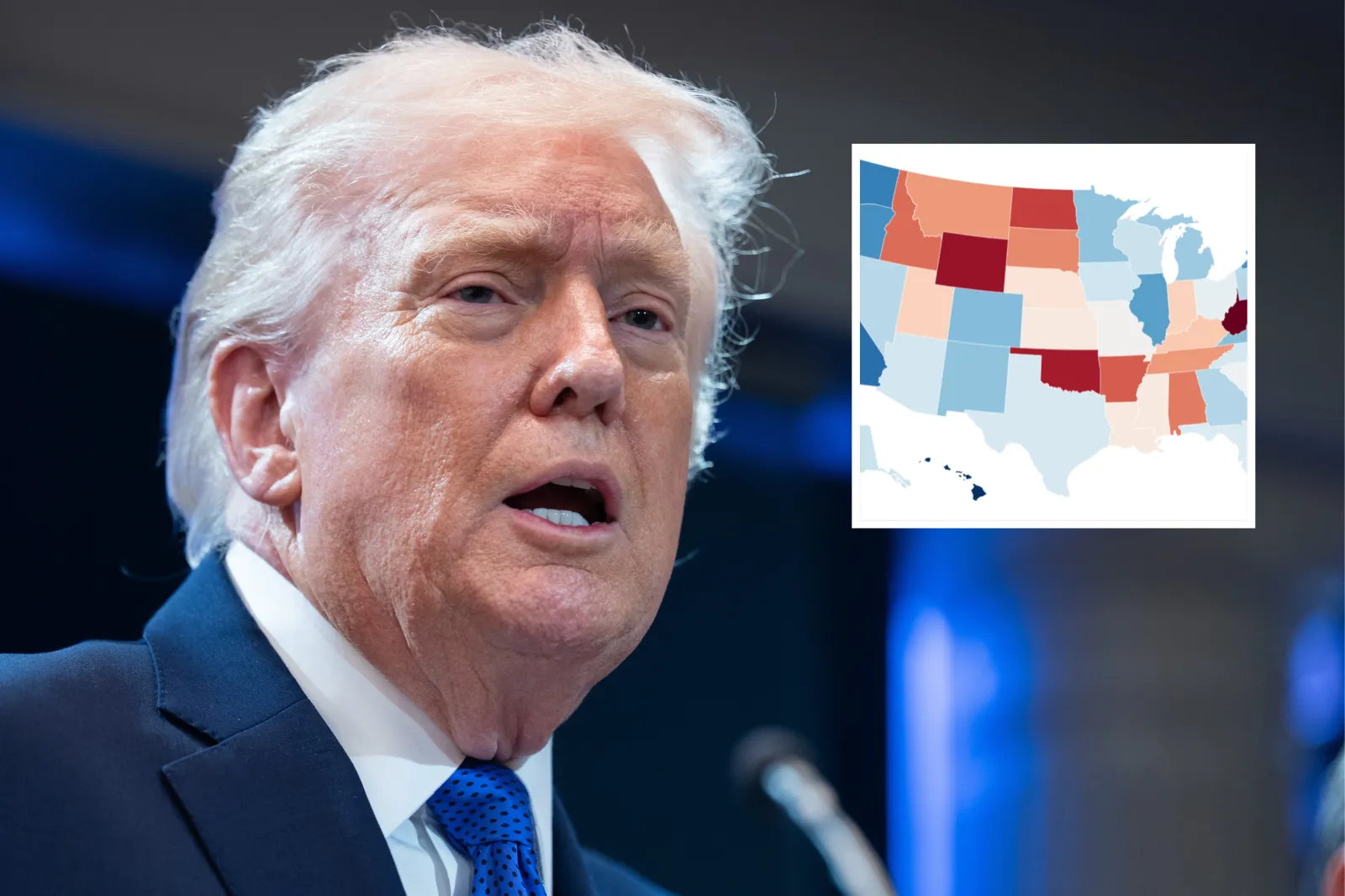
New state‑by‑state data shows the country split into deep red strongholds where Trump remains popular, deep blue states where opposition is overwhelming, and a shrinking band of battlegrounds where dissatisfaction still outweighs approval, but not decisively.
The Civiqs figures, which include responses from 87,117 registered voters from January 20, 2025, to February 19, 2026, show the share of adults in each state who say they approve or disapprove of Trump’s job performance, with a smaller group saying they neither approve nor disapprove.
Read More on Politics
White House spokesperson Davis Ingle told Newsweek in an emailed statement: "The ultimate poll was November 5, 2024, when nearly 80 million Americans overwhelmingly elected President Trump to deliver on his popular and commonsense agenda."
Deep Red: Where Trump Still Commands Clear Support
Across much of the Deep South and parts of the Mountain West, Trump continues to post majority approval or near‑majority support.
West Virginia stands out as his strongest state, with 58 percent approving and just 35 percent disapproving, giving a net approval rating (those who approve minus those who disapprove) of +23 points.
Oklahoma (57 percent approve), Wyoming (57 percent), North Dakota (56 percent), Arkansas (54 percent), Alabama (53 percent), Idaho (53 percent), Montana (53 percent), South Dakota (53 percent) and Tennessee (52 percent) remain firmly in Trump’s corner.
They are states where Republican margins have been wide for years, and the map shows little evidence of erosion. In many of them, Trump’s approval exceeds his disapproval by double digits, suggesting that opinions are not just partisan—but settled.
Even in states where approval sits closer to 50 percent, such as Kentucky, Indiana, Utah and Mississippi, Trump still holds a narrow edge, underscoring how durable his support remains in culturally conservative regions.
Deep Blue: States Where Opposition Is Entrenched
At the other end of the spectrum, Trump’s standing is weakest along the West Coast and in the Northeast, where disapproval regularly tops two‑thirds of respondents.
Hawaii records the highest disapproval in the country, with 77 percent saying they disapprove and only 19 percent saying they approve, giving a net approval rating of -58 points. Vermont follows closely at 75 percent disapproval and 22 percent approval for a net approval rating of -53 points.
In California, Washington, Oregon, Massachusetts, Maryland, New York, Rhode Island, Connecticut and New Jersey, roughly two‑thirds or more disapprove of Trump’s performance.
Approval in those states often sits in the 20s or low 30s. In California, just 26 percent approve. In Massachusetts and Maryland, approval is 25 percent. Hawaii posts the lowest approval nationwide at 19 percent.
The numbers suggest hardened opposition rather than temporary dissatisfaction. Even accounting for undecided respondents, Trump faces a steep structural deficit in those states that has changed little over time.
Swing States: Disapproval Leads, but Not Overwhelmingly
The most politically revealing part of the map lies in the middle.
In many traditional battleground states, Trump’s approval trails disapproval—but often by single digits, not landslides.
Pennsylvania shows 40 percent approval versus 55 percent disapproval, putting the president 16 points underwater.
Michigan stands at 37 percent approve, 58 percent disapprove, for a -21 net approval rating. And Wisconsin posts 42 percent approval and 54 percent disapproval, for a net approval rating of -12.
Arizona, Georgia, North Carolina and Nevada follow a similar pattern: approval in the low 40s, disapproval in the low to mid‑50s. Florida and Texas also sit in this zone, with approval at 44 percent and disapproval at 52 percent in both states.
The margins matter. While Trump is underwater, the gap is narrow enough that shifts in turnout, intensity or undecided voters could materially affect the outcome of future elections.
Middle Ground Is Small, but Important
Across nearly every state, the share of respondents who say they neither approve nor disapprove is relatively modest, usually between 3 percent and 6 percent.
That suggests most Americans have already formed an opinion—and in many places, those views are deeply entrenched. Still, in closely divided states, even small movements among undecided or weakly aligned voters could tip the balance.
Polarized Map, One Year In
Taken together, the map shows a country that looks much like it did at the ballot box, but with sharper edges.
Trump’s strongest states remain solidly supportive. His weakest states show little sign of softening opposition. And in the middle, dissatisfaction outweighs approval, but not by margins that put those states completely out of reach.
Thirteen months in, the numbers suggest stability more than momentum—an electorate largely dug in, with the battle lines clearest in the places that matter most.
What People Are Saying
White House spokesperson Davis Ingle told Newsweek in an emailed statement: "The ultimate poll was November 5, 2024, when nearly 80 million Americans overwhelmingly elected President Trump to deliver on his popular and commonsense agenda. The President has already made historic progress not only in America but around the world. It is not surprising that President Trump remains the most dominant figure in American politics."
President Donald Trump, on Truth Social this month: “The highest Poll Numbers I have ever received. Obviously, people like a strong and powerful Country, with the best economy, EVER!”
What Happens Next
With most voters already firmly decided, the next shifts in the map are likely to come not from broad opinion changes but from small movements in closely divided swing states where approval and disapproval remain within a single‑digit range.
In a polarized era, the center is dismissed as bland. At Newsweek, ours is different: The Courageous Center—it's not "both sides," it's sharp, challenging and alive with ideas. We follow facts, not factions. If that sounds like the kind of journalism you want to see thrive, we need you.
When you become a Newsweek Member, you support a mission to keep the center strong and vibrant. Members enjoy: Ad-free browsing, exclusive content and editor conversations. Help keep the center courageous. Join today.


View 0 Comments
Submit Correction
View Editorial & AI Guidelines