
10
Loading video...


By Gabe Whisnant and Anna Commander
0
Share
Newsweek is a Trust Project member
See more of our trusted coverage when you search.Prefer Newsweek on Googleto see more of our trusted coverage when you search.
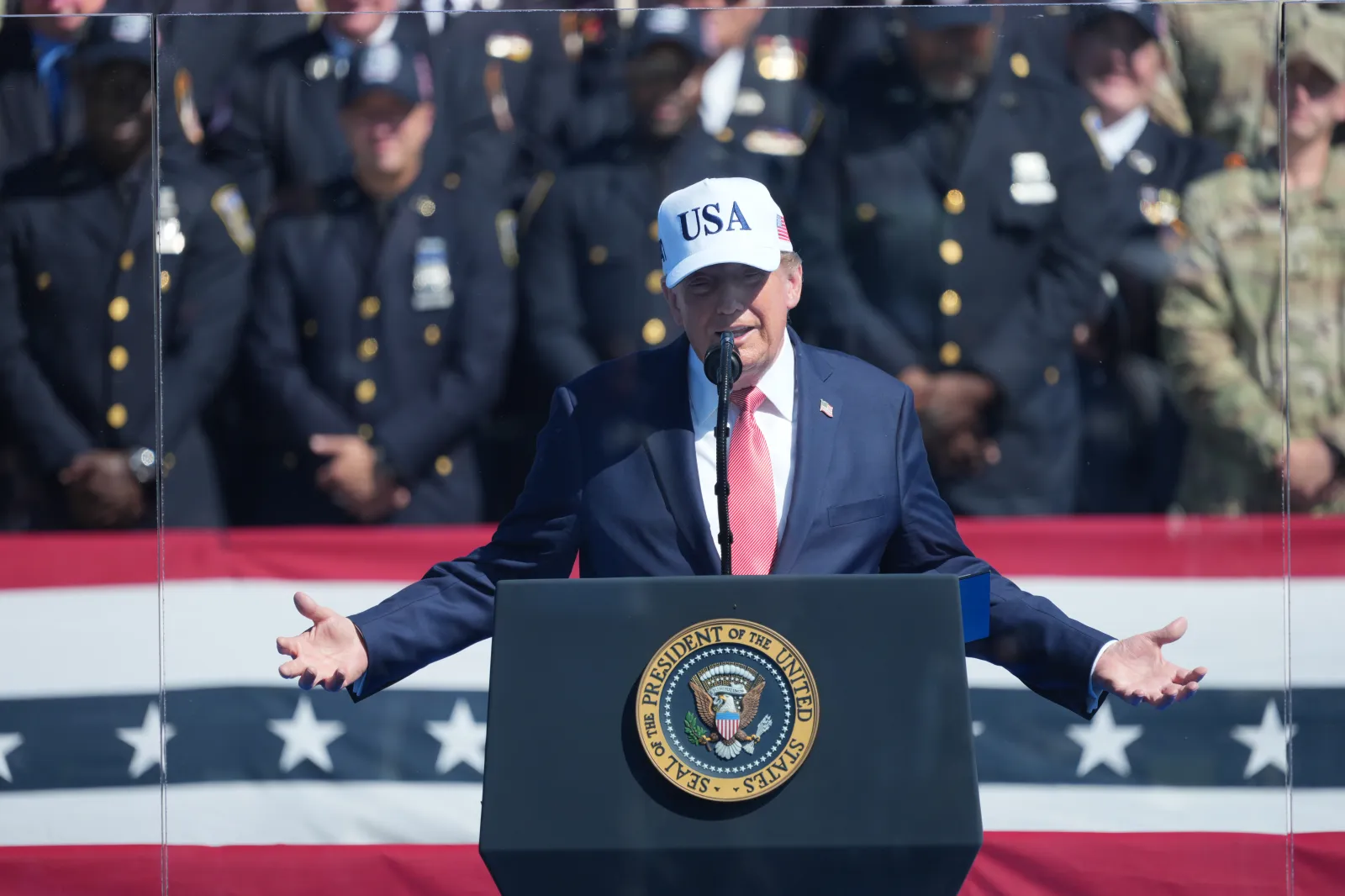
President Donald Trump on Tuesday delivered another public recollection of the aftermath of the September 11, 2001, terrorist attacks, offering fresh details as he reflected on the tragedy ahead of its 25th anniversary.
Speaking at a "Steel Across America" event near the White House to honor first responders and the victims of the attacks, Trump recalled bringing construction workers to Ground Zero shortly after the collapse of the World Trade Center towers and described a chaotic scene in Lower Manhattan as rescue and recovery operations got underway. He also recounted a dramatic moment in which, he said, two firefighters grabbed him and carried him away from an area where officials feared a nearby building could collapse.
"I was building a big building in New York, and I took the whole crew down there right after this happened," Trump said. "And they had no hesitation. Everybody went down with me. We went down as a big group of people. I'll be honest, it was raw and nobody's seen anything like it ever.
Read More on U.S.
"The United States Steel Building was creaking, really creaking, and we thought it was gonna fall down. It still creaks, but it never came down. And I'll never forget two firemen. We thought it was coming down on top of us, and two firemen, big strong guys, and I'm not the smallest guy in the world. They grab me under the arms. They literally lifted me up. This is not easy to do. They lifted me up and they started running with me. I said, 'Fellas, I can run myself.' But they were amazing. But they thought it was coming down."
...
The building that Trump referred to as the U.S. Steel Building is now known as One Liberty Plaza, a 54-story office tower in Lower Manhattan that was damaged but remained standing after the attacks.
When reached for comment via email, the Fire Department of New York (FDNY) press office told Newsweek, "We cannot provide context here; none of us were there, nor would we be the authority on whether contractors were there or not."
When asked for evidence supporting Trump's latest account of his actions and experiences in the aftermath of the September 11 attacks, White House spokesperson Davis Ingle told CNN journalist Daniel Dale that Trump had spent the day honoring "the heroic first responders who laid down their lives" and their families. According to a post by Dale on X, Ingle said the president was simply recounting his experience of New York after the attacks and accused "the failing legacy media" of trying to attack him, calling it "a disgrace."
The remarks are the latest chapter in Trump's long and evolving public narrative about 9/11, a tragedy that unfolded in his hometown and has remained a recurring theme throughout his political career.
Newsweek has reached out to the White House via email on Tuesday afternoon for additional comment.
In a lengthy post on Truth Social Tuesday night, Trump pushed back against reports questioning his account of visiting the World Trade Center site after the September 11 attacks, saying he went to Lower Manhattan shortly afterward with a group of construction workers. Trump highlighted his remarks earlier in the day and pointed to video clips and alleged statements from his former head of security, Matthew Calamari, as support for his account.
Trump also disputed reporting about his decision to attend the Pentagon’s September 11 commemoration rather than the ceremony at the World Trade Center, arguing that public officials do not deliver speeches at the New York ceremony. "Again, speeches are not made at the New York event and, even if they were, I never asked to speak," Trump said in part in his post.
He accused New York Times reporter Maggie Haberman and New York Magazine of publishing false accounts and demanded a retraction.
Republican Senator Ted Cruz of Texas was asked about Trump's remarks on CNN Tuesday night, saying to Kaitlan Collins, "September 11 was 25 years ago, it was a horrific moment for our entire country and you can doubt whatever you want about Donald Trump but the man is a New Yorker, he loves New York, and I have every doubt that what he's conveying there is what he experienced and it was a traumatic experience for all of us."
Related Story

’25 Years Ago’ Account Explains How It Will Cover 9/11 Live Updates
Trump's First Public Comments on September 11
Trump was at his Trump Tower apartment in Midtown Manhattan on the morning of September 11 and gave media interviews as the attacks unfolded.
In a live telephone interview with WWOR-TV just hours after the Twin Towers were struck, Trump discussed the New York City attacks and the response he believed the United States should pursue against those responsible. During the same interview, he also remarked that his building at 40 Wall Street had become the tallest remaining building in Lower Manhattan following the collapse of the World Trade Center.
"Forty Wall Street actually was the second-tallest building in downtown Manhattan, and it was actually before the World Trade Center the tallest, and then when they built the World Trade Center it became known as the second-tallest, and now it's the tallest," Trump, then a real estate developer, said during the interview.
"And I just spoke to my people, and they said it's the most unbelievable sight. It's probably seven or eight blocks away from the World Trade Center. And yet Wall Street is littered with two feet of stone and brick and mortar and steel."
Two days later, Trump appeared near Ground Zero, where he surveyed the destruction and spoke to reporters and television crews. A Washington Post report from September 13, 2001, described him arriving at the site and observing the ongoing recovery effort.
In interviews at the time, Trump described the devastation as unlike anything he had ever witnessed and said workers associated with his company were assisting in the area. He also spoke about participating in the rebuilding effort that would eventually follow.

...
Ground Zero Becomes Part of Trump's Political Story
As Trump entered national politics, September 11 increasingly became part of his public identity.
During the 2016 Republican primary campaign, he frequently referenced the attacks while defending New York against criticism from rivals and emphasizing his connection to the city. At campaign events, Trump spoke about witnessing the attacks and experiencing their aftermath firsthand.
"Hey, I watched when the World Trade Center came tumbling down, and I watched in Jersey City, New Jersey, where thousands and thousands of people were cheering as that building was coming down. Thousands of people were cheering," then-presidential candidate Trump said during a rally he held in Birmingham, Alabama.
Trump reiterated his remark later to ABC News and said the cheers came from parts of New Jersey with "large Arab populations." There is no evidence to support his claim of the celebrating in New Jersey.
During a Republican primary debate in South Carolina in 2016, he pushed back against criticism of "New York values" by invoking the city's response to the attacks.
"It was with us for months, the smell," Trump said at the time. "Everybody in the world loved New York and loved New Yorkers."
He also repeatedly argued that he would have taken a harder stance against terrorism than had he been president, instead of George W. Bush, in 2001, making 9/11 a frequent point of reference in broader discussions about national security and foreign policy.
Trump Provides New Details Over the Years
The substance of Trump's personal recollections has expanded over the years.
In interviews and speeches, he has described watching the attacks from New York, visiting Ground Zero shortly afterward and speaking with first responders and construction workers involved in the recovery effort.
During a 2016 campaign rally and in a 2021 interview with Newsmax, Trump said firefighters moved him away from what he identified as the U.S. Steel Building after a "screech" and concerns that the structure might collapse. On Tuesday, he revisited the story while adding details about bringing a construction crew to Ground Zero and witnessing fires that continued burning in the rubble.
A Defining Event in Trump's Public Life
Trump's relationship with September 11 has long been different from that of most national political figures because he was a New Yorker, businessman and public figure living in the city when the attacks occurred.
That connection has made 9/11 a recurring subject throughout his political career, from campaign rallies and presidential debates to commemorative events and anniversary interviews. Trump is expected to commemorate the 25th anniversary of the September 11 attacks at the Pentagon on Friday rather than at the annual ceremony at Ground Zero in New York City.
The New York Times said that Trump would not attend the ceremony at Ground Zero because he wouldn't be allowed to give a speech as politicians have been banned from speaking since 2012.Vice President JD Vance will be in New York instead on September 11, a White House official said.
As the nation prepares to mark 25 years since the attacks, Trump's latest recollections add new personal details to a story he has been publicly telling since the fall of 2001.
Contact Newsweek editors on this story: Samantha Beech, Dave Siminoff, Gray R. Thomas
View 0 Comments
Submit Correction
View Editorial & AI Guidelines