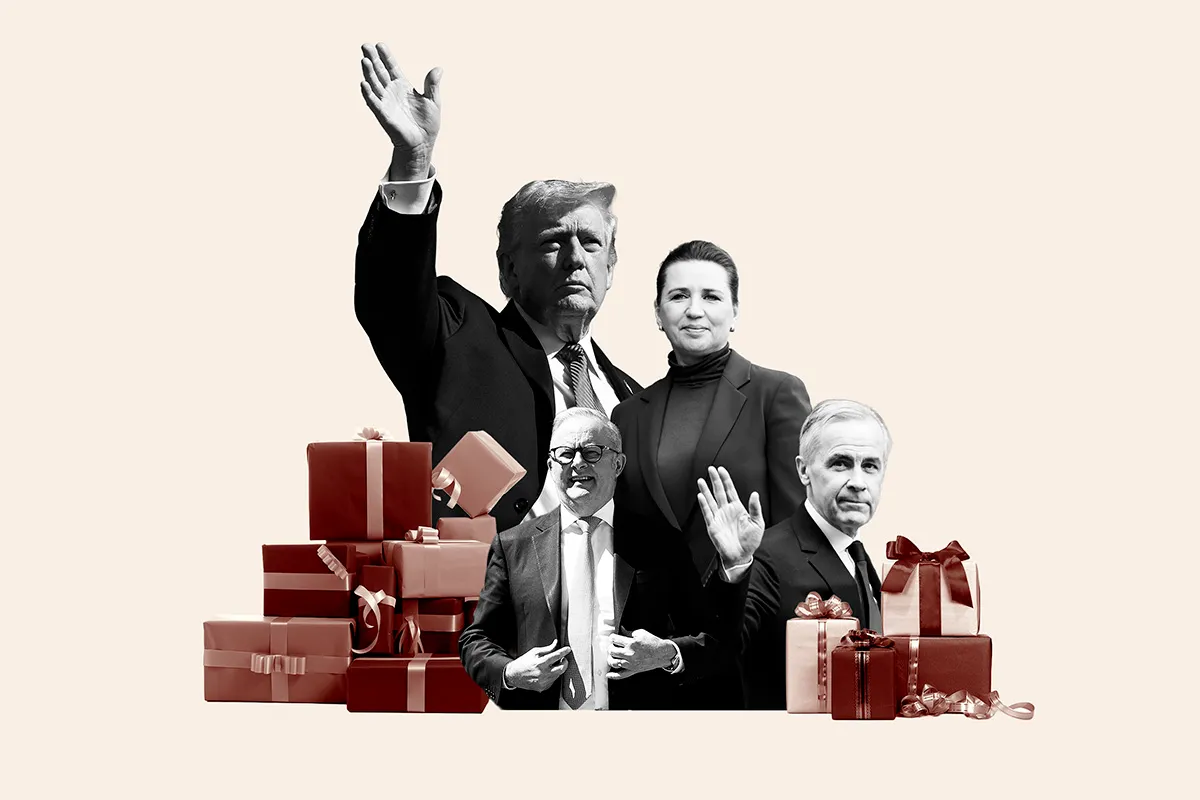
Getty Images/Newsweek Illustration

By Andrew Stanton
Reporter
0
Share
Newsweek is a Trust Project member
See more of our trusted coverage when you search.Prefer Newsweek on Googleto see more of our trusted coverage when you search.
Despite gaining momentum after U.S. President Donald Trump's threats to seize Greenland, Denmark's left-leaning parties were handed an election sting, Reuters reports on Tuesday, as the bloc was heading for its worst results in over 100 years.
The voting results follow Trump’s rhetoric on Greenland since his return to the White House last year. Denmark Prime Minister Mette Frederiksen’s left-wing party lost numerous seats in the legislature compared to four years ago, per Reuters. Control of the government, however, remains to be negotiated.
Denmark Election Results: What to Know
The left-leaning "red bloc" did win 84 seats compared to the 77 captured by the right-leaning "blue bloc," Reuters reports, while citing projections by local media.
Read More on World
But neither coalition secured an outright majority in Denmark's legislature, which means the Moderate party will play kingmaker. Leaders will spend the coming weeks working to form a government—and it's no guarantee that the left-leaning bloc will reign victorious.
Still, Trump's Greenland threats represented a turning point in public polling that allowed the left-leaning coalition to put up a fight for government control.
Getty Images/Newsweek Illustration
Trump has repeatedly argued the U.S. should acquire Greenland, an autonomous territory within the Kingdom of Denmark. He said that seizing control of the autonomous island is critical for U.S. security given the threats posed by Russia and China, and the White House has even declined to take off the table the option of employing military force to capture it.
But that position has drawn criticism from European allies and NATO.
Polling showed Frederiksen’s support slipping before the Greenland threats, but it rebounded in recent months. Both conservative parties and those to her left had picked up steam in polls. She called the early election in February to capitalize on growing support in the polls amid Trump's Greenland rhetoric.
Frederiksen leads the Social Democrats, a center-left party. But her current coalition also includes the center-right Venstre and centrist Moderates parties. How that coalition may shift in the new government remains unclear. In Denmark, leaders of more than 10 parties negotiate for control of the government after an election due to its multiparty system, in which no party comes close to an outright majority.
The Social Democrats’ polling steadily increased amid the Greenland crisis. The pollster Voxmeter’s final poll of 2025 showed Frederiksen's party polling at 18.9 percent. It had surveyed 1,005 people from December 15 to December 21. By its final poll on Monday, the party’s support swelled to 22.4 percent.
Denmark Left Made Polling Comeback Amid Trump Greenland Threats
Polling from late last year showed the “blue bloc” surge, with the December Voxmeter poll showing the bloc with 50.4 percent support. That advantage had since vanished, with the pollster's latest survey showing the red bloc ahead with 48.3 percent. The moderate parties could decide government control.
Frederiksen has been a vocal opponent of allowing the U.S. to annex Greenland, saying earlier this year that Copenhagen is "ready to defend our values—wherever it is necessary.”
She previously discussed the Greenland crisis with Newsweek. "I have tried to de-escalate the situation, because in this world, with a very aggressive Russia, with a closer cooperation between Iran, North Korea and Russia, helped by China, I will do what I can to ensure that nothing goes wrong between allies and good friends and partners. But at the same time, we have to stick to the most important values and principles," she said.
She also addressed the Danish relationship with the U.S. when announcing the election. "It will be in the next four years that we as Danes and as Europeans will really have to stand on our own feet," Frederiksen said, in remarks reported by Reuters. "We need to define our relationship with the United States, and we must rearm to ensure peace on our continent."
The relationship with the U.S. was not the only core issue for voters in the Danish elections, as immigration and the cost of living also remained critical to constituents.
Trump Loomed Over Canada, Australia Elections
Left-leaning candidates in Canada and Australia rode anti-Trump waves to victory in elections last year, despite polling that suggested conservatives were poised to surge in both countries.
It is “unique” that a U.S. president could have such an impact on another country's elections, Carolyn Dudek, professor of political science at Hofstra University, told Newsweek.
“Perhaps, when there were tensions with Europe over the Iraq war, that explained the outcome of the Spanish election, ie Spain’s population wanted to get out of the war in Iraq and move away from the US’s policy there. I don’t think the link between the administration and shifting the election was quite as direct as this is today though. It was more about the war,” she said.
Left-leaning leaders distancing themselves from Trump is not just a “strong electoral strategy” but part of a foreign policy strategy, as those leaders do not view his White House as a reliable partner, she said.
Dudek also said that governments in some countries, like Hungary and Slovakia, are still more sympathetic toward the Trump administration. Other European allies, however, will continue needing to “look elsewhere for support,” she said.
Trump has made similar comments about taking control of Canada and making it the 51st state, a proposal deeply unpopular among both liberals and conservatives in America's neighbor to the north.
Polls had shown former Prime Minister Justin Trudeau, leader of the center-left Liberal Party, in danger of losing a majority before those threats. But Trudeau, whose personal popularity waned, stepped down from the campaign. Mark Carney, former Central Bank of England governor, stepped in and carried the party to victory in the April 2025 elections.
Carney hit out against Trump in his victory speech. “As I’ve been warned, America wants our land, our resources, our water, our country. But these are not idle threats. President Trump is trying to break us so that America can own us. That will never, that will never ever happen,” he said.
In Australia, backlash toward Trump’s sweeping tariffs helped Prime Minister Anthony Albanese of the Labor Party win reelection in May, reported The New York Times.
Albanese had not positioned himself as particularly anti-Trump, but conservative candidate Peter Dutton had more closely aligned himself with MAGA-like politics, a move that did not play well among Australia’s electorate. A poll by YouGov and Australia’s ABC News showed that in April 2025, 66 percent of Australians believed their country could not rely on the U.S. for national security. It surveyed 1,500 respondents from April 17 to April 24.
In his victory speech, Albanese acknowledged the role Trump played in the election. “Our government will choose the Australian way. Because we are proud of who we are—and all that we have built together in this country. We do not need to beg or borrow or copy from anywhere else. We do not need to seek our inspiration overseas. We find it right here in our values—and in our people,” he said.
The Associated Press contributed reporting for this article.
View 0 Comments
Submit Correction
View Editorial & AI Guidelines