...

By Mandy Taheri
Reporter
0
Share
Newsweek is a Trust Project member
See more of our trusted coverage when you search.Prefer Newsweek on Googleto see more of our trusted coverage when you search.
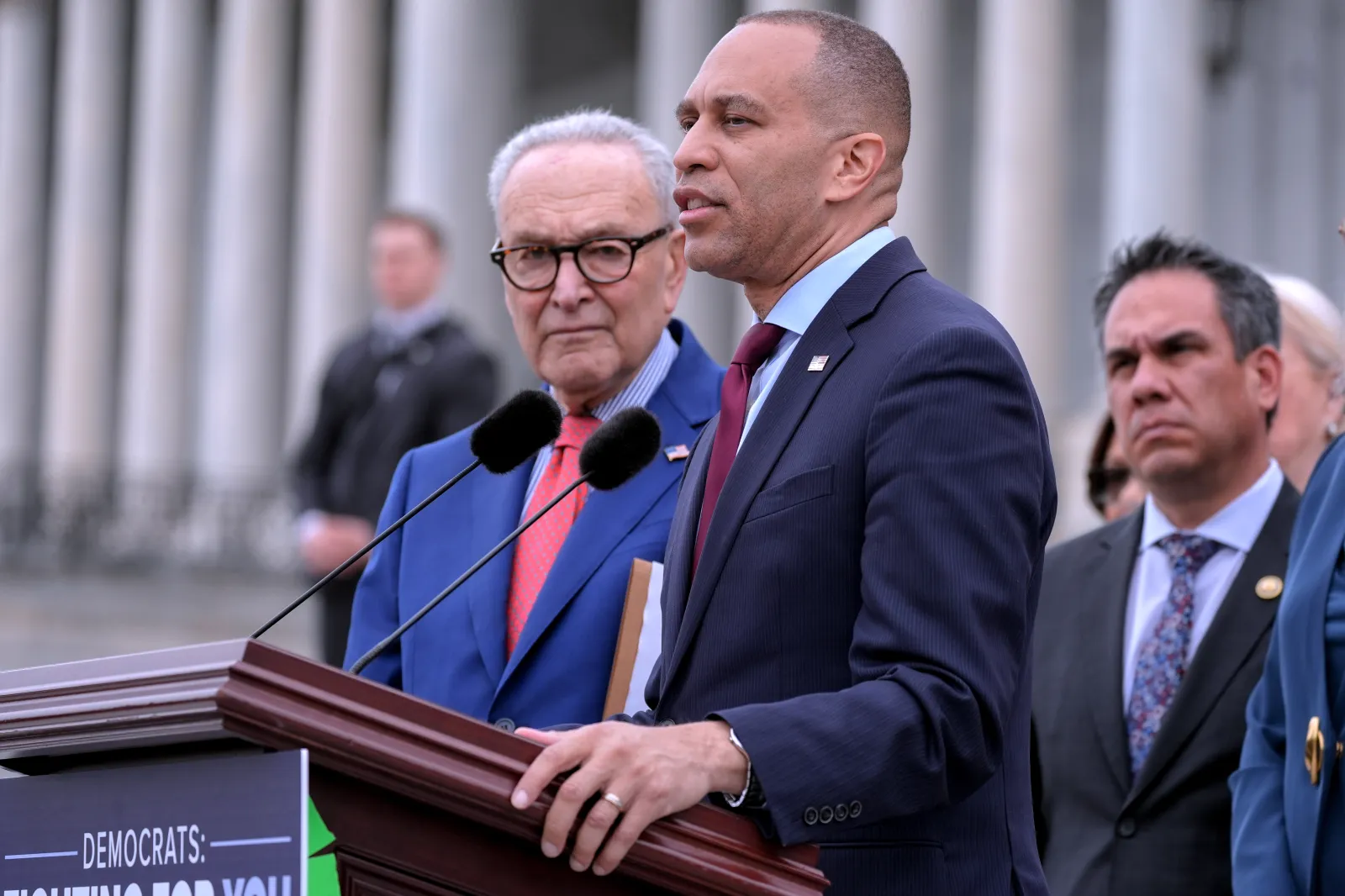
As Democrats gear up for the 2026 midterms in hopes of a “blue wave” that would reclaim control of Congress, an intraparty debate is continuing over whether Democrats should center their message on opposition to President Donald Trump, including calls for impeachment, or instead focus on a broader, specific policy-focused vision.
“Democrats are debating tactics instead of presenting a unified governing brand,” Matt Klink, owner and president of Klink Campaigns, told Newsweek in an email.
The debate reflects an ongoing broader identity crisis facing Democrats as the party looks to regain political momentum after Republicans swept the White House and Congress in 2024, while recent polls have shown voters’ dissatisfaction with the party.
Read More on Politics
While opposition to Trump has long served as a unifying force for Democrats, some strategists and lawmakers warn that centering the party solely around resistance risks alienating voters more focused on policy priorities including inflation, housing costs, healthcare and America's economy in general.
With control of Congress at stake in November, the party’s messaging strategy could shape the midterms outcome as well as the coalition Democrats hope to build heading into the 2028 presidential election.
“The Democratic party must stop relying on backlash to win campaigns. It will likely work for this midterm cycle but is unlikely to carry over to 2028 because Trump will not be on the ballot,” Alex Patton, principal of Ozean Media, told Newsweek in an email.
Newsweek has reached out to the Democratic National Committee for comment via email.
Impeachment Messaging
As Democrats eye a path back to power in the 2026 midterms, the party is targeting a slate of competitive battleground races, from the closely watched Texas U.S. Senate contest to key House and gubernatorial races nationwide, while internal divisions continue over the message Democrats should rally behind heading into the election cycle.
“The impeachment messaging caters to the most progressive elements in the party and is a process argument, not a kitchen-table argument. Voters don't reward a politician for simply being anti-Trump; they reward politicians and political parties that make their lives feel more secure and affordable,” Klink told Newsweek about Democrats' push for Trump impeachment messaging.
“Being anti-Trump is the ticket needed for entry, so this stance will be ever-present among all Democrats,” he added.
Democrats have long centered opposition to Trump in campaign messaging over the past several election cycles, with some lawmakers and candidates also supporting impeachment efforts against him.
“The only thing that unites the Democratic base and papers over their mostly incoherent approach to real issues is the impeachment message. I expect that the Democrats will be leaning hard into that message over the coming months,” John Feeehry, partner at EFB Advocacy, told Newsweek in an email Wednesday.

...
However, some Democrats are pushing back against the narrative, such as Representative Robert Garcia, a California Democrat, who said at the 2026 IDEAS conference hosted by the Center for American Progress earlier this week, “You can’t take it off the table. But the reality [is] Trump does an impeachable offense every week. And so we could spend an enormous amount of time going through that process, or we could try to do everything we can to stop and slow the Trump regime.”
Trump, who's in the midst of his second term in the Oval Office, has repeatedly proved to hold a strong influence over primary and general elections. Representative Thomas Massie on Tuesday was beaten by Trump-backed Ed Gallrein in the Republican primary for Kentucky’s 4th Congressional District, with 45.1 percent of the vote to Gallrein's 54.9 percent.
The defeat came amid Massie’s ongoing feud with Trump, in which the Republican representative had broken several times with Trump over the Epstein files and Iran war, among other issues.
Doug Gordon, co-founder of Upshift Strategies, told Newsweek that Democrats need to match up Republicans' 2024 messaging to the present, saying, “Republicans were elected in 2024 to lower prices. But instead they have focused on taking health care away from tens of millions of people, gotten the country stuck in an unnecessary war that has sent gas prices through the roof and are more focused on building ballrooms and seeking revenge on their political opponents than on lowering costs for Americans. Democrats need to keep hammering that message every day between now and election day."
Democrats Pushing for a New Message
California Democratic Governor Gavin Newsom, often at odds with the president and believed to be a front-runner for the 2028 Democratic presidential nomination, said during the IDEAS conference that “The Democratic Party should be a party that builds,” and position itself in contrast to the “destruction on the other side, of institutions and allies and trust.”
New Jersey Democratic Governor Mikie Sherrill said that instead of focusing on Trump, the party should target responding to voters’ concerns, saying, “We cannot be the party of strongly worded letters. We can’t settle for 10-year studies.”
She focused her remarks on kitchen-table issues such as affordability, while Senator Elizabeth Warren advocated for universal childcare and Senator Raphael Warnock emphasized preserving voting rights protections.
During the conference to establish the Democratic Party's standing, Representative Greg Casar said on Tuesday, "If all we do is accountability but don't also do affordability work, then I think we'll have failed."

...
“I expect Democrats to test two lanes: a populist ‘who is making your life harder?’ message and a more pragmatic ‘here is what we will do about costs’ message. The winning version blends both,” Klink said. “You need a contrast, but you also need consent, which entails a clear story, credible messengers, and a practical reason for voters to say yes.”
The political strategist concluded, “Right now, the Democratic platform is less a full rebrand than a recalibration after 2024: affordability, protecting democracy, reproductive rights, health care, housing, and pushing back on Trump. If voters think it sounds familiar, it's because it is. They rejected it in 2024.”
But other strategists, such as Maya Handa, who oversaw Democratic socialist Zohran Mamdani’s campaign for New York City mayor in 2025, say more is up for grabs this year in terms of Democratic branding. “It’s about what we are going to say in 2026, but also about how we say it and how we campaign,” she said in April.
...
“What we saw in ’25 actually speaks to a little bit of both of those kind of pillars. I do think a focus on affordability was really, really important. And I think one thing that we saw was candidates being able to really focus in on tangible political platforms, tangible messages that were about what we were going to do for you,” Handa added.
Patton urged Democrats to “stop playing the political game from 20 years ago. That era is gone,” later adding, “In a nutshell, I would tell the Democrats to Cowboy up!”
Americans' View of the Democratic Party: Poll
While Trump has recently posted approval ratings below 40 percent, polls have also shown some challenging favorability and satisfaction ratings for the Democratic Party among voters.
A New York Times/Siena poll conducted from May 11-15 found that 26 percent of voters are satisfied with Democrats, 11 points lower than Trump's approval rating in the same poll.
Forty-four percent of Democrats describe being unsatisfied with their party, compared to 23 percent of Republicans who express the same reservations about theirs. The poll found that among potential Democratic supporters, 53 percent are dissatisfied, and 45 percent satisfied. Yet despite the contentment deficit, Democrats lead the generic 2026 midterm election ballot 50 percent to 39 percent. The poll of 1,507 registered voters has a margin of error of plus or minus 2.8 percentage points.
An April Pew Research Center survey found that Americans viewed both major parties more unfavorably than favorably, with 58 percent expressing an unfavorable view of Democrats and 59 percent viewing Republicans unfavorably.
The poll also found Democrats’ favorability ratings had improved from a low point in August 2025 when it was 36 percent. Among Democratic voters and Democratic-leaning independents, 84 percent viewed the party favorably, up from 77 percent in the summer. The poll surveyed 5,103 U.S. adults from April 20-26 and has a margin of error of plus or minus 1.6 percentage points.
View 0 Comments
Submit Correction
View Editorial & AI Guidelines