10
Loading video...

By Khaleda Rahman
National Correspondent
0
Share
Newsweek is a Trust Project member
See more of our trusted coverage when you search.Prefer Newsweek on Googleto see more of our trusted coverage when you search.
Longtime U.S. Representative John Larson was ousted in Connecticut’s Democratic primary on Tuesday, becoming the latest in a series of sitting Democrats to lose their seats in primaries this year.
The 78-year-old Larson’s defeat in Connecticut's 1st Congressional District by former Hartford Mayor Luke Bronin, 47, is one of the clearest signs of Democratic voters’ desire for generational change in the party.
It underscores a growing debate within the Democratic Party about who should lead it into the future, as some within the party want to replace old-guard figures with younger, often more progressive alternatives, as voters "seem to be clamoring for change," one expert told Newsweek.
Read More on Politics
Larson is now the seventh House Democrat ousted in a primary this year—an unusually high number that ties the 21st-century record for incumbent primary defeats, when seven Democrats were ousted in 2012.
Several older Democratic incumbents have lost their seats to younger primary opponents this year. In some cases, incumbents have been booted from Congress by candidates who have risen from the party’s left flank, including self-described democratic socialists.
And the defeat of two incumbents, Representatives Al Green and Julie Johnson of Texas, came about after congressional districts in the state were redrawn to give Republicans an advantage in November’s midterm elections.
Related Story

Voters Don’t Want Ideology—They Want a Revolt

...
The Age Factor
The string of incumbent losses comes amid a reckoning within the Democratic Party following Joe Biden’s drawn-out decision to ultimately drop out of the 2024 election at 81 amid concerns about his age and mental fitness. That helped pave the way for President Donald Trump’s second term in the White House.
Since then, several successful candidates have campaigned on the need for generational change, pitching themselves as more capable of connecting with voters increasingly frustrated by the status quo.
Democratic voters have shown their preference for younger candidates in this year’s primary elections, ousting five incumbents over the age of 60.
Larson’s age was a major factor in the Connecticut primary.
Larson, who was running for a 15th term, had not faced a primary challenge since he was first elected in 1999. But concerns about his age and health were raised after an incident on the House floor last year where he abruptly stopped speaking during a speech. He later said it was due to a complex partial seizure.
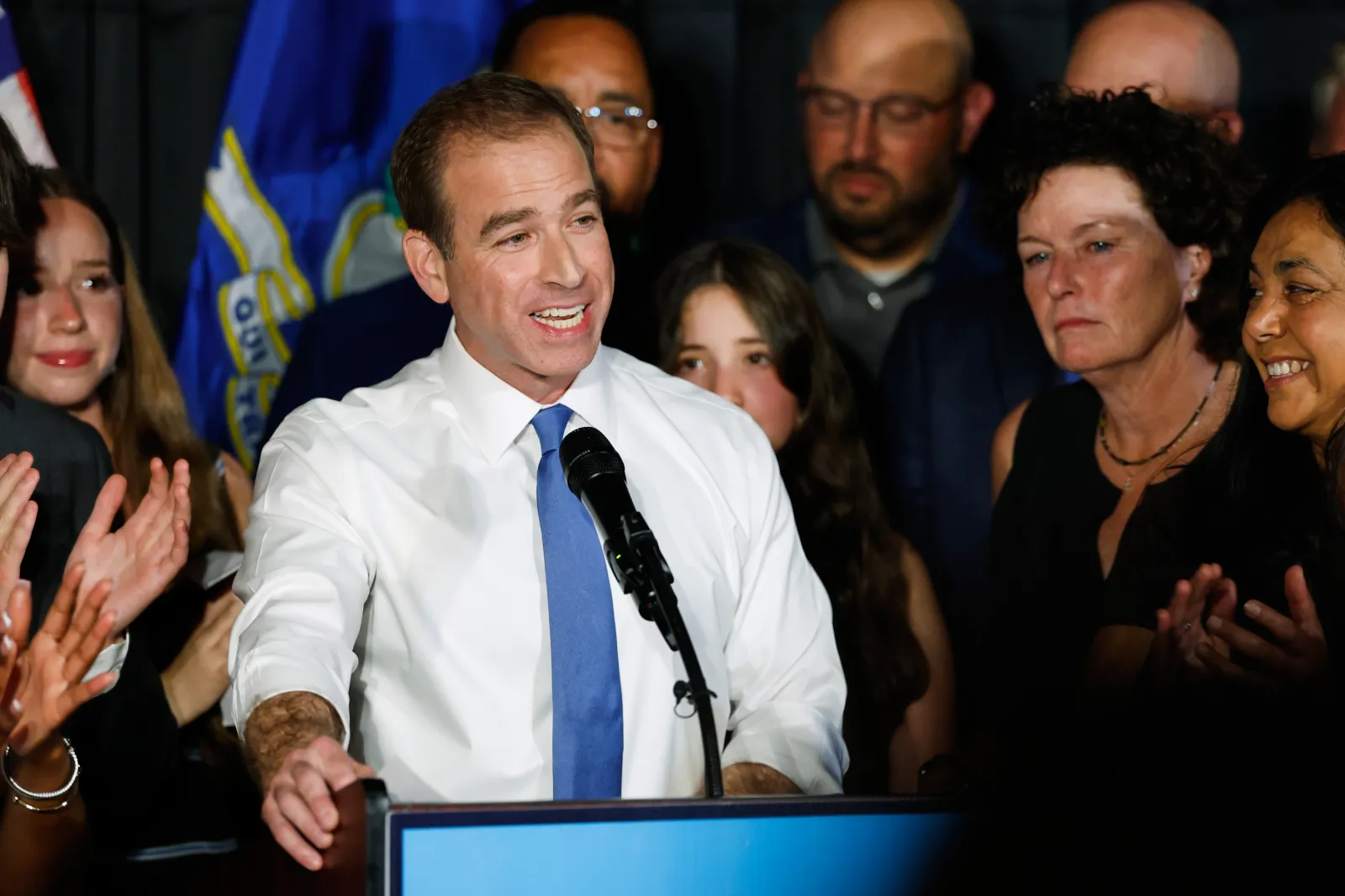
Bronin’s campaign focused on the need for generational change, in Congress and within the Democratic Party. He stressed that once again when speaking to supporters after his victory.
“If we are going to fix this mess that we are in, we need to build a Democratic Party that is bringing a whole new energy to this fight,” he said.
If the party won’t adapt, “then the changes are going to come from the ground up,” he said. “And that’s a message the party needs to hear.”
...
Other older incumbent Democrats also lost their seats to primary challengers decades younger, including Colorado Representative Diane DeGette, New York Representative Adriano Espaillat, Michigan Representative Shri Thanedar and Texas Representative Al Green.
But some older veteran lawmakers—Representatives Ed Case and Brad Sherman—were able to see off primary challenges from younger opponents.
A Progressive Revolt
Several of the year's incumbent losses have been viewed as a sign of growing strength among the party's progressive wing.
In New York City, candidates who ran to the political left of Espaillat and Representative Dan Goldman successfully ousted the two sitting congressmen.
Espaillat, at 71, lost to a younger challenger: Darializa Avila Chevalier, a 32-year-old democratic socialist who once helped organize pro-Palestinian protests at Columbia University. Goldman, 50, a two-term incumbent, was beaten by former city Comptroller Brad Lander, 57.
The winning candidates were backed by the city’s major Zohran Mamdani, a democratic socialist. While the upsets were seen as evidence of the mayor’s rising influence and the ascendant progressive movement, he framed it at the time as a question of electing “better Democrats” who would “put working people back at the heart of politics.”
For 78-year-old Green, a progressive who was seeking a 12th term, the generational divide contributed to the end of his two‑decade run in Congress. He lost to freshman Representative Christian Menefee, 38, in the Democratic primary runoff in Texas’ 18th Congressional District, although the two were forced to face off in a race triggered by Republican-led redistricting.
What It Means for Democrats
The string of losses for incumbent Democrats may not signal that voters want a wholesale ideological transformation of the Democratic Party.
Costas Panagopoulos, a professor of political science at Northeastern University, said the ousting of older incumbents signals that voters are tired of a gerontocracy—being ruled by the elderly—and want change.
Voters “seem to be clamoring for change, including generational change,” he told Newsweek.
He said dissatisfaction with aging politicians, including President Donald Trump, Biden and Republican Kentucky Senator Mitch McConnell, has likely fueled that sentiment. “Voters seem to want fresh faces and new ideas this cycle,” he said.
Boris Heersink, an associate professor of political science at Fordham University, said incumbents are “still much more likely than not to win re-nomination” on average, though there have been high-profile exceptions this year.
“On the Democratic side, it seems to be a mix of things - partly left-wing challengers criticizing incumbents on issues like American support for Israel or broader issues like money in politics, and partly generational change arguments,” he told Newsweek.
But he said 2026 “might be a particularly potent year for these types of challenges because both topics are particularly salient: support among Democrats in particular has shifted away from Israel due to Gaza in the last few years and there remains considerable frustration at the domination of older politicians.”
Heersink said the shift could potentially lead to difficulty for Democrats if they ultimately win a slim majority in the House.
“Some candidates who have not yet stated they would support Hakeem Jeffries for Speaker could hold out their vote if the Democratic majority ends up being very small,” he said. “What it probably does suggest is that the party will need to come to terms with how to handle these shifts in voter preferences.”
What's Next for the Democratic Party?
The next key milestone for Democrats is the Democratic National Committee's summer meeting in Austin, Texas, scheduled for August 13-15, where party leaders are expected to assess the primary landscape and begin shaping their strategy for the general election.
A handful of states also have crucial primary contests remaining. Delaware's primary is set for September 8, while New Hampshire and Rhode Island vote on September 15, marking some of the final major primary elections of the 2026 cycle.
Once the primary season concludes, Democratic attention will shift to the general election campaign. Election Day is November 3, 2026, when all 435 House seats and 35 Senate seats will be on the ballot, with control of Congress at stake.
How party leaders respond to the rise of younger candidates in the coming months could help determine not only Democrats' performance in November, but also the direction of the party heading into the 2028 presidential cycle.
Contact Newsweek editors on this story: Alfred Joyner and Gray R. Thomas
View 0 Comments
Submit Correction
View Editorial & AI Guidelines