...

By Newsweek Editors
0
Share
Newsweek is a Trust Project member
See more of our trusted coverage when you search.Prefer Newsweek on Googleto see more of our trusted coverage when you search.
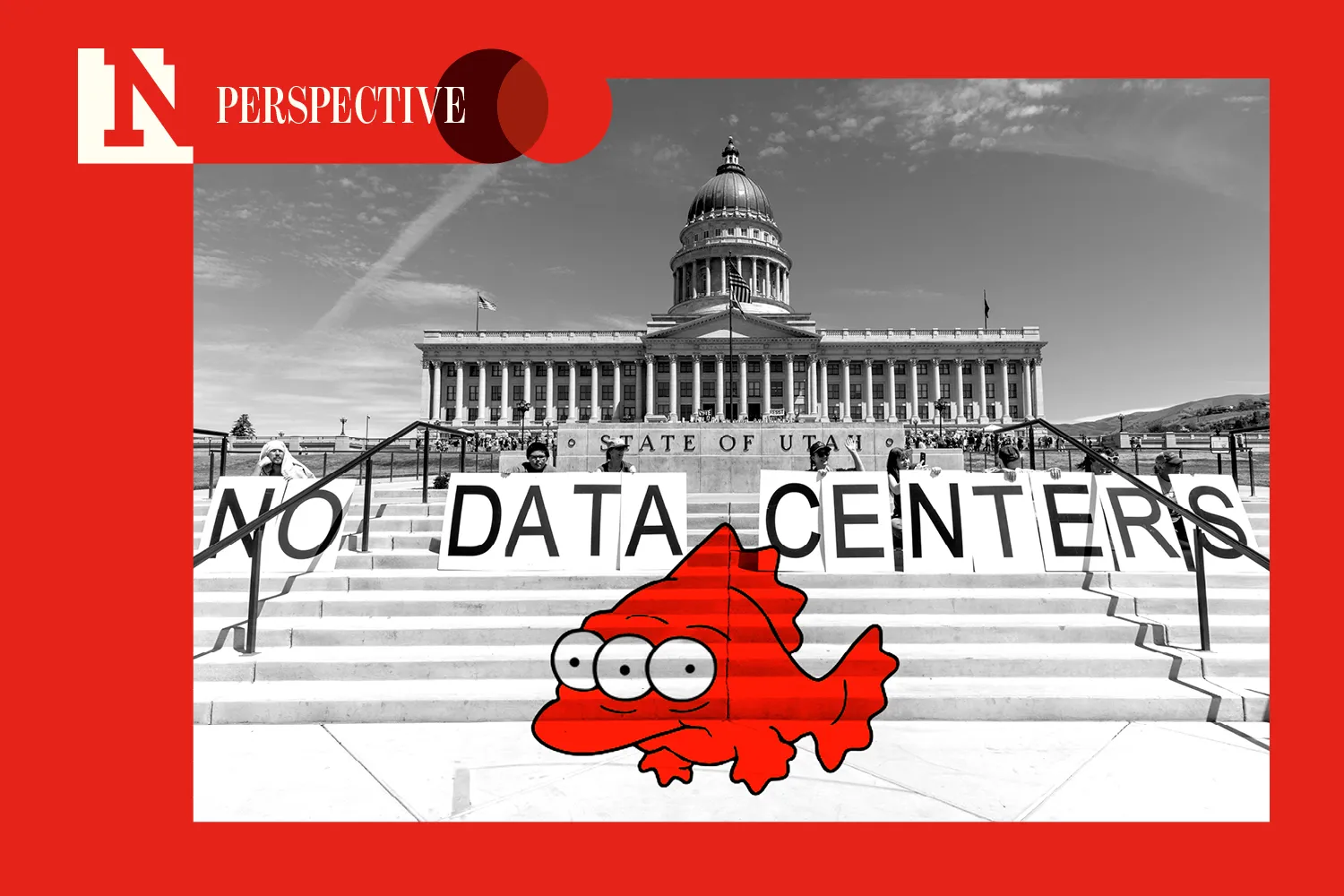
For a generation, America’s cartoon image of nuclear anxiety was Blinky, the three-eyed fish from The Simpsons.
Blinky arrived on American television in 1990, and was the storyline when Bart Simpson caught him downstream from the Springfield Nuclear Power Plant in an episode that turned cartoon pollution into a campaign problem for Mr. Burns.
The joke illustrated the invisible industrial risk that people feared about nuclear power. You did not need to understand reactor design, radiation exposure or regulatory capture. You only needed to see the triclops fish.
Read More on Analysis
Today, data centers spreading across the U.S. face a similar problem.
The AI boom was sold as weightless clouds of ethereal intelligence. But the future has started showing up in American towns as a windowless box that devours vast amounts of electricity, water, land and transmission capacity.
And therein sits one of the strangest turns in the politics of technology: Americans now appear more willing to live near a nuclear plant than an AI data center.
The surprise is found in Gallup’s 2026 poll released in May. Seventy-one percent of Americans oppose building AI data centers in their area; 53 percent oppose a local nuclear plant.
AI infrastructure is inheriting the role nuclear plants once held in the public consciousness.
AI’s Cloud Now Has a ZIP Code
The AI boom rides on a heavy cloud. Data centers are large physical buildings that require land, electricity, and often cooling water. And lots of each.
In fact, the Department of Energy describes data centers as among the most energy-intensive building types, consuming 10 to 50 times the energy per floor space of a typical commercial office building.
It helps explain why local opposition is clustering around environmental effects and utility bills.
The industry’s marketing problem is a gap between metaphor and machinery. A cloud sounds frictionless and natural; a data center sounds dystopian and synthetic.
Americans were sold Hobbiton, but they’re getting Sauron’s tower.
Gallup found that opponents most often cite resource use, with 18 percent mentioning water and 18 percent energy, while 16 percent refer to pollution, including of noise, air and water.
Roughly one in five opponents also cite local quality-of-life concerns, and a similar share mention economic costs such as higher utility bills or taxpayer costs.
Data crowdsourced by Erin Brockovich—another throwback to 1990s culture—tells the same story from the ground.
The veteran environmental activist has trained her sights on data centers, launching a map that has logged more than 2,700 community complaints in its first weeks, with Texas—home to over 460 data centers—supplying the largest share.
Residents flag water first, then electricity, then health, then wildlife: a citizen-reported ranking that tracks closely with what national pollsters are finding.
That’s the three-eyed fish problem. Once the public sees data centers as a proxy for invisible risk, just like they used to with nuclear energy, their distrust changes the argument from one about progress to permission.
Nuclear Power: Scary—But Understood
Nuclear power remains unpopular as a neighbor, even as data centers take its crown of public suspicion. More than half of Americans still oppose the construction of a nuclear plant in their area, as Gallup’s March 2026 Environment poll found.
Yet the same poll also registered support for putting more national emphasis on nuclear power at 46 percent, its highest level in the survey trend. Nuclear views are softening, and there’s growing acceptance of its role in the energy mix.
The strange reversal is that nuclear power now benefits from being publicly named as dangerous.
A nuclear plant arrives with a carefully crafted regulatory script. The Nuclear Regulatory Commission (NRC) licenses and regulates U.S. commercial nuclear power plants, and the current licensing process requires construction and operating approvals.
The NRC oversight process inspects, measures and assesses the safety and security performance of operating commercial nuclear plants.
The agency conducts formal hearings on disputed licensing matters, and people directly affected by nuclear power plant proceedings may participate in those hearings.
Emergency planning is also built into the public vocabulary of nuclear risk, with the NRC evaluating plant staffs' ability to implement emergency plans during full-scale exercises at least every two years.
Data centers, by comparison, often arrive in gentler language but without a single federal safety-licensing framework comparable to nuclear power’s NRC regime.
Nuclear still has a fear problem, but data centers have a trust one.
Americans Weigh Benefits Against Hidden Costs
The backlash is not simple hostility to technology, because Pew, another top pollster, found that Americans can identify local benefits.
Pew’s data shows Americans rate data centers more negatively on the environment, home energy costs and nearby quality of life, and more positively on local jobs and tax revenue.
Among Americans who had heard a lot about data centers, 67 percent told Pew the facilities were mostly bad for home energy costs, 63 percent mostly bad for the environment and 51 percent mostly bad for nearby quality of life.
Gallup, meanwhile, found the pro-data-center case rests heavily on economics, with two-thirds of supporters citing economic benefits, 55 percent specifically mentioning jobs and 13 percent mentioning tax revenue.
That is the industry’s strongest argument, and the data deserves to be taken seriously. But a jobs-and-tax-revenue pitch weakens when residents suspect the costs will arrive through water systems, power grids, land use and monthly bills.
The Energy Information Administration forecast in January that U.S. electricity use would rise 1 percent in 2026 and 3 percent in 2027, marking the strongest four-year growth period since 2000.
Driving that surge? You guessed it: increasing demand from large computing centers.
That forecast turns a local zoning dispute into a national ratepayer question. To most Americans, this will feel like an invisible AI tax they’re being forced to pay.
Industry Needs Consent Before the New Blinky Appears
Gallup’s finding should alarm tech companies because data centers are essential to their AI plans. Nothing can happen without them, and they are going to need a lot more than are currently available.
It should concern the White House just as much, given the emphasis President Donald Trump has placed on unleashing AI to maintain U.S. dominance over its rivals, especially China. It’s a national security issue as much as an economic one.
A public that sees data centers as imposed extraction will be harder to persuade with abstract promises about national competitiveness and security, especially as polling shows deep skepticism about costs and quality of life.
The way out is political candor. Data-center developers can disclose expected electricity demand, water use, backup-power arrangements, ratepayer exposure, tax incentives and local job estimates before residents learn those facts from opponents.
They can also admit that AI infrastructure is industrial infrastructure, which means communities are entitled to ask industrial questions—and to expect appropriate regulation that balances public safety against vital technological progress.
Blinky was funny because the fish exposed what official language often tried to blur.
Data centers may never produce a cartoon mutant that perfect, but Gallup and Pew have already identified the substitutes.
It’s the utility bill, the water pipe, the hum, the land deal and the suspicion that ordinary towns are being asked to subsidize someone else’s AI future.
If the industry keeps selling clouds while building factories, some creative satirist will invent its representative mascot, and probably use generative AI to do so. It might be even less flattering than a three-eyed river mutant.
View 0 Comments
Submit Correction
View Editorial & AI Guidelines