
...

By Hannah Millington
Health Reporter
0
Share
Newsweek is a Trust Project member
See more of our trusted coverage when you search.Prefer Newsweek on Googleto see more of our trusted coverage when you search.
Vaccines given via dental floss could one day allow people to immunize themselves from COVID in the comfort of their own homes without having to use needles.
This is the finding of North Carolina (NC) State University researchers who have demonstrated the new delivery method in an animal model—introducing a flu vaccine via the tissue between the teeth and gums.
The novel approach has potential for broad application, the team says.
Read More
Overlooked Bat Viruses May Be ‘Small Step’ From Causing Next Pandemic3 min read

Why Are So Many Children Getting Long COVID?6 min read

New Bat Viruses Discovered in China ‘Raising Urgent Concerns’3 min read

"We expect the approach to work with COVID vaccine that uses mRNA, hepatitis and tetanus since they use subunit proteins as antigens, and other vaccines that use inactivated or attenuated viruses as antigens (such as MMR vaccine)," paper author and NC State nanomedicine professor Harvinder Singh Gill told Newsweek.
"In essence through proper formulation of the coating, the approach should work with any vaccine."
...
The researchers discovered the new method stimulates the production of antibodies in mucosal surfaces—the moist linings of various body cavities— like the nose and lungs.
"Mucosal surfaces are important, because they are a source of entry for pathogens, such as influenza and COVID," Gill said in a statement.
"However, if a vaccine is given by injection, antibodies are primarily produced in the bloodstream throughout the body, and relatively few antibodies are produced on mucosal surfaces.
"But we know that when a vaccine is given via the mucosal surface, antibodies are stimulated not only in the bloodstream, but also on mucosal surfaces.
"This improves the body's ability to prevent infection, because there is an additional line of antibody defense before a pathogen enters the body."

...
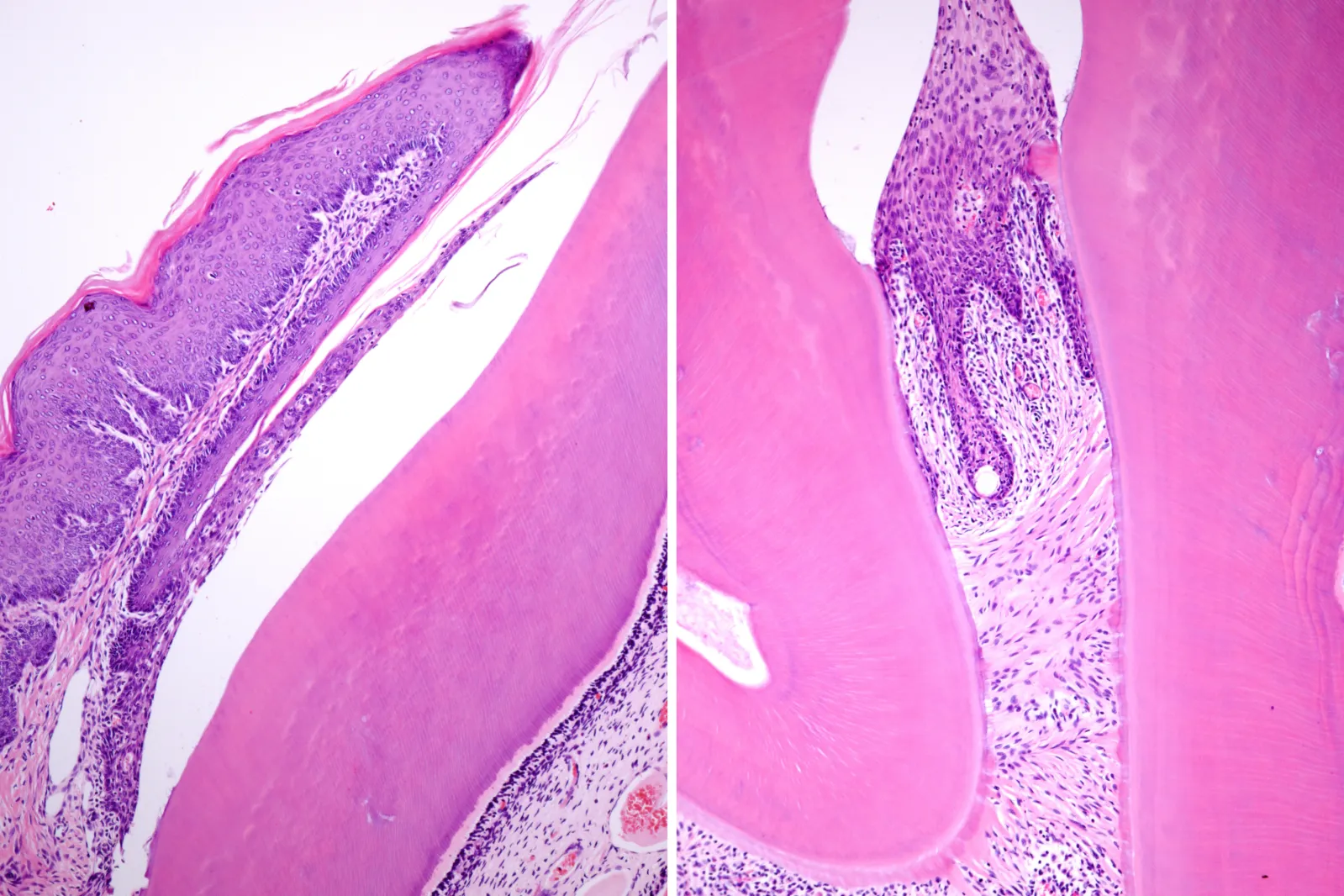
Something called the 'junctional epithelium'—a thin layer of tissue that lines the surface of body parts—also played an important role in the study.
While most epithelial tissues include robust barriers designed to keep 'bad' things like viruses and dirt from entering your blood stream, the junctional epithelium lacks such a barrier.
This allows the junctional epithelium to release immune cells to fight bacteria, typically found in saliva and between teeth and gums.
Gill explained, "The idea to use the junctional epithelium came through a chance reading in the literature that the 'junctional epithelium' is 'highly permeable'. The Gill lab has been working to develop mucosal vaccines for almost 20 years."
He said the words 'highly permeable' were "like nectar" to him and "sparked an aha moment" because the mucosal tissues such as those in the gut, lungs and reproductive services are 'highly impermeable', making vaccine delivery challenging. This left him excited to test the new method out.
"To our knowledge no one has ever used the junctional epithelium nor the floss for vaccine delivery," Gill added.
...
To assess the viability of delivering vaccines through the junctional epithelium, the researchers applied the vaccine to unwaxed dental floss and then flossed the teeth of mice. They compared antibody production in mice that received a peptide flu vaccine "via flossing the junctional epithelium; via the nasal epithelium; or via placing vaccine on the mucosal tissue under the tongue."
"We found that applying vaccine via the junctional epithelium produces far superior antibody response on mucosal surfaces than the current gold standard for vaccinating via the oral cavity, which involves placing vaccine under the tongue," paper author Rohan Ingrole, who was a Ph.D. student under Gill at Texas Tech University, said in a statement.
"The flossing technique also provides comparable protection against flu virus as compared to the vaccine being given via the nasal epithelium."
"This is extremely promising, because most vaccine formulations cannot be given via the nasal epithelium—the barrier features in that mucosal surface prevent efficient uptake of the vaccine," added Gill.
"Intranasal delivery also has the potential to cause the vaccine to reach the brain, which can pose safety concerns. However, vaccination via the junctional epithelium offers no such risk.
"For this experiment, we chose one of the few vaccine formulations that actually works for nasal delivery because we wanted to see how junctional epithelium delivery compared to the best-case scenario for nasal delivery."
The researchers also tested whether the junctional epithelium delivery method worked for three other prominent classes of vaccines—proteins, inactivated viruses and mRNA (a type of single-stranded RNA involved in protein synthesis, RNA being a key molecule found in living cells and viruses).
The delivery technique produced "robust antibody responses" in the bloodstream and across mucosal surfaces in all three.
Evident at least in the animal model, it didn't matter whether food and water was consumed immediately flossing with the vaccine—the immune response was the same.
The researchers acknowledged, however, the impracticality of asking people to hold vaccine-coated floss in their fingers. This led them to introduce a floss pick with a handle, just like the one you might use for removing plaque and food particles.
They coated the floss with fluorescent food dye, recruited 27 study participants, explained the new floss-based vaccine concept and asked them to try to deposit the food dye in their epithelial junction with a floss pick.
Roughly 60 percent of the dye was deposited in the gum pocket, suggesting the floss pick may be a practical vaccine delivery method to the epithelial junction, according to the researchers.
"For accessibility the advantage is that the vaccine is coated as a solid and thus it can be more stable and may not need cold storage. A floss could be self-administered, is painless and may receive better acceptance as compared to shots," said Gill.
While more research is needed before the innovative method could be considered for clinical use, the researchers think the positives could extend beyond the improved antibody response—from ease of administration and easing vaccine concerns about needles to a comparable price.
The CDC recommends an updated 2024–2025 COVID-19 vaccine for most adults 18 and older, while parents of children aged six months to 17 years should discuss the benefits of vaccination with a healthcare provider. However, six in 10 Americans said they would probably not get an updated 2024–2025 COVID-19 vaccine, according to an October Pew Research Center survey.
Concern about side effects and feeling that the updated vaccine is personally unnecessary were the top two reasons why people were reluctant—regardless of age, party, or race and ethnicity. A smaller share of those not planning to get an updated vaccine said a major reason why is that they generally don't get vaccines. Very few cited cost as a major reason, according to the survey.
Some drawbacks of the potential floss-vaccine to consider include that it wouldn't work on infants and toddlers without teeth and whether it would work for people with gum disease or other oral infections.
What about side effects? "This requires more study. The anticipation is that the side effects may not be any greater than conventional shots," said Gill.
"Next, the approach should be tested on larger animals such as pigs. Additional engineering is also needed to improve upon the device itself so that it is more user friendly. In the long-term, our vision is that this could be a kit either used in the comfort of home, or a dentist's office, or pharmacies."
Do you have a tip on a health story that Newsweek should be covering? Do you have a question about vaccination? Let us know via health@newsweek.com.
Reference
Ingrole, R. S. J., Shakya, A. K., Joshi, G., Lee, C. H., Nesovic, L. D., Compans, R. W., & Gill, H. S. (2025). Floss-based vaccination targets the gingival sulcus for mucosal and systemic immunization. Nature Biomedical Engineering. https://doi.org/10.1038/s41551-025-01451-3
View 0 Comments
Submit Correction
View Editorial & AI Guidelines