
By Brendan Cole
Senior Reporter
0
Share
Newsweek is a Trust Project member
See more of our trusted coverage when you search.Prefer Newsweek on Googleto see more of our trusted coverage when you search.
The head of the White House coronavirus task force, Vice President Mike Pence has announced that the capacity for testing for COVID-19 would increase in the coming days and weeks.
The expected boost in testing capacity comes as health officials say the virus has killed at least 85 people people in the U.S. with 5,068 cases, according to Johns Hopkins.
The testing process is evolving by the day but here are the main points on what happens now:
Read More
How to Download the Coronavirus Guidelines for America and Check the CDC’s Latest Advice and Updates on COVID-193 min read

How widespread is testing in the U.S.?
Pence has said that 2,000 labs will soon be able to offer high-speed testing while former Food and Drug Administration [FDA] commissioner Scott Gottlieb tweeted that nationwide, "we now have the ability to test about 26,000 people per day," a figure he expects will "rise substantially."
NBC News reported that as of March 16, around 33,000 tests have been done so far, citing figures from public health department websites in 40 states.
The Massachusetts-based company Thermo Fisher Scientific has got emergency approval from the U.S. Food and Drug Administration [FDA] to produce high-speed tests it says can diagnose the virus for up to five million people a week.

...
To increase accessibility, there are some drive-through testing sites in some cities, and even outside some stores, the Associated Press reported.
Meanwhile according to the Centers for Diseases Control [CDC], 84 state and local public health laboratories in 50 states and the District of Columbia are offering testing, including one or more in 50 states plus DC and Guam, as of March 15.
What should people do if they get symptoms?
Guidance is available on each state's department of health, but broadly speaking, the advice for people across the U.S. is the same. Those who think they are displaying symptoms, which include a cough and a fever, are told to call a healthcare facility first to ascertain whether a test is necessary.
Then, if a medical professional decides that a test is required, there will be liaison with state authorities on how to best do this without risking further exposure.
How the test is carried out and is it free?
No blood or urine is required and the process, which resembles a flu test, is relatively quick.
The CDC recommends at least two swabs, both from the throat and from the nose, which is where the virus tends to enter.
A swab is used to collect cells through the nose from what is called the nasopharyngeal region. Although the swabbing can be uncomfortable, it is not painful and only takes around 10 seconds, if the patient is calm, USA Today reported.
Last week, Democratic representative Katie Porter managed to get a commitment from CDC director Robert Redfield that the government would pay for the tests, CNN reported.
Many insurers say they will pay for the cost of testing for some policyholders, but not necessarily the treatment.
During a testy exchange last Thursday, Porter raised concerns that the fear of cost of medical services linked to the tests could reach more than $1,300 and that this would put people off from being tested.
When she got the pledge from Redfield, she said: "Everyone in America, hear that. You are eligible to go get tested for coronavirus and have that covered, regardless of insurance."
How is the sample examined?
Once taken, the sample is sent to a laboratory in a sterile container, and simply put, a chemical separates the cells from the swab.
The liquid that is left goes through a machine which compares the patient's ribonucleic acid (RNA) that carries their genetic information, with the coronavirus RNA
Technicians then look for genetic sequences specific to the coronavirus, the New Scientist reported.
While the test only takes a day to run if all the required equipment is present, shortages and shipping logistics can stretch the time needed to get a result into days or even weeks, according to Wired.
Dwayne Breining, from Northwell Labs in New Hyde Park, sounded an optimistic note however telling USA Today that more labs meant that the time needed to get results to patients had sped up from four days to between 24 and 48 hours.
"If you're just getting the COVID-19 test, it's usually one swab, or sometimes we take one nose swab and one throat swab and put them both in the same vial for testing,'' he told the paper.
"Generally, when people have the symptoms, they'll be getting tested both for the COVID-19 but also for the flu and the other viruses that are still prevalent, at least in the Northeast where we are.''
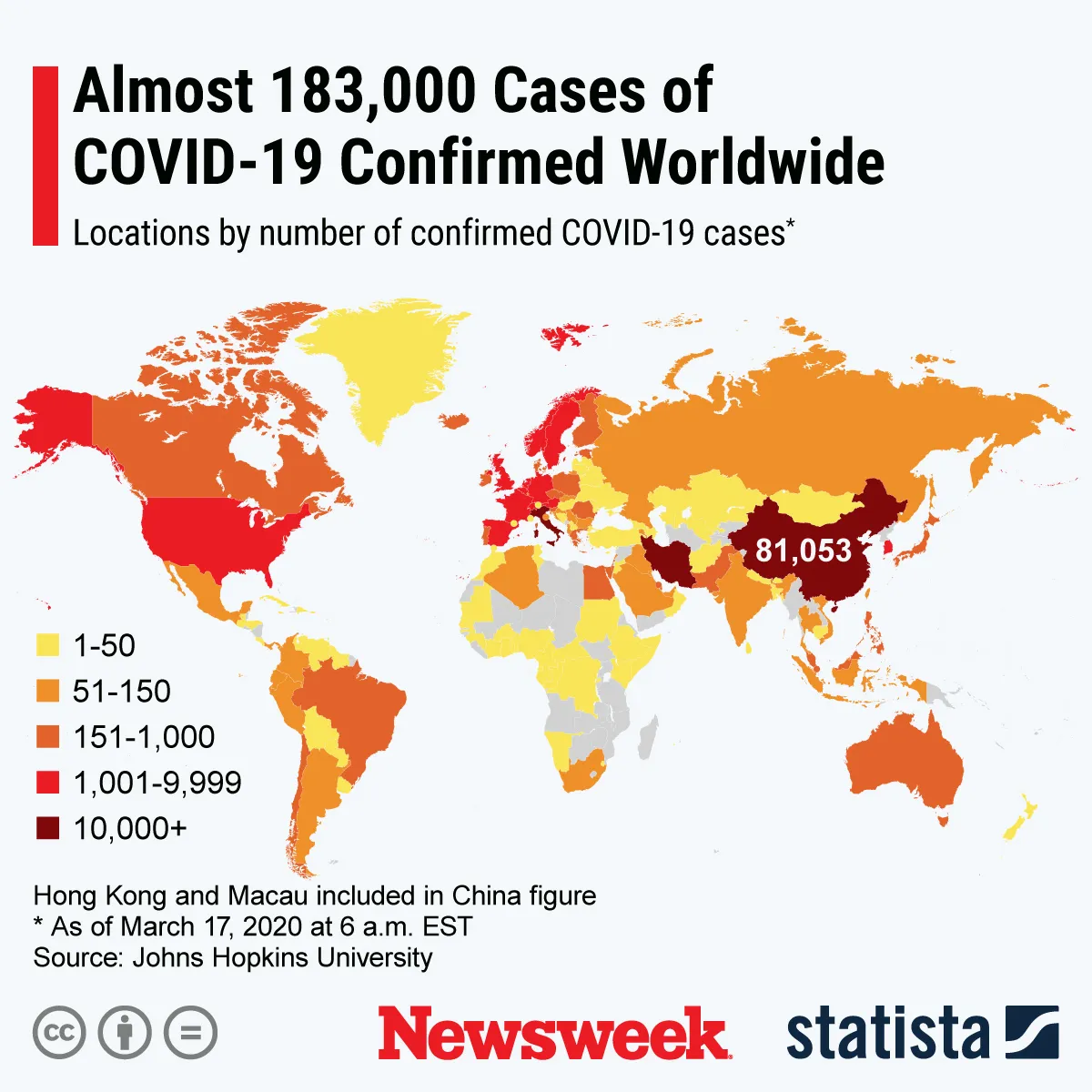
The graph below from Statista shows the latest numbers of the coronavirus pandemic, as of March 17.
...
Can tests give false negatives?
A test result can produce a false negative, according to the World Health Organization [WHO]. This could either be due to the samples not being refrigerated but also because someone who is infected, may not have secreted the virus into the throat.
"If a negative result is obtained from a patient with a high index of suspicion for COVID-19 virus
infection, particularly when only upper respiratory tract specimens were collected, additional
specimens, including from the lower respiratory tract if possible, should be collected and tested," the WHO laboratory testing guidance states.
Could there be online diagnoses in future?
The prospect of triage taking place online has been mooted. Currently in the pilot stage, President Donald Trump expressed hope last week that the test-screening site developed by Verily—a subsidiary of Alphabet, whose parent company is Google—could cover the U.S. in future. Currently, it only covers Santa Clara and San Mateo Counties, in northern California and there is no word on whether it would be rolled out nationally.
However, the tool available at Project Baseline, informed people trying to access it on Monday it was unable to schedule any more appointments, telling them to "check back later," according to Tech Crunch.
World Health Organization advice for avoiding spread of COVID-19
Hygiene advice
- Clean hands frequently with soap and water, or alcohol-based hand rub.
- Wash hands after coughing or sneezing;
- When caring for the sick; before; during and after food preparation; before eating; after using the toilet; when hands are visibly dirty; and after handling animals or waste.
- Maintain at least 1 meter (3 feet) distance from anyone who is coughing or sneezing.
- Avoid touching your hands, nose and mouth. Do not spit in public.
- Cover your mouth and nose with a tissue or bent elbow when coughing or sneezing. Discard the tissue immediately and clean your hands.
Medical advice
- If you feel unwell seek medical care early and call local health authorities in advance.
- Stay up to date on COVID-19 developments issued by health authorities, follow guidance.
Mask usage
- Healthy individuals only need to wear a mask if taking care of a sick person.
- Wear a mask if you are coughing or sneezing.
- Masks are effective when used in combination with frequent hand cleaning.
- Do not touch the mask while wearing it. Clean hands if you touch the mask.
- Learn how to properly put on, remove and dispose of masks.
- Clean hands after disposing of mask, do not reuse single-use masks.
View 0 Comments
Submit Correction
View Editorial & AI Guidelines