Newsweek/Getty

By Newsweek Editors
0
Share
Newsweek is a Trust Project member
See more of our trusted coverage when you search.Prefer Newsweek on Googleto see more of our trusted coverage when you search.
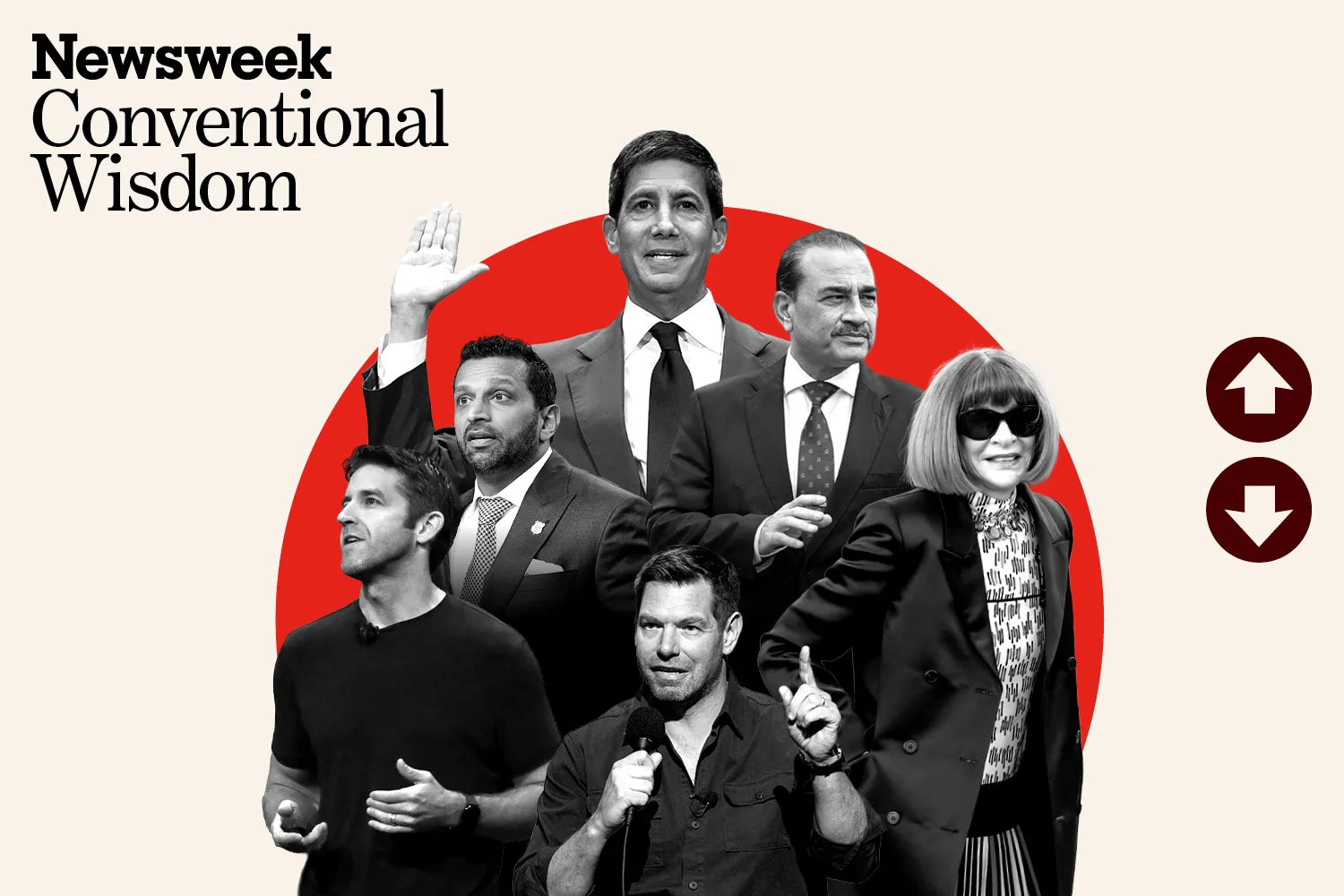
The surest way to lose right now is to be exactly who you're supposed to be. Authority is deployed, lawsuits filed, hearings aced, sets visited, campaigns launched—and yet the results never turn out the way they were expected. The machinery keeps spinning; it just doesn't always know who it's working for. But even a merry-go-round has its winners and losers.
Kash Patel ⬇
Two months after the FBI director did his best frat party bro impression with the U.S. men’s hockey team, The Atlantic published a 24-source investigation alleging that he has "alarmed colleagues with episodes of excessive drinking and unexplained absences." Patel's response was a 19-page defamation lawsuit attacking the magazine's journalistic standards—one that contains multiple spelling errors, including "feable" for feeble and "politices" for policies. The FBI director is suing for inaccuracy, inaccurately.
Read More on Opinion
Cheyenne Hunt ⬆
When Annika Albrecht felt sick at the prospect of Eric Swalwell becoming California's governor, she called her friend Cheyenne Hunt, a lawyer and progressive social media creator, and asked her to post a video about what she says Swalwell had done to her. Hunt's March 31 video was immediately flooded with messages from more than 30 women with similar stories; 14 days later, Swalwell announced his resignation from Congress and abandoned a gubernatorial campaign he had launched with a Zoom call for California content creators, betting that influencer reach could deliver the voters legacy media couldn’t. Right about the reach, wrong about who would use it.
Kevin Warsh ⬅➡
Trump's nominee to succeed Federal Reserve Chair Jerome Powell survived a bruising confirmation hearing—fending off attacks on his independence, questions about $100 million in undisclosed investments, and demands that he commit to cutting rates. Not that it matters: retiring Republican Senator Thom Tillis is single-handedly blocking the nomination until Trump drops a criminal investigation into Powell that seven Republican senators have publicly called meritless, and Trump has no plans to comply.
John Ternus ⬆
Tim Cook spent 15 years turning Apple from a one-genius operation into a $4 trillion supply chain empire, inheriting it from a dying Steve Jobs and expanding it through sheer operational mastery. His successor as CEO, John Ternus—who joined Apple in 2001 and spent 25 years designing its hardware, from early iPhones through the M-series chips—takes over September 1, just as AI begins to reshape what hardware is even for. The man who built the machine now gets to decide what it builds next.
Anna Wintour ⬇
The woman who inspired Meryl Streep's Miranda Priestly visited The Devil Wears Prada 2 set in Milan, filmed what director David Frankel called a "gag take"—and then jumped her cue, leaving the shot partially out of focus. "I can't ask Anna to do take two," Frankel told the Back Row podcast. While she was cut from the movie, she was queen of the set: after spotting too many pink flowers in a fictional Dior office, Wintour informed the crew the designer would only ever have white ones.
Asim Munir ⬆
Pakistan's Field Marshal hosted 21 hours of US-Iran talks in Islamabad that produced no agreement, flew to Tehran as the first regional leader to visit the country since the war began, and this week persuaded Trump to extend the ceasefire by personal appeal—earning a Truth Social mention and the presidential designation "my favorite field marshal." It is a remarkable pivot for the military chief who former Pentagon official Michael Rubin last year called "Osama bin Laden in a suit."
Originally a staple of Newsweek's print edition, Conventional Wisdom used arrows to track whose stock was rising or falling in the political circus. We're reviving it in the digital age because the problem it lampooned—hyperbole and partisan certainty masquerading as insight—has only intensified.
CW assigns arrows—up, down, or sideways—to the figures and forces shaping current events. The arrows don't predict the future or claim special insight. They capture the prevailing winds of the moment, uncluttered by tribal howling. In an era when partisan media reinforces rather than questions assumptions, CW operates from the center—skeptical of left and right alike, committed to puncturing inflated reputations and recognizing overlooked truths.
Do you agree with our editors on which way the political winds are blowing? Send us a message here.
Hey gang, Carlo Versano here. I hope you enjoyed this article. As Newsweek's Director of Politics and Culture and editor of the 1600 newsletter, I'm keen to hear what you think. Now, Newsweek is offering a new service to allow you to communicate directly with me in the form of a text message chat. You can sign up and get a direct line to me, as well as the reporters who work for me. You can shape our coverage.
As a Newsweek member, we're offering this service to you for free. You can sign up below, or read more about how it works here. Let's talk!
View 0 Comments
Submit Correction
View Editorial & AI Guidelines