...

By Newsweek Editors
0
Share
Newsweek is a Trust Project member
See more of our trusted coverage when you search.Prefer Newsweek on Googleto see more of our trusted coverage when you search.
Two hundred and fifty years ago this summer, a few dozen gentlemen, some of them heavily indebted, committed treason in writing and then proudly signed their names underneath it.
The conventional wisdom of 1776 held firm opinions about who was ascendant and who was finished—and, as ever, it was confidently wrong about half of them.
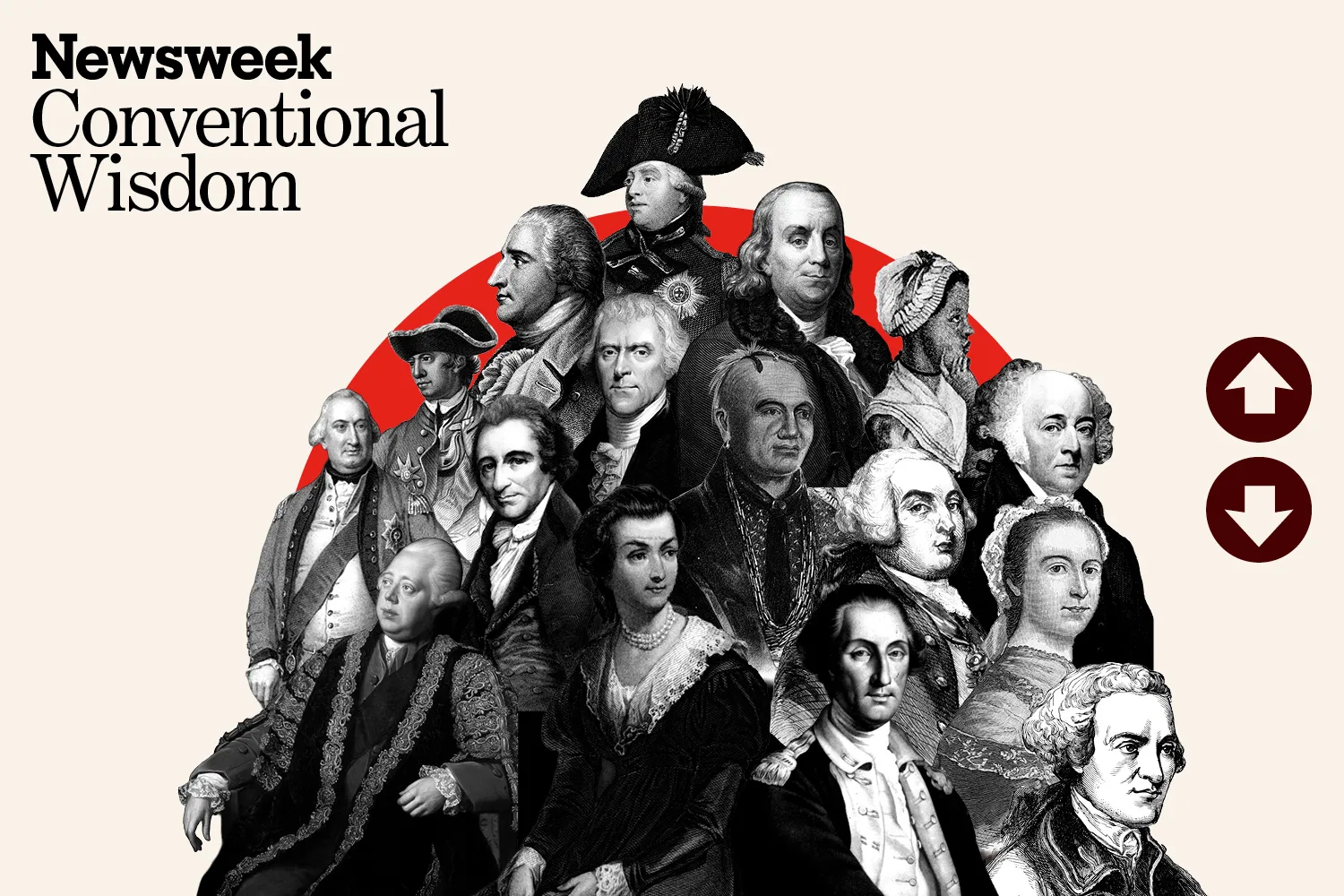
On the occasion of the Semiquincentennial, CW returns to the summer that started everything—from Philadelphia to Versailles to Iroquois country—to sort the winners from the losers, with the one luxury the founders never had: knowing how it turned out.
Read More on Opinion
General George Washington ⬆
The Continental Army spent the back half of 1776 losing the Battle of Long Island, abandoning New York City and retreating across New Jersey with a force that shrank by the week. Then, on the night of December 25, Washington ferried what was left across the ice-clogged Delaware and overran the Hessian garrison at Trenton the next morning, before most of it had finished waking up. He couldn't hold a city. As it turned out, he only had to hold the army together long enough.
King George III ⬇
The Declaration spends most of its length on him directly—a 27-count indictment charging him with obstructing justice, dissolving legislatures and "cruelty & perfidy scarcely paralleled in the most barbarous ages." The diary entry he supposedly wrote on July 4—"nothing of importance happened today"—is a fabrication that has outlived most of the real facts about him. The truth stings more: news crossed the Atlantic at the speed of a sailing ship, so on the day his empire cracked, George simply had no idea. History's most consequential breakup letter, and the recipient didn't read it until August.
Lord North ⬇
The prime minister spent the 1770s presiding over the policies—the tea duty, the Coercive Acts, the Prohibitory Act that cut the colonies loose from royal protection—that turned a tax dispute into a war. He also spent much of it trying to resign, only for George III to refuse to let him go. History pinned the loss of America on the one man in the cabinet who kept asking to leave. He didn't believe in the war and had to own it anyway.
Thomas Jefferson ⬆
At 33, the Virginian drew the drafting assignment largely because the senior men were busy and he had, by John Adams' account, "a happy talent for composition." Congress then edited him in open session for two days, striking roughly a quarter of his text—among the deletions, the grievance he'd sharpened above all the others. He sat and stewed through every cut. The man who wrote that all men are created equal enslaved more than 100 of them. The passage Congress deleted? The one where he blamed the king for the slave trade.
Benjamin Franklin ⬆
At 70, he was the oldest man in the room and the only one already world-famous. A printer, scientist and wit, he was added to the drafting committee mostly to lend the thing gravity. By year's end, Congress had shipped him across a British-patrolled Atlantic to charm France into the war, a job he'd perform so well that Paris turned him into a celebrity in a fur cap. He was inventing a republic and courting a monarchy in the same 12 months, having just disowned his own son for siding with the king (see below). The most versatile founder could do everything except keep his family on the same side.
John Adams ⬆
No delegate did more to drag independence through a hesitant Congress. A colleague christened him "the Atlas" of the cause. On July 3 he wrote to wife Abigail that the second of July "will be the most memorable Epocha in the History of America," to be marked forever with "Pomp and Parade…Bonfires and Illuminations." He nailed the pageantry but missed the date by two days. Nobody has grilled a hot dog on the second of July since.
Abigail Adams ➡
In March, while her husband helped assemble a republic, she wrote asking him to "Remember the Ladies" in the new code of laws and not to put "unlimited power" in the hands of husbands, noting that "all Men would be tyrants if they could." John's reply was that her letter made him laugh. The prevailing winds of 1776 filed her under charming. History would eventually concede she had a point. It was in no particular hurry.
Thomas Paine ⬆
In January, he published Common Sense, which argued in plain English that an island had no business governing a continent and sold in the hundreds of thousands to a population of barely 2.5 million. That December, the first American Crisis handed Washington's frozen, half-mutinous troops "the times that try men's souls." Paine signed his royalties over to the Revolution and pocketed almost nothing. He invented the viral pamphlet and the starving artist business model in the same 12 months.
Mercy Otis Warren ⬆
While the men gave speeches, she wrote the propaganda. Her savage satirical plays skewered the royal governor and his circle, circulating through the colonies and making Loyalists look ridiculous. She published them anonymously, because a respectable woman could not put her name to political writing. Decades later she wrote one of the first full histories of the Revolution, settling a few scores with the founders along the way. She shaped the story twice: once without her name on it, and once by outliving the men and writing theirs.
General William Howe ➡
He won the Battle of Long Island, took New York City, seized Fort Washington and ran the Continentals clear across New Jersey. By any scoreboard, he was the most successful general of 1776. He also let Washington's beaten army escape at every turn, then settled into comfortable winter quarters while a popular satirical verse needled him about the hours he kept with Mrs. Loring. He conquered the most important city in America and somehow made the war longer. Sideways is generous.
Lord Cornwallis ⬇
Serving under Howe, he chased Washington's disintegrating army the length of New Jersey and, by December, judged the rebellion so nearly finished that he packed for a winter's leave in England. Then came Trenton and Princeton, and his passage home was canceled. Five years later at Yorktown, with the war lost, he pleaded illness and sent a deputy to surrender in his place. In 1776 he couldn't wait to get home. By 1781, he couldn't bring himself to show up.
John Hancock ⬆
As president of the Continental Congress, he signed the engrossed parchment first and far larger than anyone else, with a signature you can read across a room. The story that he sized it so King George could read it without his spectacles is almost certainly apocryphal, which has never once slowed its retelling. He put his name to a hanging offense in the biggest letters on the page. Say what you like about the man's judgment: he was all-in.
Louis XVI ⬇
The absolute monarch of France, watching his old enemy Britain bleed in America, quietly began funneling money and muskets to the rebels in 1776 through a front company run by the playwright Beaumarchais—years before he'd admit it in public. Bankrolling a republican uprising against a fellow king proved a superb way to wound London and a catastrophic way to run a treasury. But the war helped empty his coffers, and the empty coffers helped summon a revolution of France's own. He funded the first one. He paid for the second with his head.
Governor William Franklin ⬇
The last royal governor of New Jersey carried the additional distinction of being Benjamin Franklin's son. And when the moment came, he chose the crown. In June, New Jersey's revolutionaries branded him "a virulent enemy" and jailed him. He would spend much of the next two years imprisoned in Connecticut, some of it in solitary. One hundred miles away, his father was helping build the very republic holding him captive, and lifted barely a finger to intervene. The Revolution split more than an empire. It split the Franklins, and that break never healed.
Joseph Brant (Thayendanegea) ➡
The Mohawk leader sailed to London over the winter of 1775-76, sat for a society portrait and met the king, then came home to raise Iroquois warriors for the crown—betting, shrewdly, that the British were likelier than the land-hungry colonists to respect Indian territory. Most of the Six Nations followed him; the Oneida and Tuscarora sided with the Americans and the great confederacy tore itself apart. The bet was rational and it still lost. Whoever won the war, the treaties that followed took the land anyway. Both sides waved the flag of liberty. Neither meant it for him.
Phillis Wheatley ⬆
One of the most celebrated poets in the colonies was a young Black woman, born in West Africa, sold into slavery in Boston as a child and freed only a couple of years before. She was the first African American to publish a book of poetry. In 1775 Wheatley wrote an ode to General Washington. In early 1776 he wrote back praising her "great poetical Talents" and invited her to visit his headquarters, which she did. A formerly enslaved woman composed one of the Revolution's most admired tributes to the man leading it, and the slaveholding general received her graciously. The contradiction was obvious. It took the country another 89 years to do anything about it.
Lord Dunmore ⬇
Virginia's last royal governor was losing the colony when, in November 1775, he played the card the planter class feared above all others: He offered freedom to any enslaved person owned by a rebel who would leave and take up arms for the king. Hundreds ran to his lines and formed an "Ethiopian Regiment," some wearing sashes stitched with "Liberty to Slaves." Over the course of the war, tens of thousands more would flee to the British. By the summer of 1776 Dunmore himself was routed, his followers ravaged by smallpox, and he sailed away for good. But the point had been made, and it was excruciating: In the year America declared that all men were created equal, the surest offer of freedom on the continent came from the other side.
General Benedict Arnold ⬆
In 1776 he was the most aggressive fighting general the Americans had; a veteran of the punishing winter march on Quebec, and the mind behind the improvised freshwater fleet that stalled the British at Valcour Island and cost them an entire campaign season. Congress kept passing him over for promotion and creditors kept circling, but the conventional wisdom of the moment marked him a star on the rise. The arrow is accurate for the date. Give it four years.
Originally a staple of Newsweek's print edition, Conventional Wisdom used arrows to track whose stock was rising or falling in the political circus. We're reviving it in the digital age because the problem it lampooned—hyperbole and partisan certainty masquerading as insight—has only intensified.
CW assigns arrows—up, down or sideways—to the figures and forces shaping current events. The arrows don't predict the future or claim special insight. They capture the prevailing winds of the moment, uncluttered by tribal howling. In an era when partisan media reinforces rather than questions assumptions, CW operates from the center—skeptical of left and right alike, committed to puncturing inflated reputations and recognizing overlooked truths.
Do you agree with our editors on which way the political winds are blowing? Send us a message here.
View 0 Comments
Submit Correction
View Editorial & AI Guidelines