...

By Stav Ziv
Staff Writer
Share
Newsweek is a Trust Project member
See more of our trusted coverage when you search.Prefer Newsweek on Googleto see more of our trusted coverage when you search.
After several hours of silence while the Rosetta orbiter was circling Comet 67P/Churyumov-Gerasimenko and out of signal reach of its lander, named Philae, the two finally made contact. Scientists were waiting eagerly for the first batch of data from Rosetta to reach the Earth to confirm whether Philae was sitting safely on the surface of the comet or had drifted into space.
The first-ever landing of a probe on a comet encountered some unexpected turbulence Wednesday when the probe's harpoons failed to fire in order to anchor it to the surface. Scientists reported Wednesday night that Philae had rebounded away and was at risk of drifting into space, jeopardizing a mission 10 years in the making.
At a Thursday briefing broadcast from the European Space Operations Center in Darmstadt, Germany, at 8 a.m. EST, mission leaders announced that Philae is safely sitting on the surface of Comet 67P/Churyumov-Gerasimenko. This morning in Europe, they were able to confirm that the probe was "alive" and were "finally able to transmit data from [the] orbiter to the Earth."
Read More on Science
The probe's landing (or footage of the scientists monitoring the probe's landing), which was livestreamed online and broadcast on TV, riveted viewers Wednesday, and news that it was at risk of drifting into space had people on edge, already tasting the disappointment that could follow the thrill of the first landing signal. "We were very eager to get a communication link this morning," said Koen Geurts, an engineer at the Lander Control Center at DLR German Aerospace Center, speaking from Cologne. "We started to receive the data collected overnight. The science measurements were conducted normally. The lander from a system point of view is operating normally."
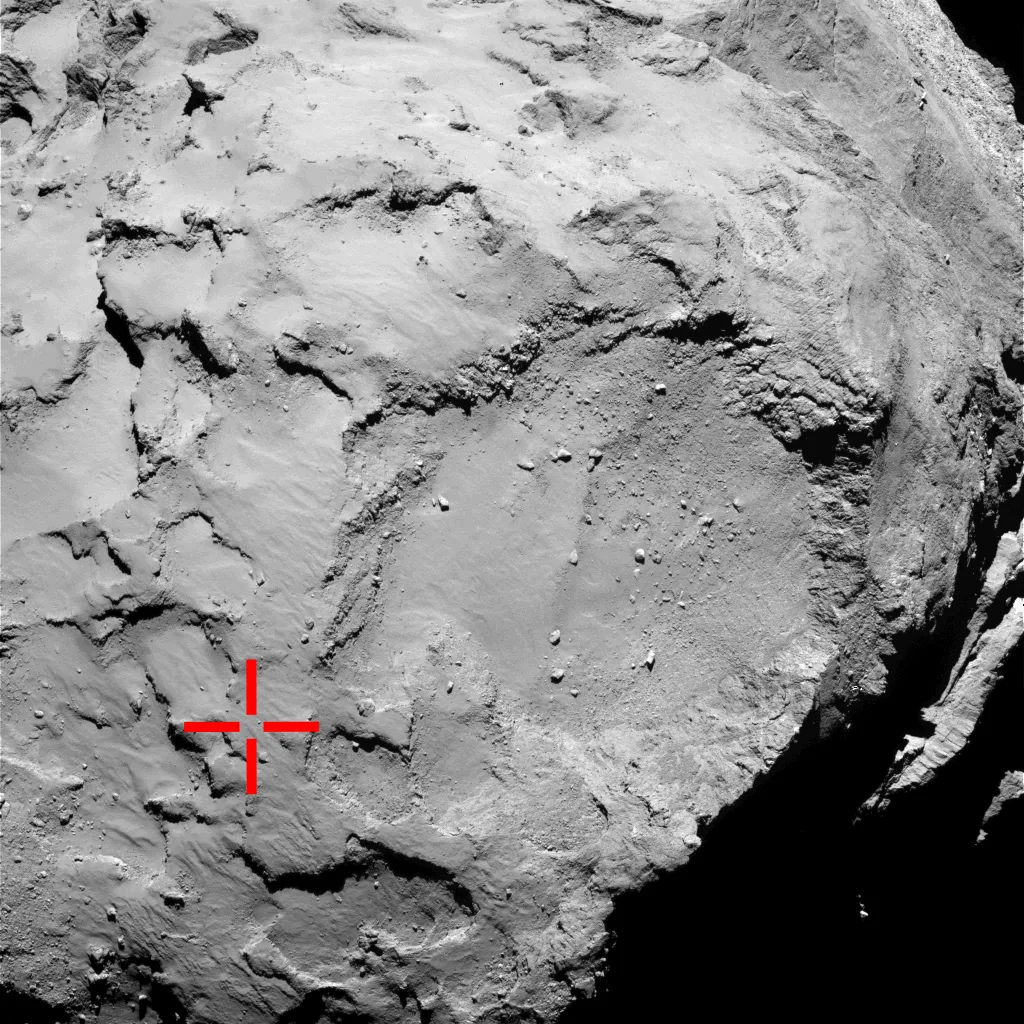
According to Biebring, Philae bounced not once, but twice, ultimately making three landings. The first bounce took nearly two hours, said Stephan Ulamec, Philae lander manager at the DLR. Philae lifted up roughly one kilometer above the surface of the comet and touching back down approximately one kilometer away from the original landing spot. The second, much smaller jump, lifted the 100-kilogram (220-pound) Philae off the surface for just a few minutes before the lander settled safely into its current position, ensconced in the shadow of a cliff.
"We have a better understanding now how we got there, but still do not know where," said Ulamec. Scientists are currently trying to determine precisely where on the comet Philae finally landed. "Concert data imply somewhere in this area," he said, pointing to a shaded region at the edge of a large crater on a projected diagram. Site B, a spot within the crater, had been a candidate for landing. Philae "could be somewhere in the rim of this crater, which could explain the bizarre orientation."
The probe, said Geurts from the Lander Control Center, is not sitting parallel to the surface of the comet. As Biebring described, it has one foot almost sticking up in open space and two feet on the surface.
Biebring said that scientists were considering whether and how to rectify its precarious orientation, which they believe is the reason Philae's solar panels are receiving only a fraction of the intended sunlight. "You can imagine the gentle maneuver we have to do now," he said.

...
While Philae is using a primary and secondary battery for the initial data collection currently in progress, it would rely on solar energy to operate over an extended period of time, Geurts explained. It's currently receiving roughly a quarter of the sunlight scientists were aiming for, Geurts says, roughly an hour and a half per day instead of six or seven, which will have an impact on the energy budget and Philae's ability to continue conducting science in the long term.
The lander's precarious position is also making scientists hesitant to deploy the drill that's supposed to collect samples from 23 centimeters beneath the surface of the comet and analyzed by an onboard laboratory, work that could help shed light on the formation of planets and life. The mission leaders are concerned deploying the drill could cause Philae to lift back up into space, since it is resting safely, but not anchored to the comet, according to Ulamec.
"We have to be very careful," Ulamec said.
Besides the drill, the other instruments on Philae have already successfully begun their work, Biebring said, collecting data on magnetic fields and topography, capturing images of the comet from close up and more. Some of the first images have been transmitted from the orbiter back to Earth, where they are being processed and analyzed.

...

...

...

...

...

...
"We [see] both something that's man-built, the lander, and something that nature built from [billions of] years ago, containing all the mystery we are trying to look at," said Biebring of an image that showed both the lander and part of the comet.
As the briefing was taking place, scientists were already preparing the next set of commands to uplink to the orbiter and lander to perform another round of scientific measurements. The ESA will host a Google hangout Friday at 8 a.m. EST, where they will discuss the comet landing.
"Where we are is not entirely where we wanted to be," Biebring told journalists at the briefing. But "do not put the emphasis on the failures of the system, it is gorgeous where we are now."
Submit Correction
View Editorial & AI Guidelines