10
Loading video...


By Hugh Cameron and Jennifer Radcliffe
0
Share
Newsweek is a Trust Project member
See more of our trusted coverage when you search.Prefer Newsweek on Googleto see more of our trusted coverage when you search.
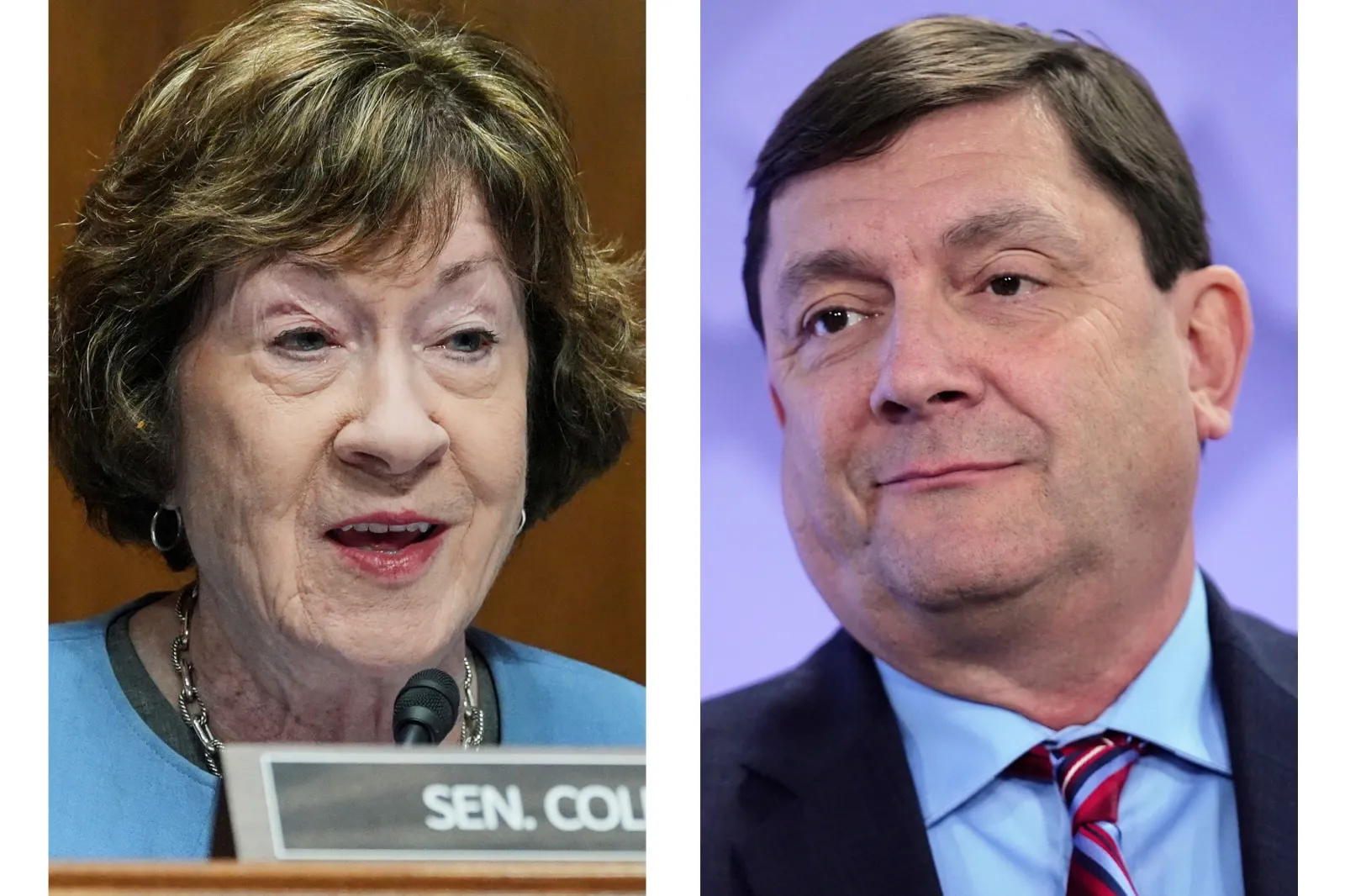
Republican Senator Susan Collins and Democratic challenger Troy Jackson clashed over President Donald Trump, healthcare, tariffs and the cost of living Tuesday in the first of four debates in Maine’s closely watched U.S. Senate race ahead of the November 3 election.
Jackson sought to portray Collins as a longtime Washington incumbent who had failed to use her influence to stop Trump’s policies, while Collins emphasized her seniority, bipartisan record and position as chair of the Senate Appropriations Committee.
The race could help determine control of the Senate. Collins, first elected in 1996, is seeking a sixth term after nearly three decades in Congress. Jackson is a former Maine Senate president and fifth-generation logger who became the Democratic nominee in July, leaving him with an unusually short general-election campaign. Tuesday's debate was held one day after early voting began in Maine.
Read More on Politics
Newsweek has contacted the campaigns outside of regular working hours for comment.
...
Jackson Presses Collins on Trump and Kavanaugh
Jackson repeatedly returned to Collins' 2018 vote to confirm Supreme Court Justice Brett Kavanaugh, a vote that has long angered many Maine Democrats. Jackson asked voters: "Would you trust her to pick the next Supreme Court justice?"
He argued that Collins' support for Kavanaugh shows a pattern during her nearly three decades in the Senate. "Senator Collins has had 30 years to show whose side she's on," Jackson said.
Collins countered that Jackson was misrepresenting her record. She pointed to her opposition to Trump’s One Big Beautiful Bill Act, citing its negative impact on Medicaid.
A Bangor Daily News analysis cited by MS NOW found that Collins had cast more deciding votes against her party than any other senator serving at the time, although those votes represented a small share of her complete record.
Asked about the possibility of Trump campaigning in Maine, Collins said she had heard nothing from his office and added that she was “not exactly his favorite senator.”
Economy, Tariffs and Energy Costs
Both candidates acknowledged that Maine families are struggling with housing, electricity and other expenses, but they blamed different levels of government.
Collins faulted policies in Augusta for Maine’s high electricity and property-tax burdens. Jackson argued that federal policies, including Trump’s tariffs and tax cuts, had increased costs while benefiting wealthy Americans.
Collins described herself as an outspoken opponent of tariffs on Canada, Maine’s largest international trading partner, and pointed to her efforts to obtain tariff relief for products, including road salt.
Jackson responded that those minor exemptions did little to offset Trump’s damaging trade policies.
“We can’t eat road salt,” he said, arguing that tariffs raise prices for consumers.
The two also disagreed over energy policy. Collins argued that the United States must become more energy independent and advocated increasing energy supplies. Jackson said policymakers should instead invest in affordable renewable energy and accused Collins of offering inadequate solutions to a problem she had helped create.
Healthcare Exposes Ideological Divide
Healthcare produced one of the debate’s clearest policy contrasts.
Collins highlighted her work on rural hospitals, medical research and physician-training programs. She argued that Maine’s problem was not limited to the price of insurance, but also included access to doctors and medical facilities.
“There is no one who has worked harder for rural healthcare than I have,” Collins said.
She also rejected Jackson’s criticism of her record on federal health programs.
“I have never voted to cut the Medicaid program. Never. I’ve never voted to cut Medicare,” Collins said.
Jackson accused Washington lawmakers of protecting pharmaceutical manufacturers and health insurers while patients continue to face high costs. He defended his support for Medicare for All, saying he wanted to ensure that people across Maine had health coverage.
Collins said Jackson’s proposal would amount to “big government” taking over the healthcare system.
Experience Versus Confrontation
Both candidates addressed lingering concerns about their campaigns—Collins with the fallout from a federal corruption probe and her political proximity to Trump, and Jackson facing an uphill battle to gain Mainers’ trust after less than three months in the race. Both said they had been cleared of wrongdoing.
The candidates closed by offering sharply different definitions of political power.
Collins argued that effectiveness in the Senate requires “knowledge, experience, seniority and relationships.” She pointed to her work on pandemic-era small-business assistance, medical research and protections for Maine’s lobster industry.
Jackson argued that seniority means little if lawmakers are unwilling to confront presidents and powerful economic interests.
“I don’t owe Donald Trump and the billionaires anything,” Jackson said. “Power means nothing if you won’t use it when the people of Maine need it.”
Additional debates are set for October 8, October 13 and October 15.
Susan Collins vs. Troy Jackson: What the Latest Polls Show
The survey of 1,505 registered voters had Jackson winning among independents—52 percent to 45 percent—with anti-Trump sentiment offering the candidate an apparent boost, given the president’s job approval rating among those polled at 40 percent approving and 59 percent disapproving.
Some 44 percent of Maine voters said their ballot is "mainly a vote against President Donald Trump," while 16 percent consider it a vote for the president and 39 percent said he did not play into their choice a great deal.
While voters in this particular poll chose Jackson, a majority of 57 percent nevertheless feel that the five-term Republican will end up claiming victory in the Maine Senate race, compared to 41 percent for her opponent.
Other recent polls have likewise shown a competitive race less than a month out.
A CBS News poll released last week was an even split between the pair at 50 percent apiece. Collins’ time in office appears an advantage for the senator, with 62 percent saying she has the "right experience" compared with Jackson’s 38 percent. These figures are flipped, however, when it comes to which candidate "will bring needed change."
And a significant 10 percent of voters said they might still change their minds before the election takes place.
Why the Debate Matters for the Maine Senate Race
The stakes are high for Collins and Jackson during the debates, offering both a chance to shape the narrative of the race and address questions Mainers may have around their candidacies.

...
A notable challenge for the Democrat is recognizability, given Collins is among the longest-serving U.S. senators and Jackson only entered the race on July 25.
A co/efficient poll published last week found that 44 percent said they had a favorable view of Collins as a candidate, with 47 percent viewing her unfavorably and 9 percent holding no opinion. A larger 16 percent had no opinion on Jackson, whom 36 percent viewed favorably and 47 percent unfavorably.
*The New York Times/Press Herald/*Siena Poll—conducted September 15 to 22 among 619 likely voters in Maine—found that 6 percent had "not heard of" Jackson, while an additional 4 percent did not have or offer an opinion on him.
"It feels a little bit like the Kamala race from 2024. You get in this late, it’s really hard to tell your story," Bev Uhlenhake, former chair of the Maine Democratic Party, told NBC News.
And Collins is likewise facing her own set of challenges, including Democrats attempting to tie her campaign to the policies and popularity of the Trump administration. Maine voted against Trump in each of the past three elections, though Collins has comfortably held her seat thanks to cultivating a reputation as a moderate Republican willing to work across the aisle on local and nationwide issues.
The national environment is less forgiving in 2026 given the low approval ratings for Trump, though Collins has distanced herself from the president when it came to new tariffs on Canada and on other matters.
As well as her legislative support for Trump’s agenda, Democrats and the Jackson campaign have recently focused on her vote to confirm Kavanaugh—who helped overturn the landmark Roe v. Wade decision—and the ProPublica report alleging her involvement in a pay-to-play scheme and a related probe by the FBI, which her office has called "categorically false."
Latest Developments in the Maine Senate Race Between Jackson and Collins
Both candidates have continued to broadcast what they see as their electoral advantages in recent days.
A Democratic super PAC spent $3.4 million on an attack ad focused on the ProPublica story, the Portland Press Herald reported. Collins’ campaign has released ads focused on Jackson’s experience.
Trump said on Monday that he could add Maine to the list of battlegrounds in which he is rallying ahead of the midterms.
And Politico reported last week that independent Vermont Senator Bernie Sanders will be campaigning alongside Jackson in Maine, at rallies planned in Bangor, Lewiston and Biddeford on October 10 and October 11.
For more analysis from us on the numbers shaping U.S. politics and the 2026 midterms, sign up for Newsweek's Midterms Monitor newsletter.
Newsweek’s reporters and editors used Martyn, our AI assistant, to produce this story. Learn more about Martyn here. Contact Newsweek editors on this story: Daniel Orton, James Debens and Edward T. Cummins
View 0 Comments
Submit Correction
View Editorial & AI Guidelines