
By Alexis Kayser
Healthcare Editor
0
Share
Newsweek is a Trust Project member
See more of our trusted coverage when you search.Prefer Newsweek on Googleto see more of our trusted coverage when you search.

...
Five years after her type 2 diabetes diagnosis, Deb Biller was running out of options.
Biller knew that her glucose levels had been rising at each yearly check-up with her primary care physician (PCP). But in 2017, she was shocked when her doctor walked into the room and said, “Congratulations. You’ve joined the ranks of the folks with diabetes.”
Read More on Health Care
The doctor told Biller to cut down on her sugar intake, and the mechanical engineer from Northfield, Ohio, knew that was sound advice—but she struggled to change her deeply rooted habits.
By 2022, she was on three glucose medications for her diabetes, plus a slew of other medications for fibromyalgia and antibiotics for infections in her mouth. Her body mass index (BMI) was 35.6. (BMIs over 30 meet the classification for obesity.)
When her original PCP retired, Biller sought care at Cleveland Clinic’s Family Health Center in nearby Twinsburg, Ohio. Her new doctor recommended adding insulin to her list of daily meds.
“I was actually terrified of insulin,” Biller, now 63, told Newsweek—not of the injections themselves, but of the health decline they represented. That fear was a turning point that inspired her to take control of her health, she said.
Fortunately, it was an opportune moment. Cleveland Clinic was preparing to research a non-pharmaceutical intervention for patients with type 2 diabetes. A company called Twin Health claimed it had created the first AI-powered “digital twin” of patients’ metabolisms, and the world-renowned health system was going to put it to the test.
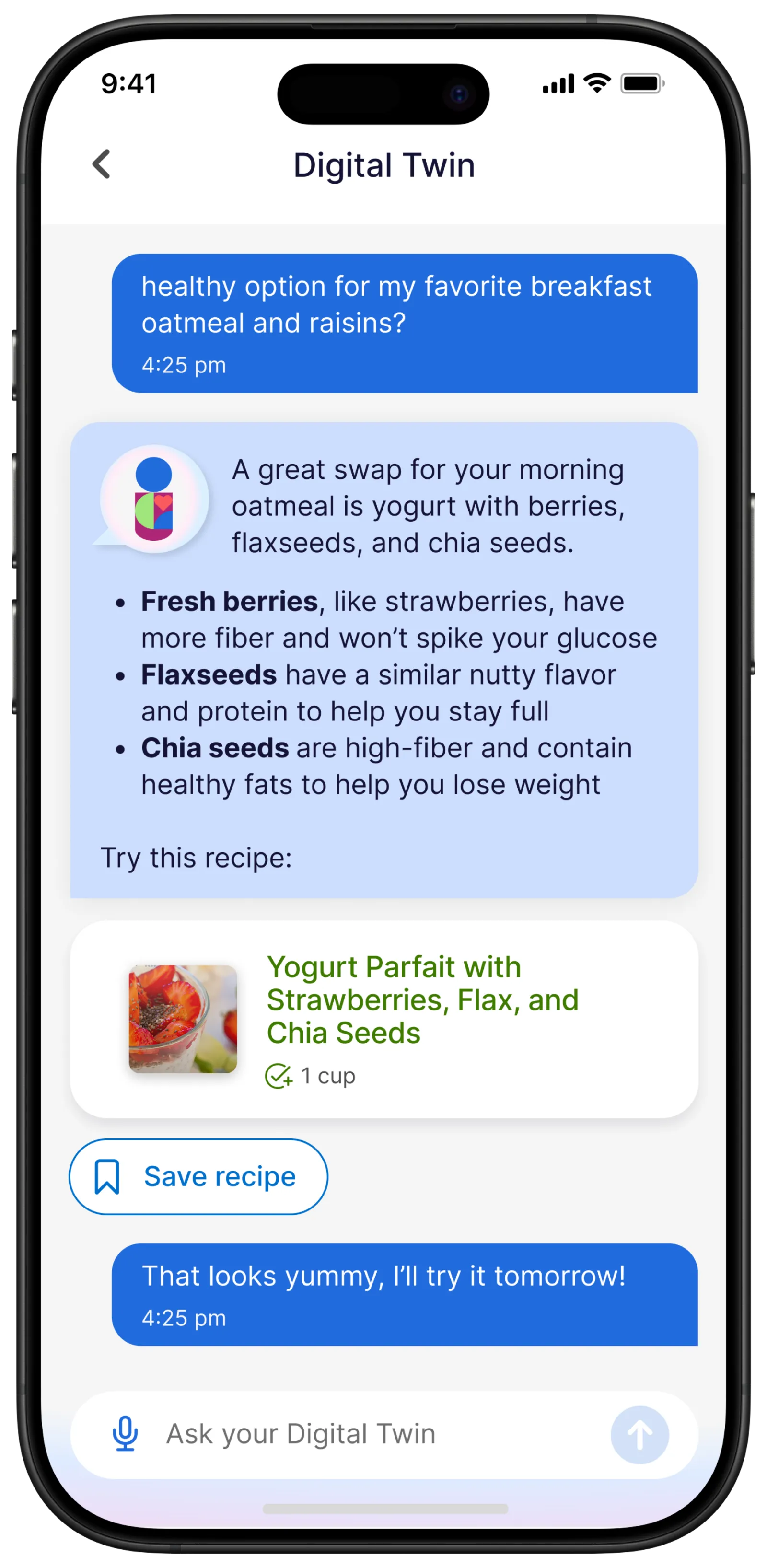
There would be no injections, no pills, no strict workout regimens. Twin Health promised to help patients improve the biomarkers and symptoms of type 2 diabetes with an app and a Bluetooth-synced scale, blood pressure cuff and wearable device similar to a Fitbit.
...
After a year in the trial, Biller's neuropathy was gone. To her dentist’s surprise, the abscesses in her mouth healed. She got off all sleeping and pain pills and most of her glucose-regulating medications, except for metformin (a cheap, readily available pill that is often used as the first line of defense in patients with type 2 diabetes, and even prediabetes). She dropped 50 pounds and no longer met the criteria for obesity.
But the most remarkable change—in endocrinologists’ eyes—was in her hemoglobin A1C, a test that measures a patient’s average blood sugar in the past two to three months. Before using the Twin Health app, Biller's A1C was over 8 percent, putting her at a high risk of complications. Now, the number comes in around 5.8 percent—and according to Cleveland Clinic, anything under 6.5 percent is not consistent with diabetes.
“I never dreamed I'd see that again, ever,” Biller said.
Most clinicians wouldn’t dare to dream it, either, according to Dr. Kevin Pantalone, an endocrinologist and the director of diabetes initiatives at Cleveland Clinic. He was doubtful when the email pitch from Twin Health that prompted the trial first landed in his inbox, telling Newsweek, “The skeptic in me wanted to know more.”
“Historically, patients with diabetes go from one medicine to two medicines to three medicines, because their condition worsens and they require more and more therapy over time,” Pantalone said. “To be able to control somebody's diabetes [while] at the same time reducing their number of medicines just seemed very aspirational.”
By the end of the 12-month, 150-patient study, he was a believer. (The study was published in NEJM Catalyst and is only accessible to subscribers, but Newsweek obtained the full report.) Seventy one of the 100 patients using Twin Health’s intervention had achieved an A1C under 6.5 percent, effectively reversing their type 2 diabetes. Only 2.4 percent of the 50 patients receiving standard care from Cleveland Clinic saw the same result.
More than half of Twin Health users were able to come off all their glucose-lowering medications except for metformin, compared to 2.8 percent in the standard care group, and Twin Health patients dropped body weight at around twice the rate of their peers, according to the study.
“Nothing outside of bariatric surgery has ever been shown to improve A1C, to help with weight loss [while] at the same time reducing medications in the background to control someone's type 2 diabetes,” Pantalone said. The digital twin, he believes, is changing that paradigm.
...
What Is a Digital Twin?
Digital twins are virtual replicas of real-world people, products or processes that can simulate an action’s outcome on those people, products or processes without altering the originals. Seventy-five percent of businesses employ digital twins to help make data-driven decisions, especially in areas like supply chain optimization and product development, according to IBM.
They’ve been gaining traction in the health care industry as AI gets better at high-speed, high-scale data analysis. GE HealthCare employs digital twins to help hospitals anticipate patient capacities, redesign medical units and plan for new facilities. Academic medical centers in more than 70 countries use Sophia Genetics’ digital twin technology to assist with cancer diagnosis and treatment, drawing upon data from other patients with similar characteristics. Each month, more than 35,000 oncology patients are modeled against the company’s digital twins to identify potential genomic origins of the disease and predict how they'll respond to certain therapies, Jurgi Camblong, founder and CEO of Sophia Genetics, told Newsweek.
“This is the type of medicine we want, right?” Camblong said. “We don't just want [medicine] to be an art. We want it to be based on objective data, where the oncologist helps the patient to understand the case, what the options are and make that decision together.”
All digital twins are complex—requiring vast data sets and savvy AI models—but it was almost inconceivable to create one for a person’s metabolism, according to Jahangir Mohammed, founder and CEO of Twin Health. Fortunately, he was no stranger to the unknown, having founded Kineto Wireless (one of the pioneering companies that enabled mobile phones to make calls over Wi-Fi) and Jasper (an Internet of Things platform that sold to Cisco for $1.4 billion in 2016).
Mohammed got the idea for Twin Health several years ago while visiting home in South India. While having dinner with his mom and her siblings, he learned that four of the 10 had type 2 diabetes. They started casually sharing their high blood glucose levels, “like talking about a cricket score,” he told Newsweek. “I was just taken aback by how nonchalant they were.”
He soon discovered that more than 77 million adults in India suffer from type 2 diabetes, or about 7.5 percent of the population—and more than half of them are unaware of their condition. Diabetes is also prevalent in the U.S., with 38.1 million adults, or 14.7 percent of the population, meeting criteria for a diagnosis.
Mohammed’s research revealed that many highly prevalent chronic diseases tend to show up in a cluster: diabetes, obesity, hypertension, high cholesterol, fatty liver disease. When left uncontrolled, they can lead to even more severe consequences like stroke and Alzheimer’s disease.
The World Health Organization estimates that more than 60 percent of global deaths are caused by major preventable diseases. And a growing body of research links several of those diseases to dysfunctional metabolism—the process that converts food and drink into energy and maintains homeostasis.
Metabolic dysfunction “may be the world’s largest unsolved problem,” Mohammed told Newsweek. So why hasn't it been solved?

...
He brought the issue to clinicians, who told him that metabolism was “complex, dynamic and different for everyone.” There are hundreds of metabolic pathways in the body that impact thousands of biomarkers. It would be impossible to reduce that complexity to a single number, test or snapshot in time.
Mohammed focused on the simple, well-known truths about metabolism. It is impacted by a person’s behavior, including diet, exercise, sleep, stress and medications. The reverse is also true, as a person’s biologic makeup can influence their impulses, energy and actions.
“Behavior causes biology. Biology causes behavior,” Mohammed said. “It's a circular causality.”
He believed that if a person saw how their actions would affect them biologically through a digital twin, they may be inclined to change their behavior. And if an AI agent was available to provide 24/7 guidance, it might be easier to find and follow a healthy path.
That’s the simple hypothesis that reversed Deb Biller’s diabetes: examining a choice that “would have been pretty bad,” Mohammed said, “but we turned it into something not so bad.”
How Does the Twin Health Platform Work?
The Twin Health platform is designed to give patients real-time insight into how decisions about food, movement, sleep, stress and medication will affect their metabolic health. It blends continuous biometric monitoring, vast proprietary datasets, behavior-specific AI algorithms, and human coaching—all working together inside a smartphone app.
Mohammed and his team have spent seven years compiling the data needed to power the system. They analyzed 8 million meals eaten by people wearing a continuous glucose monitor (CGM), noting which foods they consumed in what order, and if they engaged in blood-sugar-lowering activities like taking a walk or a small shot of apple cider vinegar before eating. That foundational dataset allows the model to forecast individualized glucose responses and provide tailored recommendations.
Each time new data is logged, the system becomes more personalized. The platform gathers continuous biomarkers and behavior data to create a digital model of someone’s biology, metabolic pathways and how their behaviors affect them. “It discerns the cause and effect,” Mohammed said.
To do that, each patient uses four Bluetooth-enabled sensors: a CGM patch, a blood pressure cuff, a body scale that measures weight and muscle mass as well as a smart watch to track activity, heart rate, sleep and breathing patterns. That stream of biometric inputs—Mohammed said it's roughly 3,000 data points per user per day—creates the substrate for the AI engine.
Over time, the Twin appears to learn to understand context. If it knows the patient is at home, it may recommend a 10-minute walk after the meal to reduce blood glucose spikes. And it is apparently adaptive, recognizing not just how a person’s body responds to food but what their preferences are.
“If I decline salad three times, it doesn't bug me the fourth time,” Mohammed said.
If warning signs emerge—such as sustained poor metrics or a sudden lapse in engagement—it flags a “human touch” moment and escalates to a live coach or clinician.

...
For patients like Biller, the constant feedback loop was transformative.
“Everything that I ate, if I took a bite, I entered it,” she said. “Over time, once I started entering my food, it would tell me that this meal is not good for you.”
In Cleveland Clinic’s trial, that immediate guidance appears to have been the key differentiator, according to Pantalone.
“What provided the success of this intervention was the real-time feedback that the patients were receiving through engagement with the app,” Pantalone said. When patients were at the grocery store, the app scanned foods labels to determine whether they’re “green, orange or red,” helping users make healthier choices without needing to decipher nutrition labels.
That immediacy is what traditional diabetes counseling can’t offer, he added. “[Patients] hear what they should be doing, but then when they're at home actually doing it, there's nobody there in real time helping them with the decision-making process.”
Biller said that she was seeing results every day, inspiring her to push through challenges and continue reaping the results of her hard work. Early internal data from Twin Health suggests that the AI twin helps produce rapid physiological improvements.
“Most people feel change in one week, and there is a remarkable change in 90 days,” Mohammed said. “Human biology is resilient and adaptive. It responds quickly.”

...
How Could Metabolic Digital Twins Change Treatment for Chronic Conditions?
If Twin Health’s approach proves durable, it could reshape how clinicians view chronic metabolic disease—and potentially other conditions defined by behavioral and biological feedback loops. For decades, doctors have told patients that type 2 diabetes is inevitably going to worsen.
“We tell them that diabetes is a progressive disease, and that even if they do everything right with their diet and exercise, that they may require more therapy with time,” Pantalone said. The emotional toll can be enormous, and many of his patients feel they’ve failed when their medication list gets longer.
Twin Health’s trial challenges that narrative, and now, other health systems are beginning to consider similar approaches. Dr. Maria Ansari, co-CEO of the Permanente Federation—the physician group for California-based Kaiser Permanente—told Newsweek her organization is piloting Twin Health after reviewing Cleveland Clinic’s results.
Beyond clinical outcomes, the technology could also potentially provide financial relief. For payers, employers and health systems strained by rising drug costs, especially GLP-1s, the early evidence is promising. Mohammed estimates the platform saves about $8,000 per year for each patient with diabetes, and 89 percent of high-cost GLP-1 users in Twin Health's commercial insurance programs didn’t regain significant weight after discontinuation.
Plus, clinicians say the technology suggests that patients are more capable and motivated than they assumed. Pantalone described how older adults he doubted were “technology” users ended up thriving in Twin Health’s program, as did longtime patients whom he thought were stuck in their ways.
“My own biases as a physician shouldn’t determine what options I give my patient,” he said. “Who am I to say, ‘I don't think you can do this’?”
Today, Twin Health isn’t something patients can download on their own—it’s offered through employers, health plans and select health systems. But as adoption expands, Mohammed says the company is preparing for demand beyond patients with a diagnosed chronic disease.
“There is significant demand from the market for AI digital twins for everybody,” he claimed, “because why wait for people to get unhealthy?”

...
Are There Any Risks When Generating a Digital Twin?
While the Cleveland Clinic study did not reveal safety concerns—and the intervention currently involves no medications—the digital twin model still requires thoughtful oversight.
Sustained engagement is one of the biggest barriers to success in the Twin Health program. Pantalone said some patients who did not succeed likely struggled due to “lack of early success or lack of support system at home.” For some users, the need to log foods—especially in social settings—can feel awkward at first, though Biller said it became routine over time.
The digital twin also needs continuous, accurate data. Biller originally had to delay joining the study because she was taking antibiotics could distort her glucose readings. Patients taking certain medications also may not be able to participate.
But unlike medications that carry physiological side-effect risks, the twin’s guidance primarily centers on adequate diet, movement, sleep and stress-management—behaviors that clinicians already recommend. And as opposed to consulting with a human clinician or dietician, patients don’t have to worry about embarrassment or disappointing their digital twin. According to Mohammed, many find that they can be more honest in the app than in a doctor’s office.
“People quickly learn that [the digital twin] always tells the truth but doesn’t judge them,” Mohammed said.
As more health systems adopt metabolic twins, researchers will need to track long-term outcomes. Cleveland Clinic extended their Twin Health study for a second year, and although that leg wrapped in May, the data hasn’t been fully analyzed and released yet. Pantalone does not expect Cleveland Clinic’s one-year remission rate to stay at 71 percent indefinitely.
“I do think, over time, we may see some waning,” he said. Still, he believes, “We're going to see success in the majority of patients, because they learned a new lifestyle through this intervention.”
Editor's Note: This article was updated on December 12 at 6:17 p.m. to correct Deb Biller's name.
View 0 Comments
Submit Correction
View Editorial & AI Guidelines