
...

By Gabe Whisnant
News Editor
0
Share
Newsweek is a Trust Project member
See more of our trusted coverage when you search.Prefer Newsweek on Googleto see more of our trusted coverage when you search.
The Supreme Court on Monday declined to review a high-profile Alabama case involving a death-row inmate, drawing a sharp dissent from conservative Justices Samuel Alito and Clarence Thomas.
The decision leaves intact a lower-court ruling that threw out the capital murder conviction of Michael Anthony Powell due to remarks made by a prosecutor during trial.
Powell was convicted and sentenced to death for the 2016 fatal shooting of Tracy Algar, 54, an Alabaster, Alabama, gas station clerk during a robbery. At trial, the defense emphasized that police never recovered the murder weapon. In his closing rebuttal, the prosecutor pointed at the defense table and stated, "There is only one person in this room who knows where the gun is."
Read More on U.S.
The Alabama Court of Criminal Appeals later overturned Powell's conviction, ruling the comment was an unconstitutional violation of the Fifth Amendment right against self-incrimination because it improperly highlighted the defendant's choice not to testify.
...
The State of Alabama petitioned the Supreme Court to summarily reverse the state court's decision. On Monday, the Supreme Court majority denied the request, letting the reversal stand.
The ruling means Alabama must now either drop the capital charges or put Powell on trial for a second time.
Newsweek has reached out to the Alabama Attorney General's Office, the Shelby County, Alabama, District Attorney's Office and Powell's representation via the Equal Justice Initiative, a non-profit legal advocacy organization.
What Samuel Alito Wrote in the Dissent
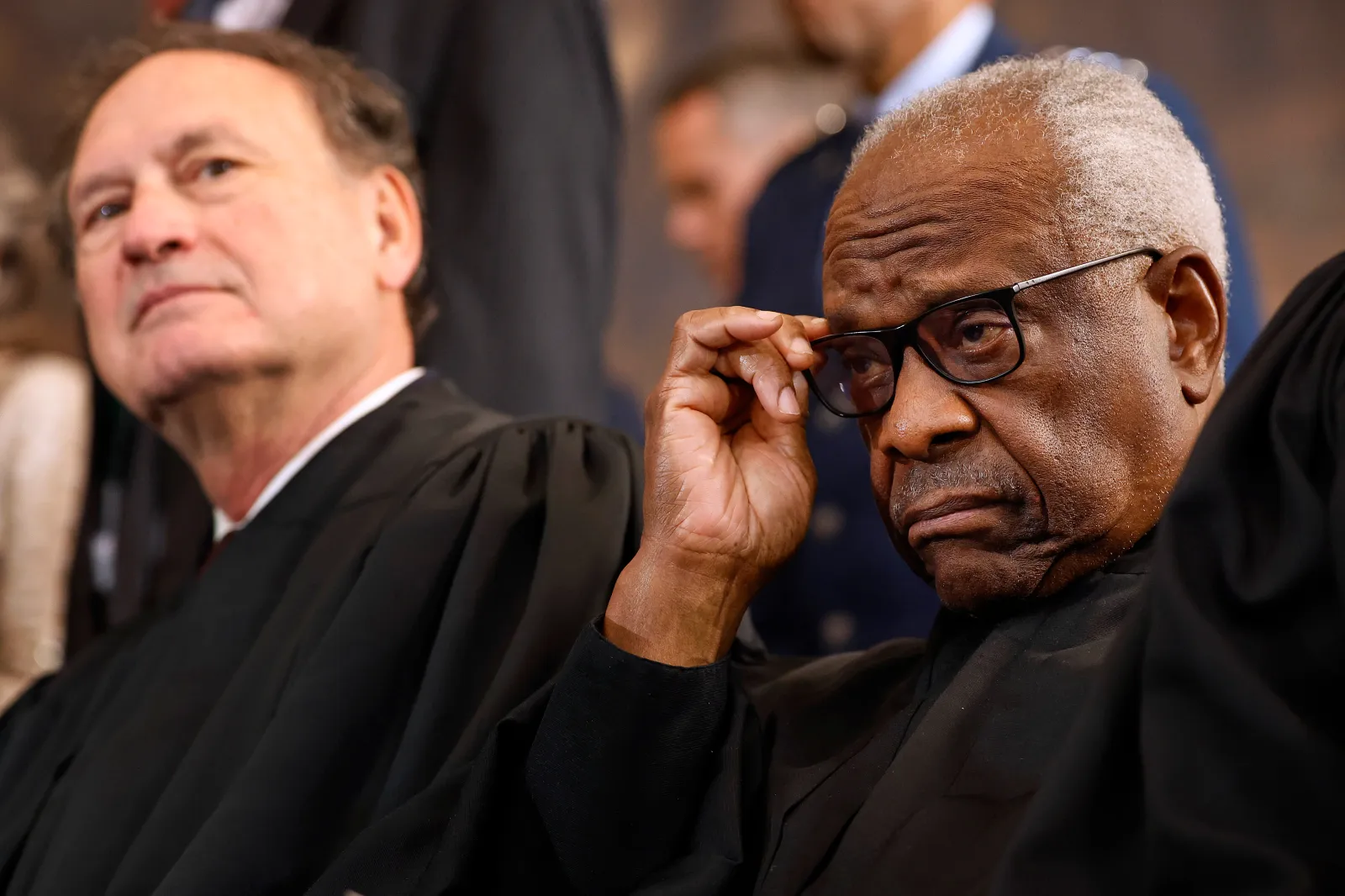
In a dissenting opinion joined by Thomas, Alito argued that the High Court should have intervened to reinstate Powell's conviction. Alito asserted that the prosecutor’s statement was a "perfectly proper" inference based on trial evidence—specifically, a forged confession letter Powell allegedly orchestrated to frame another inmate, which claimed the author had hidden the weapon. Viewed in that context, Alito argued, the remark was a fair response to the defense's arguments rather than an unconstitutional penalty on the defendant's silence.
"A prosecutor in this capital case made a statement in closing argument that the trial judge interpreted as a comment on properly admitted evidence. On appeal, however, the Alabama Court of Criminal Appeals interpreted the statement as a comment on the defendant's failure to take the stand, and on that basis it reversed the defendant's conviction…The State is right: The decision below contravenes [Supreme Court precedent], and this Court should summarily reverse it."
The dissent underscores an enduring friction on the High Court regarding the scope of constitutional protections during closing arguments. While the majority chose not to disrupt the state court's findings, Alito and Thomas signaled deep concern that lower appellate courts are interpreting Fifth Amendment boundaries too strictly, altogether ignoring the real-world context of a trial to overturn valid convictions.

...
What Led to the Supreme Court's Alabama v. Michael Anthony Powell Ruling
The initial 2021 trial in Shelby County Circuit Court was heavily contested, as prosecutors lacked direct physical evidence tying Powell to the execution-style shooting of Algar. Law enforcement never recovered the murder weapon, and none of the dozens of fingerprints, shoeprints, or DNA samples collected from the Alabaster Chevron matched Powell.
Instead, the state built a circumstantial case centered on local surveillance footage showing a man in a fedora walking between the gas station and Powell’s nearby apartment complex around the time of the crime. Investigators also discovered ammunition at a home belonging to one of Powell's girlfriends that matched the caliber and brand of the shell casing found at the scene. Furthermore, the state introduced a forged confession letter that Powell had allegedly coerced a fellow jail inmate into writing to frame another individual.
Powell chose not to testify in his own defense. Seizing on the evidentiary gaps during closing arguments, the defense heavily emphasized that the state had "no gun." That prompted the prosecutor's fateful rebuttal remark pointing directly at Powell, ultimately leading the jury to return a guilty verdict and recommend a death sentence by an 11-to-1 vote.
"Investigators with the Alabaster Police Department and assisting agencies did an outstanding job putting this case together," said then-Shelby County District Attorney Jill Lee. "Chief (Curtis) Rigney and the entire department, along with the combined efforts of the Major Crimes Task Force, helped to bring justice for this family. Justice was served and I am thankful Tracy's family can start to heal from this horrific event."
On May 3, 2024, the Alabama Court of Criminal Appeals officially overturned Powell’s capital murder conviction and death sentence, ruling that the prosecution had committed a reversible error by unconstitutionally highlighting the defendant's decision to remain silent. After the appellate court denied a state application for rehearing on August 9, 2024, and the Supreme Court of Alabama subsequently declined to review the case on September 12, 2025, the State of Alabama escalated the matter federally.
Led by the Alabama Attorney General's office, the state filed a petition for a writ of certiorari with the U.S. Supreme Court on January 12, seeking a summary reversal of the state court's decision—an appeal that ultimately concluded with the High Court's refusal to review the case.
View 0 Comments
Submit Correction
View Editorial & AI Guidelines