...

By Micah McCartney
Reporter
0
Share
Newsweek is a Trust Project member
See more of our trusted coverage when you search.Prefer Newsweek on Googleto see more of our trusted coverage when you search.
The People's Liberation Army Navy dispatched forces to monitor U.S. naval exercises with the Philippines and Australia in the South China Sea earlier this week.
Therse were the first such drills reported since the Philippines declared a no-fly zone over an area that included Second Thomas Shoal, one of the most fiercely contested features in the country’s territorial dispute with China.
Why It Matters
China lays claim to most of the South China Sea, an energy-rich conduit for as much as one-third of global shipping, citing alleged historical rights. A 2016 ruling by an international arbitral tribunal largely dismissed those claims.
Read More on World
China’s expanding presence in the Philippines’ maritime zone and repeated clashes with its coast guard have led the U.S. treaty ally to step up military spending and strengthen defense ties with Washington and other partners in the region, including through Maritime Cooperative Activities since late 2023 aimed at increasing interoperability. Beijing has responded by accusing Manila of destabilizing the region by involving outside forces.
Newsweek reached out to China’s Ministry of National Defense with an emailed request for comment.
...
What To Know
The People’s Liberation Army Southern Theater Command conducted "combat readiness patrols" in unspecified waters of the South China Sea from Sunday to Monday, command spokesperson Zhai Shichen said in a statement.
"The Philippines is drawing in extra-regional countries to organize so-called ‘joint patrols,’ disrupting the situation in the South China Sea and damaging regional peace and stability," he said. "Theater Command forces will firmly defend national territorial sovereignty and maritime rights and interests, and steadfastly maintain regional peace and stability."
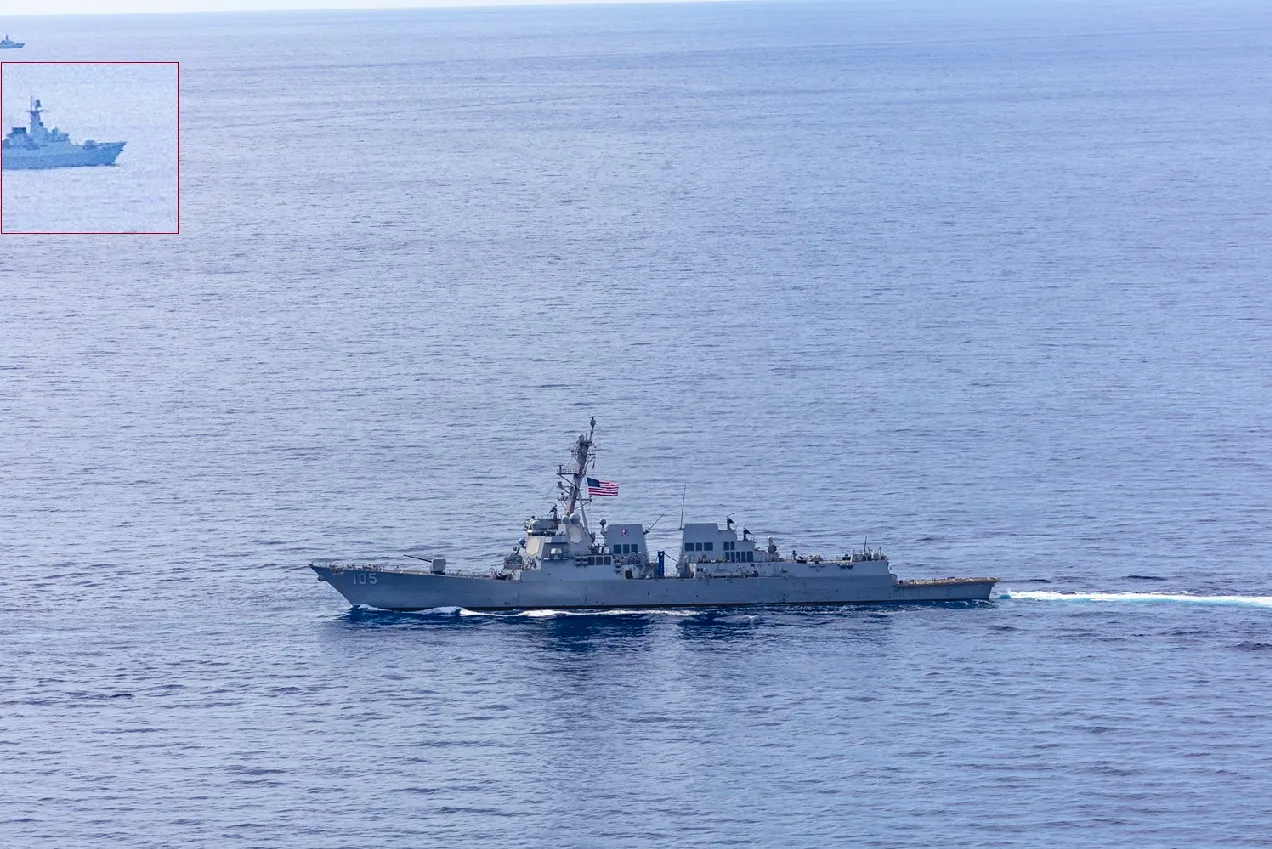
The Chinese patrols coincided with a two-day Maritime Cooperative Activity (MCA) involving the U.S., the Philippines and Australia. The U.S. Indo-Pacific Command said training focused on visual information drills and replenishment-at-sea.
Participating forces included the U.S. guided-missile destroyer USS Dewey and a P-8A Poseidon reconnaissance aircraft, while Australia contributed a P-8A and the frigate HMAS Toowoomba. These were joined by Philippine Coast Guard patrol ship BRP Teresa Magbanua, a Navy guided-missile frigate, and assorted helicopters and fighter aircraft.
A Chinese destroyer can be seen shadowing the Dewey from a distance in one U.S. Navy photo.
The MCA took place in the Philippine exclusive economic zone in the vicinity of Scarborough Shoal, known in Manila as Bajo de Masinloc and in Beijing as Huangyan Dao, Philippine media reported.
The Philippines' No Fly Zone
The atoll falls within a NOTAM (Notice to Airmen) declared last month by the Philippines covering January 21 to March 31 for MCAs and other activities under the Mutual Defense Board-Security Engagement Board (MDB-SEB). This is an annual high-level mechanism between the Armed Forces of the Philippines and the U.S. Indo-Pacific Command.
That waters around Scarborough were selected for the MCA is notable. Tensions there further intensified in August when a Chinese coast guard ship and navy destroyer collided as they sought to block a Philippine mission to supply local fishermen. Days later, China unilaterally declared a nature reserve over much of the atoll's eastern edge, drawing a sharp protest from Manila.
The number of MCAs last year hit a record 19, more than double 2024, according to a database maintained by Collin Koh, a senior fellow at the Institute of Defence and Strategic Studies in Singapore.

...
What People Are Saying
The U.S. Indo-Pacific Command stated: "The U.S., along with our allies and partners, upholds the right to freedom of navigation and overflight and other lawful uses of the sea and international airspace, and respect for all nations’ maritime rights under international law."
The Armed Forces of the Philippines said in a statement: "The 14th MMCA marked the 1st multilateral maritime cooperative activity of the year which underscores a shared, multi-national resolve to strengthen interoperability, and the freedom of navigation and overflight under international law."
Chinese Defense Ministry spokesperson Jiang Bin said of the NOTAM during a January 29 press briefing: "We are strongly dissatisfied with and firmly oppose it, and have lodged solemn representations with the Philippine side."
What Happens Next
There are more than 500 activities on the MDB-SEB calendar this year, making 2026 among the busiest—if not the busiest—in the framework’s history, Rear Admiral Roy Vincent Trinidad, a Philippine military spokesperson, told Newsweek.
View 0 Comments
Submit Correction
View Editorial & AI Guidelines