...

By Didi Kirsten Tatlow
Senior Correspondent, International Affairs
0
Share
Newsweek is a Trust Project member
See more of our trusted coverage when you search.Prefer Newsweek on Googleto see more of our trusted coverage when you search.
China's military is experiencing weakness in its command structure as President Xi Jinping continues rolling purges that have removed dozens of top generals and hundreds of lower-ranking officers, but the weakness is not expected to last and the People's Liberation Army is growing fast overall, according to a report published this week.
"In 2025 the PLA underwent significant personnel changes as part of an ongoing anti-corruption purge," the report by London-based think thank the International Institute for Strategic Studies (IISS) said.
"From an organisational perspective, until the vacancies are filled the PLA is operating with serious deficiencies in its command structure," according to the report, Military Balance 2026, that assesses military power around the world. However, the deficiencies were "likely to be a temporary disturbance" with China's military buildup likely continuing apace, it said.
Read More on Politics
In particular, China continued to increase its military threat toward Taiwan—and last year for the first time showed at a major military parade in September that it had a "nuclear triad," or nuclear weapons deployed at land, at sea, and in the air, the report said.

...
"Indeed, despite this instability in 2025, the PLA has, for the fourth consecutive year, increased the number of incursions it has made into Taiwan's air defense identification zone," the report said.
It was also "actively and assertively" projecting power into the entire Indo-Pacific region "in support of Chinese territorial claims and as a tool of statecraft."
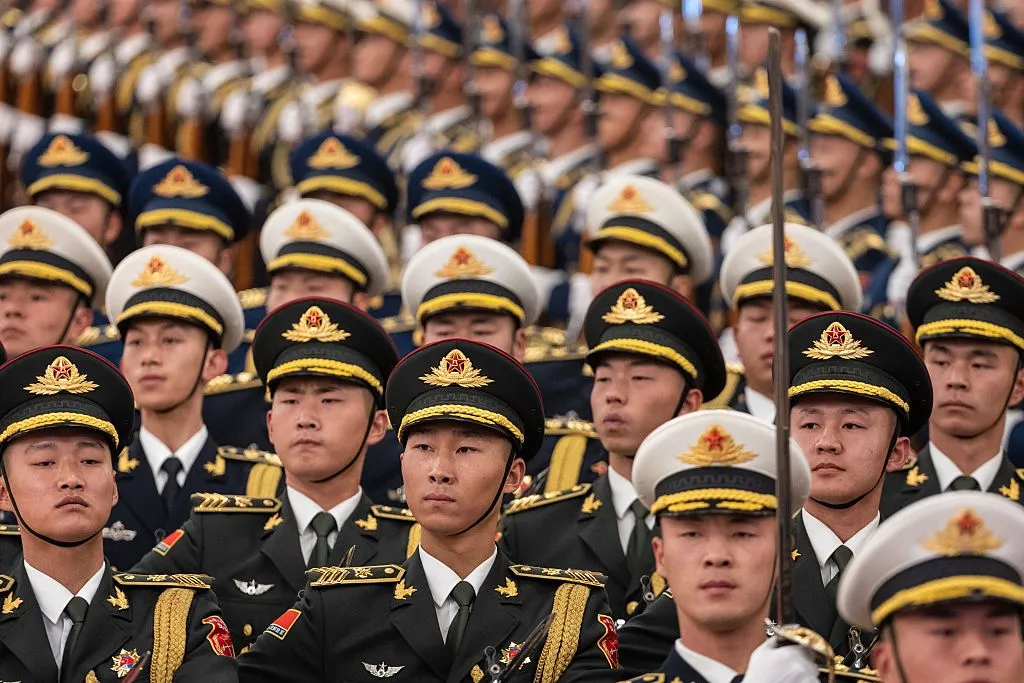
A massive military parade held on September 3 last year displayed China's growing nuclear arsenal.
"The nuclear weapons on display were intended to send a message of deterrence to the US," the report said.
Newsweek contacted the Chinese embassy in Washington, D.C., for comment but did not hear back immediately.
New Appointments Slow to Come
The report assessed the condition of the PLA in 2025 and therefore did not include the latest and most dramatic purge in January, when China's top general, Zhang Youxia, and another general, Liu Zhenli, were removed from the Central Military Commission (CMC) on charges of corruption and, apparently, for political disloyalty.
That action reduced the key body that controls the PLA for the Communist Party from 11 members when Xi took power to just two. Xi became the head of the Chinese Communist Party (CCP) in 2012.
Military analysts have been watching what Xi may do to replace the missing generals on the CMC, but he is biding his time with no promotions yet announced.
"Self-inflicted wounds to the People’s Liberation Army (PLA) high command from frequent purges have undermined the PLA leadership’s decision-making capacity by substituting the collective wisdom of elite officers with the wits of one man," Zi Yang, a Research Fellow at the S. Rajaratnam School of International Studies at Singapore's Nanyang Technological University wrote in China Brief, an online magazine of the Washington, D.C.-based research organization the Jamestown Foundation.
Yang called the situation "abnormal for any modern military," but predicted it may persist through much of 2026.
"When Xi does move to repopulate the CMC, he is likely to elevate politically loyal officers who pose no threat," Yang wrote.
Military Modernization Continuing Apace
The IISS report noted that China's 15th Five Year Plan, which will likely be fully unveiled in March, would continue its fast military modernization that has been fueling fears of a military clash between the U.S. and China—despite instability in the military.
"Although American and Chinese defence officials continue to state that war is not inevitable, a greater sense of urgency around the need to prepare for and deter a potential conflict is evident in the US, its allies and Taiwan," the IISS report said.
Part of the reason for that is the continued surge in China's defense spending, which totaled $340 billion in 2025, or an increase of about 7 percent for the third year in a row.
View 0 Comments
Submit Correction
View Editorial & AI Guidelines