10
Loading video...

By Ryan Chan
China News Reporter
0
Share
Newsweek is a Trust Project member
See more of our trusted coverage when you search.Prefer Newsweek on Googleto see more of our trusted coverage when you search.
China officially put its most-advanced aircraft carrier, CNS Fujian, into service at a ceremony attended by President Xi Jinping on Wednesday, marking a major milestone for the East Asian power in developing its armed forces to "world-class" standards.
The Fujian is China's first aircraft carrier equipped with electromagnetic catapults, a design decided by Xi personally, the Chinese military said on Friday. The technology enables the Fujian to launch heavier fixed-wing aircraft, bolstering its combat power.
Why It Matters
Like its U.S. counterpart, the Chinese military has viewed aircraft carriers as a visible symbol of its strength. Under Xi's leadership, the People's Liberation Army has been undergoing modernization, including its fast-growing nuclear forces, with a long-term goal of making it "world-class" by 2049, coinciding with the centennial of the country.
Read More on World
What To Know
As part of its military buildup, China operates the world's largest navy by hull count, with over 370 vessels, according to a Pentagon assessment. The Chinese fleet includes three conventionally powered aircraft carriers—CNS Liaoning, CNS Shandong and the Fujian. Its naval adversary, the United States, has 11 nuclear-powered aircraft carriers.
Xi, who also serves as China's military leader, attended the commissioning and flag-presenting ceremony of the Fujian, which has the hull number 18, at a naval port in the city of Sanya in the southern province of Hainan, located north of the South China Sea.
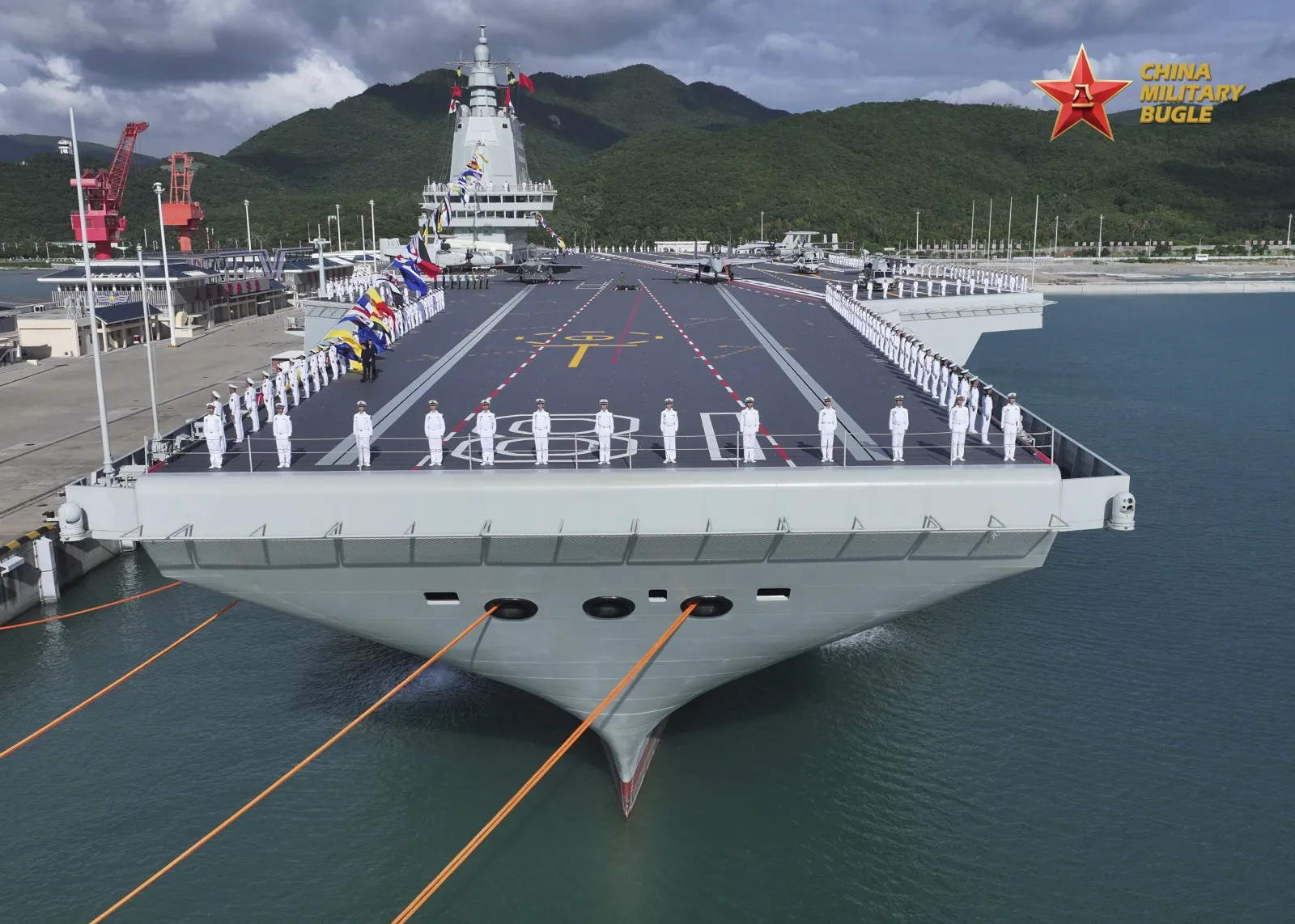
...
The Chinese military said Xi has "consistently paid close attention" to China's aircraft-carrier development. After the ceremony, the president boarded the Fujian and received a briefing on the development of aircraft-carrier fleet and the use of electromagnetic catapults.
The Chinese leader also witnessed how the Fujian's three catapults work. "He visited the catapult control station, observed the workflow, pressed the catapult button and the unloaded launcher on the deck shot like an arrow toward the bow," the report said.
Several aircraft were parked on the Fujian's flight deck for Xi's inspection, including J-15T and J-35 fighter jets and KJ-600 early warning aircraft. These were first spotted in an October 25 satellite image of Yulin Naval Base, along with the Shandong.
Unlike the Fujian, both the Liaoning and the Shandong are "ski-jump" aircraft carriers, which are not equipped with catapults to support their aircraft's flight operations.
According to the Center for Strategic and International Studies' ChinaPower project, the Fujian began construction in 2017 and was launched in 2022. The warship, named after Fujian province, underwent nine sea trials between May last year and September.
The Fujian has become one of two aircraft carriers in the world equipped with electromagnetic catapults, the other being USS Gerald R. Ford. The Chinese military said its electromagnetic catapult technology is "among the world's most advanced."

...
However, it was not immediately clear where the Fujian will be homeported. In addition to Yulin Naval Base, the home port of the Shandong, China has based its first aircraft carrier, the Liaoning, at Yuchi Naval Base in Qingdao in northeastern China.
If the Fujian joins the Shandong at Yulin Naval Base, it would strengthen China's naval presence and control in the South China Sea, where Beijing's territorial claims overlap with those of other countries and the U.S. Navy has often deployed its aircraft carriers.
What People Are Saying
Alex Luck, a naval analyst in Australia, wrote in an article for Naval News on Friday: "Aircraft carriers represent a complex ecosystem of embarked aviation and the countless subsystems supporting the functionality of a mobile air base. The nature of these largest military vessels implies a time-consuming process working up to operational capability."
The Pentagon's Chinese military power report 2024 commented: "Fujian is larger than the ski-jump carriers and fitted with an electromagnetic catapult launch system. This design enables it to support additional fighter aircraft, fixed-wing early-warning aircraft, and more rapid flight operations, thus extending the reach and effectiveness of the [People's Republic of China]'s carrier-based strike aircraft."
What Happens Next
Alex Luck, a naval analyst in Australia, said China's plan to build a fourth aircraft carrier is a question of when. It remains unclear whether the vessel will be nuclear-powered, which would enable it to operate for extended periods without refueling.
View 0 Comments
Submit Correction
View Editorial & AI Guidelines