
10
Loading video...

By Ryan Chan
China News Reporter
0
Share
Newsweek is a Trust Project member
See more of our trusted coverage when you search.Prefer Newsweek on Googleto see more of our trusted coverage when you search.
China unveiled no fewer than five types of nuclear missiles on Wednesday during a highly anticipated military parade watched by large crowds and world leaders including apparently U.S. President Donald Trump.
Chinese state media described the weapons as offering the military "global-covering" and "defense-penetrating" strike capabilities amid U.S. efforts to build a nationwide anti-missile shield.
The parade, at Beijing's Tiananmen Square marked the 80th anniversary of World War II, what China calls the "victory in the Chinese People's War of Resistance Against Japanese Aggression and the World Anti-Fascist War."
Read More on World
The U.S. Defense Department declined to comment when reached by Newsweek.
Why It Matters
China is one of nine countries armed with nuclear weapons, possessing the world's third-largest nuclear arsenal—behind Russia and the U.S.—in warhead count. As part of a military buildup, leader Xi Jinping has ordered the acceleration of nuclear development.
Last September, China conducted its first test launch of an unarmed but nuclear-capable intercontinental ballistic missile (ICBM) since the 1980s, during which the missile reached the South Pacific. Beijing claimed at the time that the event was part of its training plan.
Faced with the evolving nuclear missile threat from China, Russia and North Korea—whose leaders attended the military parade in Beijing—the Trump administration aims to deploy a $175 billion "Golden Dome" defense system by 2029 capable of intercepting missiles approaching the U.S. homeland.
What To Know
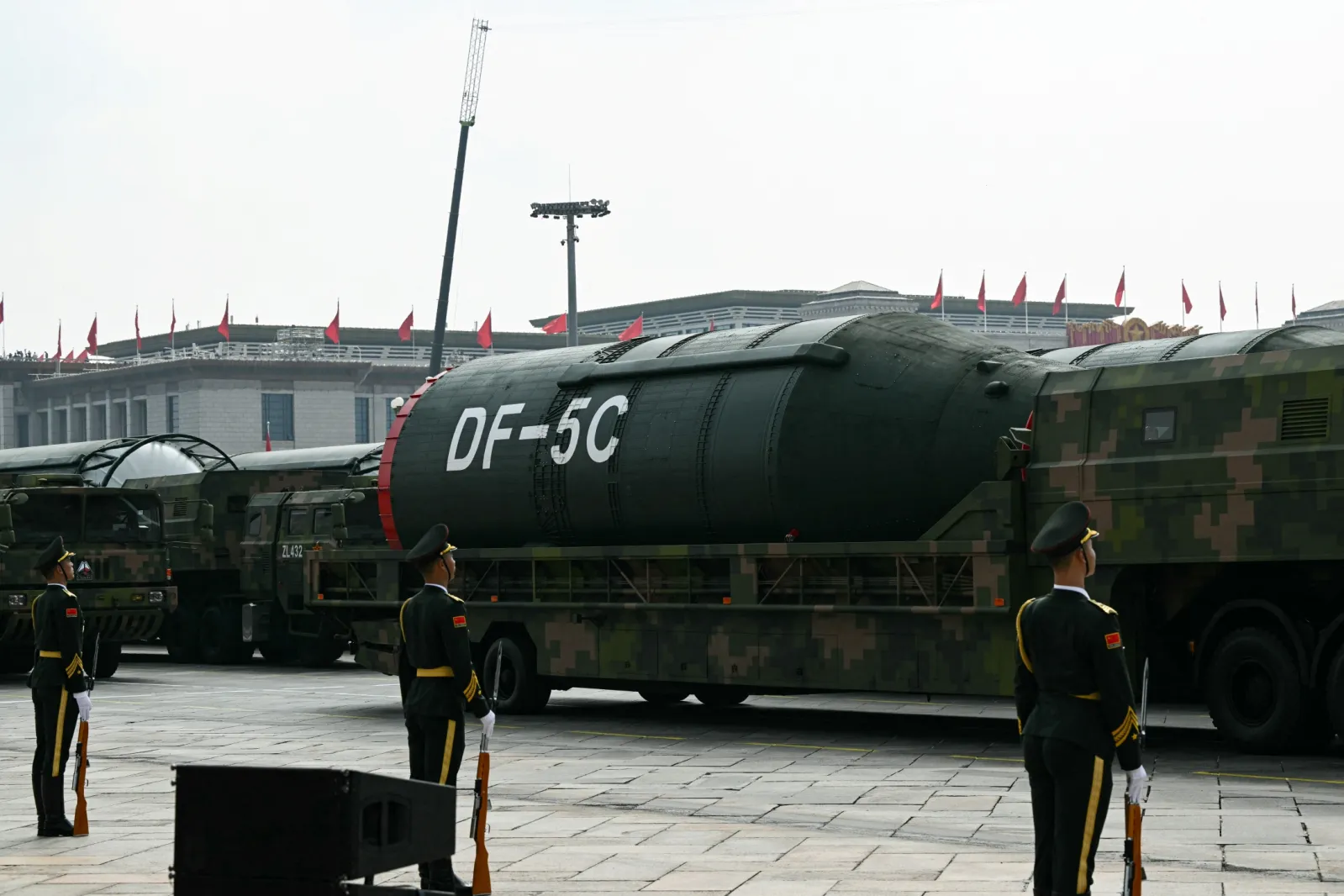
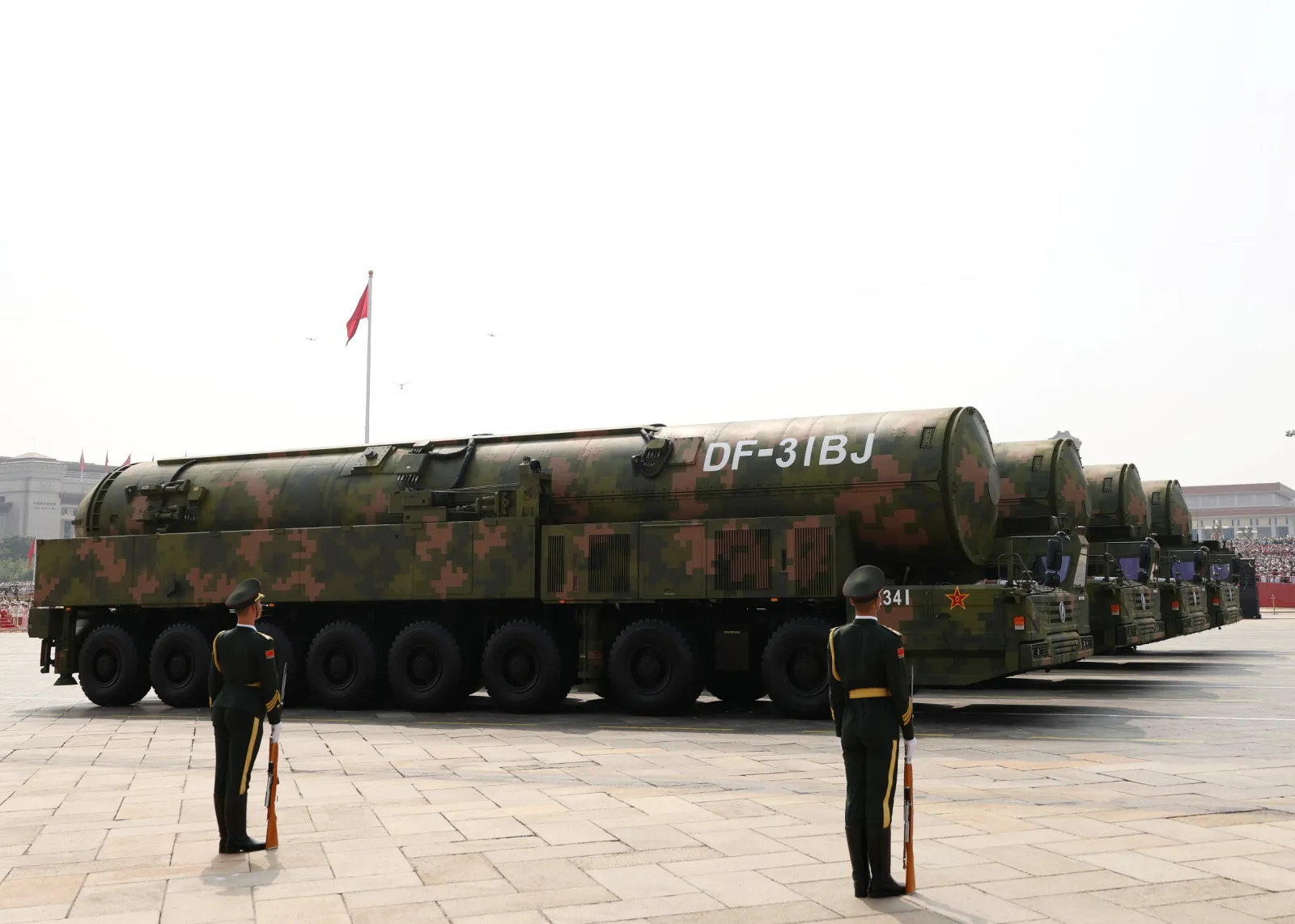
Chinese nuclear missiles displayed at Tiananmen Square included three ICBMs—the DF-5C, the DF-31BJ and the DF-61—as well as the JL-1 air-launched ballistic missile (ALBM) and the JL-3 submarine-launched ballistic missile (SLBM), the state-run Global Times reported.
This marked the "first concentrated appearance" of China's land-, sea-, and air-based nuclear triad, the paper said. The U.S. and Russia also possess nuclear triads, with the Pentagon saying each of the three parts provides "unique and complementary attributes."

...
Nuclear-armed submarines are difficult for adversaries to track while on patrol, making them more survivable in a nuclear war. While ICBMs can be launched and reach targets within minutes, bombers armed with nuclear missiles offer flexible deployment and response options.
Shao Yongling, a Chinese military expert, told the Global Times that this was the first time China's air-based nuclear forces were publicized, marking a major milestone that pointed to China's more "reliable and credible" nuclear deterrence and counterattack capabilities.
The DF-5C ICBM
Yang Chengjun, a Chinese missile and nuclear expert, told the Global Times that the DF-5C could have a range of more than 12,427 miles, capable of "covering the entire globe" and allowing China to launch counterattacks on any target worldwide that poses a nuclear threat.
...
The missile's other features include high speed in flight and the ability to carry multiple warheads—nuclear or conventional—and decoys, which Yang claimed pose great challenges to existing missile defense systems, giving adversaries minimal time to react.
In comparison, the U.S. currently deploys only a single type of land-based ICBM, the Minuteman III, which has been in service since 1970. It has a stated range of over 6,000 miles and is equipped with a single nuclear warhead, although it can carry two or three if necessary.
The DF-31BJ and DF-61 ICBM
The DF-31BJ belongs to the DF-31 family of ICBMs, which includes the DF-31AG—the missile China test-launched over the Pacific last year, with a reported range of 6,959 miles.
According to military observers, the DF-31BJ could be the designation for a silo-based DF-31 variant, with "B" indicating the upgrade and "J" representing the missile's basing mode.
...
In its report on Chinese nuclear weapons, the Federation of American Scientists said China has developed extended-range variants of the original DF-31 missile, all of which are capable of striking most of the continental U.S. from most deployment areas in China.
Meanwhile, little is known about the DF-61, thought to be the successor to the DF-41, which has an estimated maximum range of 9,320 miles and can carry up to 10 nuclear warheads.
The DF-41 was originally developed as a road-mobile ICBM, but China appears to be considering rail-mobile and silo-based deployment modes, according to a Pentagon report.
The JL-3 SLBM
The JL-3 is China's third-generation nuclear ballistic missile designed for nuclear-powered submarines, according to the Hong Kong-based newspaper South China Morning Post.

...
The Pentagon said the JL-3 has an estimated range of 6,214 miles, capable of conducting nuclear strikes on parts of the U.S. mainland when launched from China's coastal waters.
China operates a fleet of six Type 094 nuclear-powered ballistic missile submarines, each armed with 12 missiles, allowing it to maintain a constant at-sea deterrent presence. The newer Type 096 submarines are expected to enter service in the late 2020s or early 2030s.
The U.S. Navy possesses 14 Ohio-class ballistic missile submarines, each armed with up to 20 Trident II D5LE nuclear missiles, which have an estimated range of 7,456 miles.
The JL-1 ALBM
While the JL-1, with an estimated range of 1,864 to 2,485 miles, debuted on Wednesday, its carrier—the H-6N bomber—had already been unveiled at a 2019 military parade. The aircraft features a modified fuselage to carry an ALBM externally, according to the Pentagon.

...
Since the bomber is capable of aerial refueling to extend its time in the air, it has an estimated flight range of 3,106 miles. By being equipped with the JL-1, China can launch nuclear precision strikes via bombers against targets in the Indo-Pacific theater.
The U.S. nuclear-capable bomber fleet is currently equipped with the AGM-86B Air-Launched Cruise Missile, which has a stated range of 1,500 miles and carries a single nuclear warhead. Its carrier—the B-52H bomber—can carry up to 20 missiles.
What People Are Saying
Chinese military expert Zhang Junshe told the Global Times on Wednesday: "The official debut of air-launched strategic missile means that China has become one of the few countries in the world with a nuclear triad."
Chinese missile and nuclear expert Yang Chengjun told the Global Times on Wednesday: "The appearance of these strategic weapons is of great significance. First, it tells the Chinese people not to forget the history. Second, it reminds people not to ignore the real threats. The security situation China is facing is still complex and severe."
What Happens Next
It remains to be seen whether China will test-launch any of these new nuclear missiles in the future, while Washington may continue to pressure Beijing to discuss nuclear disarmament.
View 0 Comments
Submit Correction
View Editorial & AI Guidelines