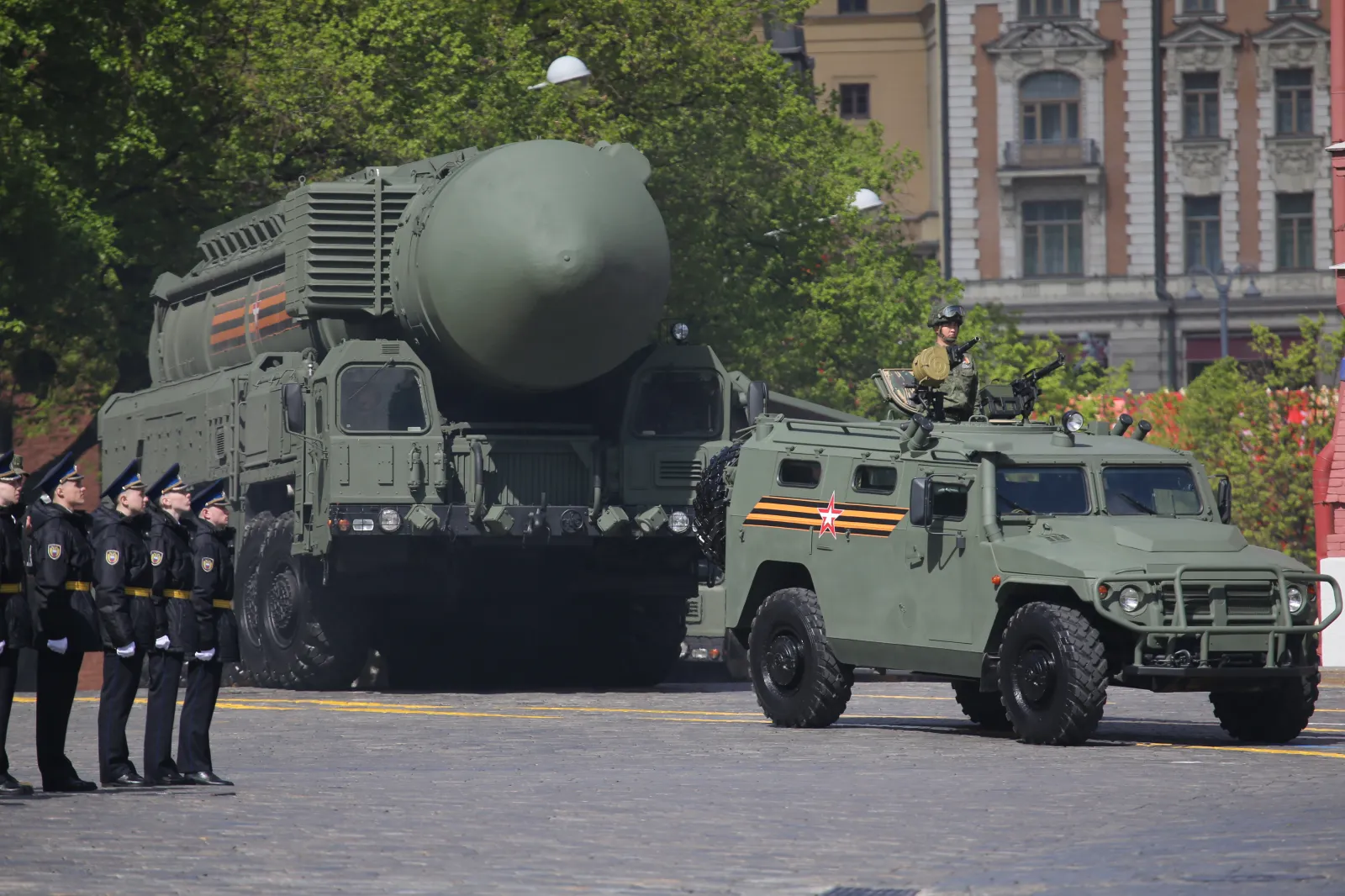
...

By Micah McCartney
Reporter
0
Share
Newsweek is a Trust Project member
See more of our trusted coverage when you search.Prefer Newsweek on Googleto see more of our trusted coverage when you search.
With the New START Treaty between the U.S. and Russia set to expire Thursday, China has weighed in on suggestions it could join a new pact, arguing it is "not fair" to expect Beijing to sign on given the far smaller size of its nuclear arsenal.
Why It Matters
The expiration comes 15 years after New START was signed by then-U. S. President Barack Obama and then-Russian President Dmitri Medvedev. For the first time in more than half a century, there will be no limits on the world’s two largest nuclear stockpiles.
Read More on World
The treaty’s end comes amid a series of nuclear-related tensions: China’s rapid warhead expansion, North Korea’s advancing nuclear weapons program, and U.S. threats to prevent Iran from developing nuclear weapons if diplomacy fails.
Newsweek reached out to the U.S. Department of State and the Russian Foreign Ministry via email with requests for comment.
What To Know
"China’s position on a trilateral negotiation with the U.S. and Russia on nuclear arms control is clear," Chinese Foreign Ministry spokesperson Lin Jian told reporters Tuesday when asked to respond to Trump’s past suggestions China could join a future nuclear arms treaty.
"China’s nuclear strength is by no means at the same level with that of the U.S. It is neither fair nor reasonable to ask China to join the nuclear disarmament negotiations at this stage," he added.
China has rapidly increased its nuclear stockpiles in recent years and now boasts more than 600 operational warheads, according to Pentagon estimates. Analysts view this expansion as part of Chinese President Xi Jinping's efforts to narrow the power gap with Washington and deter U.S. forces from intervening during a regional crisis, such as an invasion of Beijijng-claimed Taiwan.
China has not signed onto a nuclear arms treaty, though it is one of only two nuclear-armed countries, alongside India, to maintain a no-first-use policy. Beijing has called for all nuclear powers to adopt a similar commitment, a proposal that both the U.S. and Russia have dismissed.
The United States and Russia together account for roughly 90 percent of the world’s nuclear weapons, with each estimated to possess more than 5,000 warheads each, according to the Stockholm International Peace Research Institute.
...
New START limits each country to 1,550 deployed warheads—a steep reduction from their stockpiles of over 30,000 each at the height of the Cold War. It caps 700 deployed intercontinental ballistic missiles (ICBMs), heavy bombers, and submarine-launched ballistic missiles (SLBMs) capable of delivering nuclear warheads.
The treaty also requires both sides to report changes in status and movements of these assets and allows for regular inspections to verify compliance. Inspections halted during the COVID-19 pandemic, and Russian President Vladimir Putin suspended them indefinitely in February 2022, just days before his full-scale invasion of Ukraine.
What People Are Saying
Lynn Rusten, nonresident senior fellow at the Center for European Policy Analysis’ Transatlantic Defense and Security Program, wrote in recent analysis: "Not only has the arms control architecture between Russia and the West unraveled, but China is now expanding its nuclear arsenal more quickly than imagined even a few years ago. North Korea’s nuclear and missile arsenal has grown unabated, and there is no ongoing diplomacy to address it. Iran’s threshold nuclear program continues to advance, while India and Pakistan fought and may have come close to nuclear blows last year."
Former President Barack Obama wrote on the Bluesky social media platform Tuesday: "If Congress doesn’t act, the last nuclear arms control treaty between the U.S. and Russia will expire. It would pointlessly wipe out decades of diplomacy, and could spark another arms race that makes the world less safe."
What Happens Next
The Kremlin says Trump has not responded to Putin's offer for a voluntary one-year extension of New START. Trump has expressed interest in limiting nuclear weapons but signaled no urgency, telling the New York Times last month: "If it expires, it expires…We’ll just do a better agreement."
Nuclear tensions and other existential threats prompted the Bulletin of the Atomic Scientists to move the Doomsday Clock to an unprecedented 89 seconds to midnight last week.
View 0 Comments
Submit Correction
View Editorial & AI Guidelines