...

By Shane Croucher
Senior Editor
0
Share
Newsweek is a Trust Project member
See more of our trusted coverage when you search.Prefer Newsweek on Googleto see more of our trusted coverage when you search.
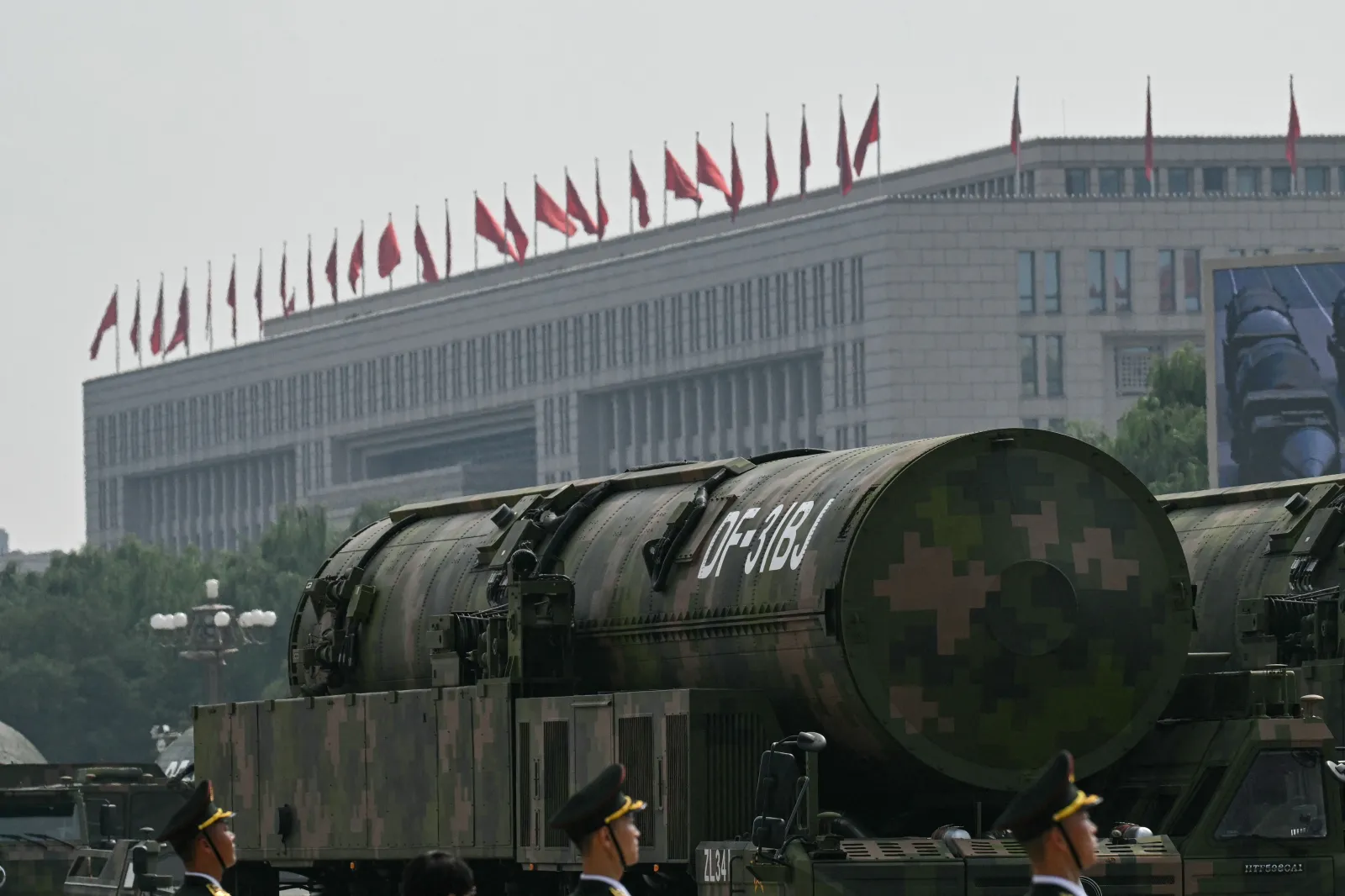
China has probably loaded more than 100 of its nuclear-armed solid-fueled DF-31 intercontinental ballistic missiles (ICBM) into three silo fields near its border with Mongolia, a new draft Pentagon report says, according to Reuters.
The draft report, which could still change, also assesses that China does not want to have talks on arms control, Reuters reported, as is hoped for by President Donald Trump, who is pushing for denuclearization with Beijing as well as Russia and North Korea.
"As a permanent member of the UN Security Council and a responsible nuclear-weapon state, China has always adhered to the path of peaceful development, pursued a policy of no-first-use of nuclear weapons, maintained a defensive nuclear strategy, kept its nuclear forces at the minimum level required for national security, and abided by its commitment to a moratorium on nuclear testing," Liu Pengyu, spokesperson for the Chinese embassy in Washington, D.C., told Newsweek in a statement.
Read More on World
A spokesperson for the Pentagon told Newsweek they have no comment.
...
Trump has recently accused China of conducting secret nuclear tests and threatened that the U.S. would resume its own. Beijing denied Trump's accusation and said it upholds its international obligations on non-proliferation.
"China is willing to work with all peace-loving countries to advocate for an equal and orderly multipolar world and inclusive economic globalization, consolidate and develop the international arms control system with the United Nations at its core, and jointly build a community of shared future for mankind," Liu told Newsweek.
According to the Missile Defense Project at the Center for Strategic & International Studies (CSIS) think tank, the DF-31 is a three-stage, solid-fueled missile with an estimated range of 4,350 to 7,270 miles. The DF stands for Dong Feng, or "East Wind," and it is also known by its NATO designation CSS-10.
First deployed in 2006, it now has three variants: DF-31 (CSS-10 Mod 1), DF-31A (CSS-10 Mod 2), and DF-31AG. It can carry a single warhead of 500 kg, delivering 200 to 300 kilotons of nuclear payload, per CSIS.
China is working to modernize its nuclear forces. According to the Bulletin of the Atomic Scientists, over the past five years, China has "significantly expanded its ongoing nuclear modernization program by fielding more types and greater numbers of nuclear weapons than ever before."
The Bulletin assesses that China currently has 600 warheads in total, of which 276 are intercontinental in range.
A Pentagon estimate from 2024 predicts that China will surpass 1,000 warheads by 2030.
"Analyzing and estimating China’s nuclear forces is a challenging endeavor, particularly given the relative lack of state-originating data and the tight control of messaging surrounding the country’s nuclear arsenal and doctrine," the Bulletin says.
"Like most other nuclear-armed states, China has never publicly disclosed the size of its nuclear arsenal or much of the infrastructure that supports it.
"This degree of relative opacity makes China’s nuclear arsenal difficult to quantify, particularly given that it is likely the fastest-growing arsenal in the world."
Updated, 12/23/25, 2:31 a.m. ET: This article was updated with a statement by Liu Pengyu.
View 0 Comments
Submit Correction
View Editorial & AI Guidelines