...

By Hugh Cameron
Reporter
0
Share
Newsweek is a Trust Project member
See more of our trusted coverage when you search.Prefer Newsweek on Googleto see more of our trusted coverage when you search.
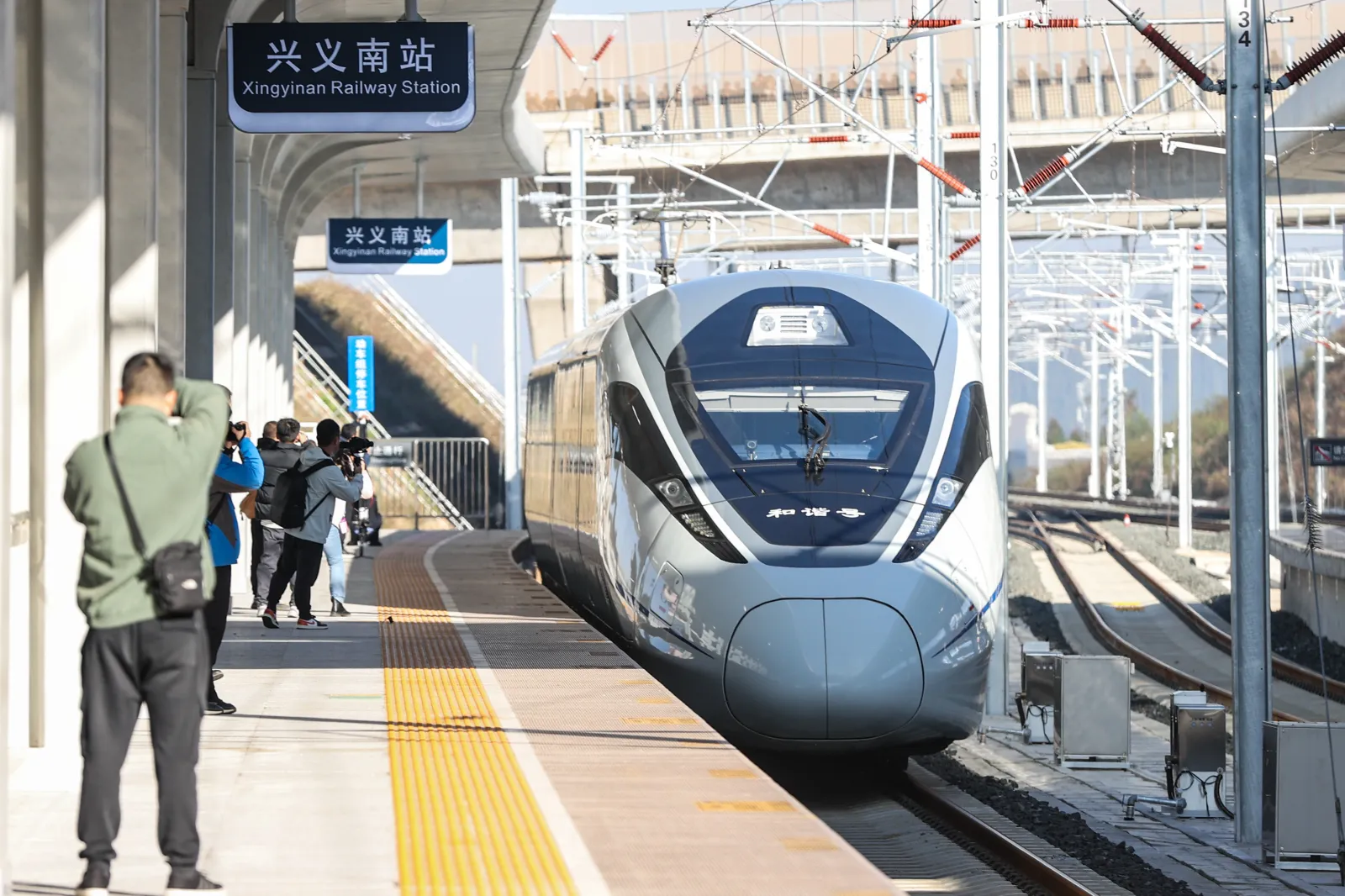
China’s high-speed rail network continues to expand at a rapid pace, and recently added routes have pushed its total length to over 50,000 kilometers, around 31,000 miles.
According to a press release from China State Railway Group, the state-owned company which operates the country’s rail network, this means the country's network now exceeds the combined length of all other countries’ high-speed systems.
Newsweek has contacted China State Railway Group via email for comment.
Read More on World
Why It Matters
China’s high-speed rail network’s world-beating development has been attributed to centralized planning, rail standardization and substantial state investment, and the scale and speed of its expansion over only a few decades have made it a revered achievement in the world of engineering. But its global dominance also reflects the difficulty other nations have faced in trying to boost connectivity, tourism and commerce with their own high-speed links.
What To Know
According to local reports, China’s high-speed railway network surpassed the 50,000-kilometer mark thanks to the launch of the Xi'an-Yan'an link on Friday. The new 299-kilometer (185-mile) line is said to cut travel time between the cities from around two hours to just one.
China State Railway Group said on Monday that the country’s high-speed services can now cover 97 percent of cities with an urban population of over 500,000, and that its network now represents over 70 percent of the total 65,000 of high-speed rail on earth.
...
Notable routes included the Beijing-Guangzhou link, stretching over 2,000 kilometers from the capital to the port city northwest of Hong Kong, and the Beijing-Shanghai line, which features Fuxing trains able to reach maximum commercial speeds of 350 kph (217mph).
China is in the process of testing next-generation trains that could further cut travel times between its major metros, such as the CR450. In October, the International Railway Journal, citing the China Academy of Railway Sciences, reported that prototypes of the CR450 reached a speed of 896 kph during a trial, a record achieved on a section of the Chengdu-Shanghai high-speed line. That is the equivalent of roughly 557 mph.
What People Are Saying
Lin Jian, a spokesperson for China’s Ministry of Foreign Affairs, posted to X: “China’s total operational mileage of high-speed rail has surpassed 50,000 km, more than the combined total of all other countries. Driving more than speed and scale—it connects people, regions, and a future on the move.”
Jonathan Holslag, a political scientist and China scholar, told Newsweek: "China’s unmatched high-speed railway expansion has been the result of an unmatched combination of political will, access to capital from state banks, effective development on foreign knowhow, and home-grown engineering. This is state capitalism at its strongest: when the political will is there the rest follows."
What Happens Next
Beijing has announced plans to expand China’s high-speed network to 70,000 kilometers by 2035. The country is also financing railway projects in other Asian nations under its Belt and Road Initiative, a plan launched in 2013 and intended to boost connectivity and trade, as well as the country's regional influence throughout the continent.
Update 12/30/25 10:06 a.m. ET: This article has been updated with comments from Jonathan Holslag.
View 0 Comments
Submit Correction
View Editorial & AI Guidelines