...

By Micah McCartney
Reporter
0
Share
Newsweek is a Trust Project member
See more of our trusted coverage when you search.Prefer Newsweek on Googleto see more of our trusted coverage when you search.
Beijing has responded to commentary on its recent "Victory Day" military parade, during which it showcased a wide array of weaponry, including its nuclear triad capabilities.
Why It Matters
The September 3 parade commemorated the 80th anniversary of the official end of World War II in the Pacific. It was presided over by Chinese President Xi Jinping and attended by leaders from more than 20 countries, including Russian President Vladimir Putin and North Korea's Kim Jong Un.
Read More on World
Analysts viewed the martial display as a signal to the United States and its allies of China's growing military capabilities and the progress the People's Liberation Army has made toward Xi's goal of building a "world-class military" by mid-century.
Newsweek reached out to the Chinese Foreign Ministry by email for comment.
...
What To Know
In a Wednesday press release, Chinese Ministry of Defense spokesperson Wu Qian said the military hardware on display last week "demonstrated the comprehensive combat capabilities of the PLA in realistic training and exercises."
He added: "Their appearance shows that our capabilities for defense are improving, but our strategic intention has not changed: We will never seek hegemony, never engage in expansion, never initiate aggression."
Wu emphasized that the parade "was not targeted at any specific country" and said a strong Chinese military supports peaceful development.
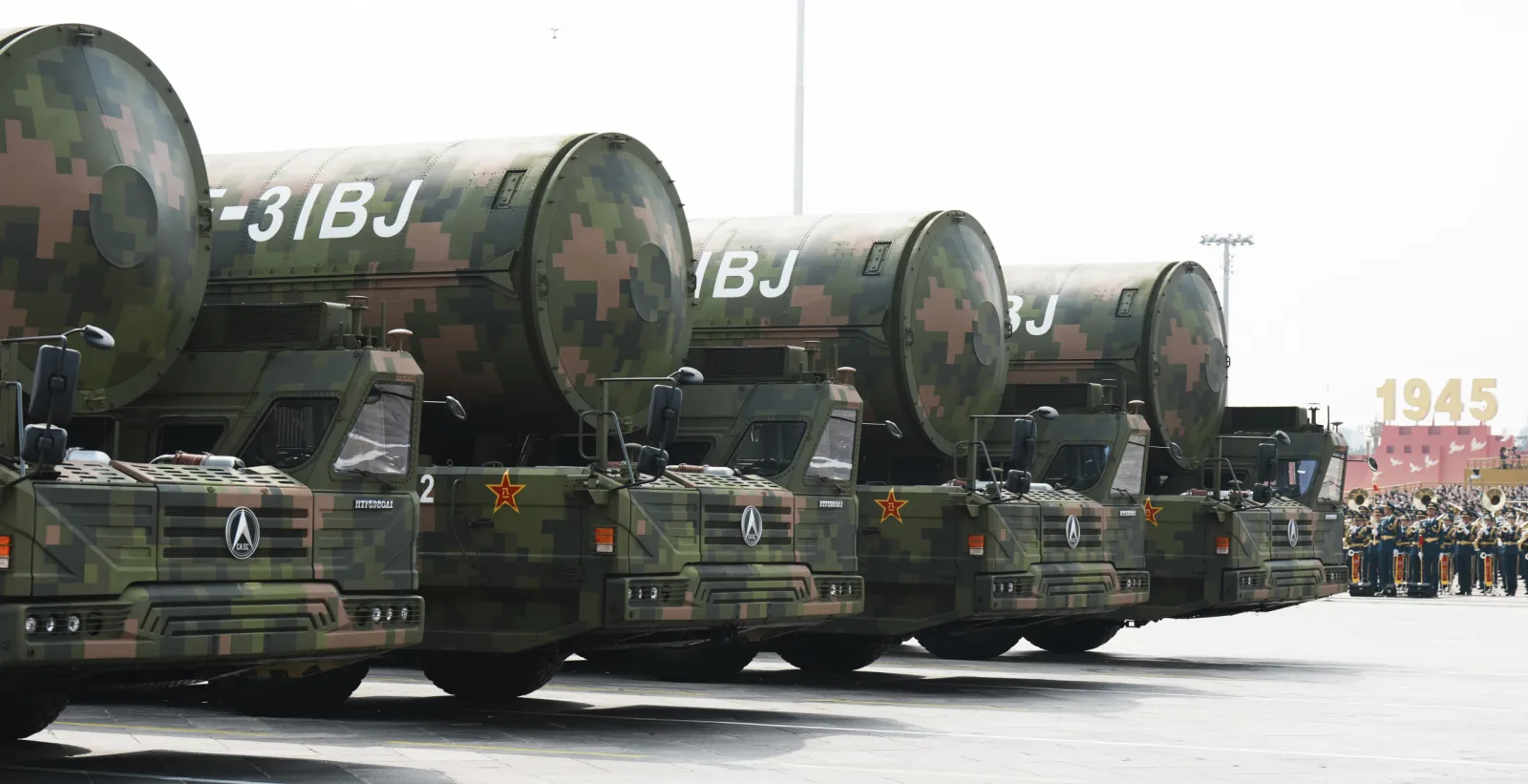
Along with hypersonic missiles, a range of new drone types, cyber warfare systems and a laser weapon, five new types of nuclear-capable systems were showcased during the parade. They included three silo-launched intercontinental ballistic missiles—the DF-5C, DF-31BJ, and DF-61—as well as the air-launched JL-1 ballistic missile, said to have a range of nearly 2,000 miles, and the submarine-launched JL-3.
Analysts noted that many of the systems on parade remain untested in combat, as China has not been involved in a full-fledged conflict since 1979.
However, the Pentagon is increasingly concerned about China's expanding missile capabilities—particularly its vast missile fleet, which poses a significant threat to U.S. naval forces in the event of conflict in the region—and its nuclear stockpile.
China is one of only four countries—with the U.S., Russia and India—with a full nuclear triad and ranks third globally in total warheads.
The arsenal is growing rapidly, believed to have reached 600 warheads this year—more than double its 2019 count—according to estimates from the Stockholm International Peace Research Institute.
What People Are Saying
Alexander Neil, Singapore-based security analyst, told Reuters: "For all the operational questions that surround some of these new elements, China was sending a message of technological advance and military strength on all fronts—there is indeed a lot for rival defense planners to get their heads around."
Ankit Panda, a nuclear policy expert at the Carnegie Endowment for International Peace, in an analysis of the parade posted to X: "As U.S.-China relations become more difficult, the nuclear dimension of competition between the two countries will grow more important."
The Chinese Embassy in the U.S. previously told Newsweek: "China abides by the policy of no first use of nuclear weapons under any circumstances and at any time, and commits unconditionally not to use or threaten to use nuclear weapons against non-nuclear-weapon states or nuclear-weapon-free zones."
The U.S. Office of the Director of National Intelligence, in its 2025 threat assessment: "China's nuclear weapons and advanced delivery systems pose a direct threat to the Homeland and are capable of delivering catastrophic damage to the United States and threatening U.S. military forces here and abroad."
View 0 Comments
Submit Correction
View Editorial & AI Guidelines